


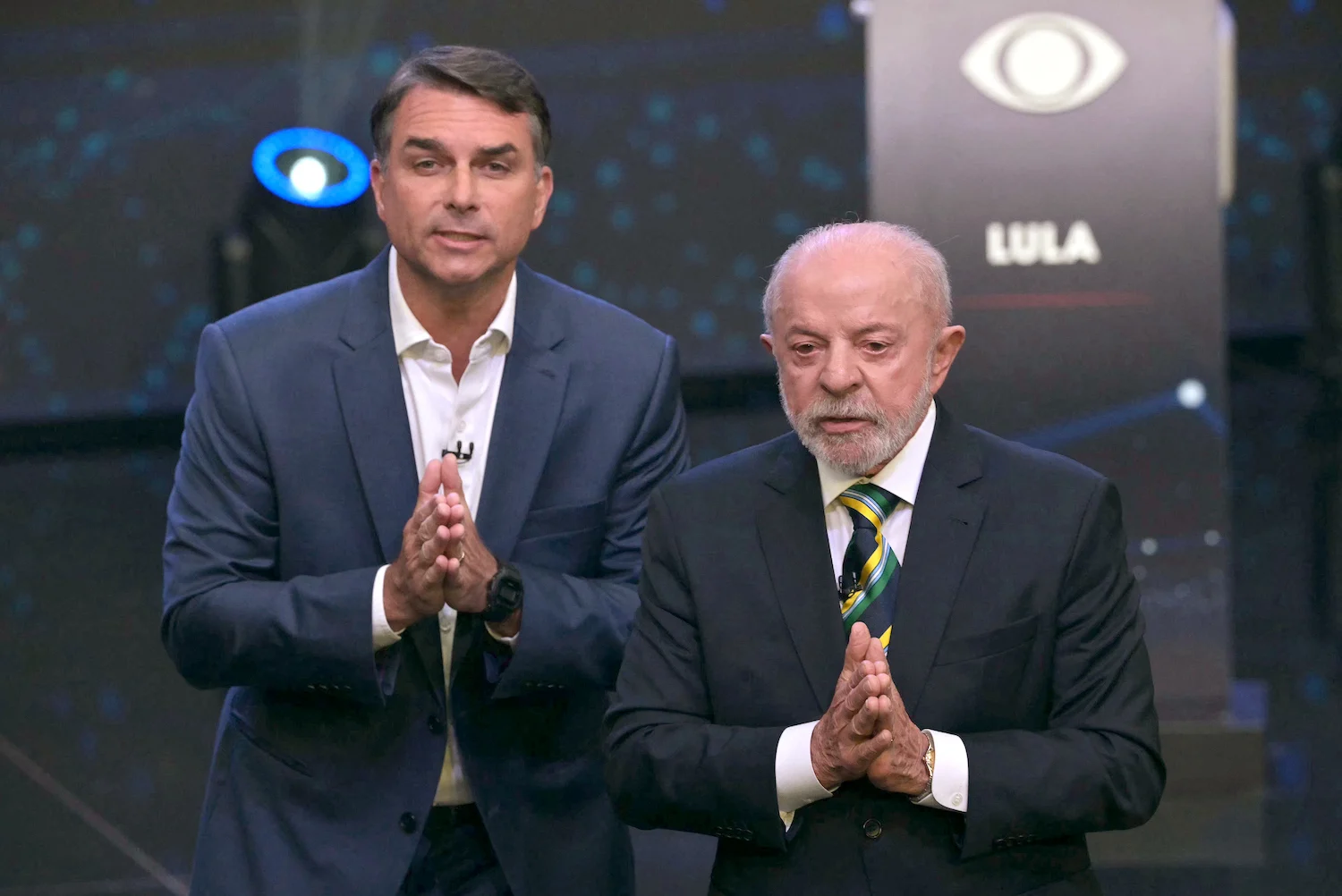
At the time of writing, prediction markets favor Sen. Flávio Bolsonaro to win Brazil’s Oct. 25 presidential runoff. But only a few months ago, his candidacy appeared to be coming off the rails. In mid-May, the far-right senator became embroiled in a major corruption scandal following the publication of leaked messages that showed he had asked for roughly $27 million from a now-jailed former banker at the center of the biggest banking fraud in Brazilian history.
The funds—around $12 million of which were transferred to a Texas account linked to the candidate’s brother Eduardo—were purportedly to help finance a hagiographic biopic about their father, former President Jair Bolsonaro, who remains under house arrest for plotting a coup to overturn Brazil’s 2022 election. Soon after the scandal broke, Flávio’s poll numbers began to plummet. He urgently needed to change the subject.
The following week, U.S. President Donald Trump and Secretary of State Marco Rubio came to the rescue. On May 26, Trump received Flávio in the Oval Office for an unannounced photo-op. He told reporters that he had asked Trump to label Brazil’s biggest gangs as foreign terrorist organizations (FTOs). Rubio granted the designation two days later. Flávio was able to project political strength and shift the conversation from corruption to insecurity; his candidacy was once again secure.
The FTO classifications are yet another example of the Trump administration interfering in Brazilian politics, coming on top of politically motivated tariffs on Brazilian exports (which Eduardo lobbied for) and sanctions on the Supreme Court justice who prosecuted Jair Bolsonaro. They are not dissimilar to the administration’s aggressive efforts to influence recent elections in Argentina, Colombia, and Honduras.
Beyond their symbolic impact in an election year, it’s worth considering what the U.S. FTO designations could mean for Brazil’s sovereignty and strategic autonomy—especially if Flávio wins on Sunday. Brazilians have reason to fear that their country could become engulfed in Trump’s expanding war on what he calls “narco-terrorism.”
Waging war on regional drug trafficking organizations was a prominent campaign theme for Trump. In January 2023, he announced that he would “take down the cartels just as we took down ISIS,” ostensibly to combat the fentanyl epidemic in the United States.
Within weeks of his 2025 inauguration, the president began to make good on his promises, designating several Latin American criminal organizations as FTOs—including the Sinaloa and Jalisco New Generation cartels and gangs such as MS-13 and Tren de Aragua. It was the first time that any U.S. administration had applied this classification to drug-trafficking organizations with no apparent political agenda.
In August of that year, Rubio declared that cartels are “armed terrorist organizations, not simply drug dealing organizations,” placing them in the same national-security framework as al-Qaeda, Boko Haram, and the Islamic State.
Starting in September 2025, this doctrinal shift servedas justification for a series of unprecedented—and seemingly unlimited—lethal military actions in the Caribbean, Central America, and eastern Pacific. In a campaign later dubbed “Operation Southern Spear,” U.S. military vessels have struck dozens of boats allegedly controlled by drug-trafficking FTOs, killing their occupants (239 people, at last count) without arrest or trial and without presenting evidence that they were carrying drugs. The identities of most of those killed remain unknown—even to the U.S. military.
The strikes have done nothing to address the fentanyl trade, since the deadly drug overwhelmingly comes to the United States by land, from Mexico. Nor have they significantly disrupted the cocaine trade, with recent reports—including an assessment by the U.S. Drug Enforcement Administration—indicating that traffickers have adapted their routes.
But the policy has achieved something else: FTO designations transformed a law enforcement issue into a military one, paving the way for an expansion of U.S. military activity across the Western Hemisphere.
The most dramatic expression of this shift so far was the Jan. 3 U.S. military attack on Venezuela and abduction of the President Nicolás Maduro to face drug trafficking charges in the United States. The attack was the first of its kind in South America and killed an estimated 75 people. The State Department linked it to a recent FTO designation, despite providing no real evidence that Venezuela’s government played a leadership role in the hemispheric drug trade.
The unauthorized U.S. military campaign across the Americas has generated concern in the U.S. Congress, which has the sole authority to send the military into hostilities. It should also concern Brazil. The designation of Brazilian criminal organizations as FTOs transforms them, at Washington’s discretion, from targets of Brazilian law enforcement into potential targets of U.S. military force.
Under incumbent left-wing President Luiz Inácio Lula da Silva, Brazil would most certainly continue to resist the pressure of such a designation on the country’s jurisdiction and sovereignty. But under Flávio, U.S. military operations on Brazilian soil are a real possibility. In response to an October 2025 social media post from U.S. Defense Secretary Pete Hegseth about a lethal strike on a boat in the eastern Pacific, the far-right candidate said “how envious” he was and invited Hegseth “to spend a few months here helping us fight these terrorist organizations.”
Allowing for U.S. military intervention in Latin America is also one of the objectives of the Shield of the Americas, a new U.S.-driven alliance in which member governments—most of them right-wing allies of Trump—appear to be playing a subordinate role to Trump’s expanding regional military campaign.
In a September meeting of the alliance in New York, participating governments endorsed a sweeping declaration drafted by the Trump administration, reportedly with minimal input from other members. The declaration calls for invoking the 1947 Rio Treaty, a Cold War-era hemispheric security treaty that mirrors NATO’s Article 5 mutual defense clause. It would facilitate collective action against nonstate criminal organizations, potentially opening the door to foreign intervention in those countries.
The governments also committed to individual and collective action against the 24 criminal organizations that the U.S. State Department classified as FTOs, including the two Brazilian gangs. “If you can’t [deal with the criminal organizations], we’ll do it for you,” Trump said.
During his May 26 meeting with Trump, Flávio reportedly promised that, if elected, Brazil would join the Shield of the Americas. He later repeated the pledge on at least two occasions.
For Brazil, the stakes could hardly be higher. Unlike many of its Latin American neighbors, Brazil has long aspired to strategic autonomy, building industrial, military, and technological capabilities to defend its sovereignty without relying on a great-power patron. That ambition has produced an increasingly sophisticated defense industry. It has also shaped Brazil’s approach to the Amazon and the South Atlantic, where its armed forces have traditionally regarded control of territory, borders, and strategic resources as a national security issue.
Ecuador offers the most obvious and disturbing preview of what Washington’s war on narco-terrorism could mean for Brazil. Under President Daniel Noboa, the country has embraced an increasingly militarized security strategy, underwritten by deeper U.S. support, largely without stemming the ever-growing violence in the country. Ecuadorian forces have been implicated in allegations of enforced disappearances, extrajudicial killings, torture, and arbitrary detention. Human Rights Watch even documented torture during a U.S.-Ecuadorian joint operation that culminated in the bombing of a dairy farm.
At sea, U.S. forces have attacked, intercepted, and destroyed Ecuadorian fishing vessels. One boat, the Fiorella, disappeared along with eight crew members in January. The circumstantial evidence strongly suggests that U.S. forces were involved, although the U.S. military has denied it. The Washington Post subsequently reported that mysterious attacks on Ecuadorian vessels formed part of a covert CIA program. In August and September alone, U.S. forces intercepted and destroyed eight more Ecuadorian fishing vessels, detaining more than 140 crew members and drawing allegations of abuse. An Ecuadorian judge recently acquitted 32 of these crew members, stating that there was no evidence that they had committed illegal acts.
Meanwhile, Noboa is opening Ecuador ever further to U.S. military deployments. Last year, the State Department, at Noboa’s request, designated two Ecuadorian gangs as FTOs. In March, U.S. Southern Command and the Ecuadorian Army began carrying out joint military operations targeting these gangs, which they referred to as “narco-terrorists.”
Despite an Ecuadorian constitutional prohibition on foreign bases, U.S. Air Force personnel are stationed at Ecuador’s Manta base, with no scheduled departure, and U.S. military aircraft are operating from the Taura Air Base. In early September, the commander of the Ecuadorian Air Force made an official request for guidelines regarding the operational control of Taura and insisted that Ecuador should retain operational and administrative control. Noboa removed him from his post two days later.
Recent reports indicate that the Trump administration is now sending hundreds more U.S. troops to Latin America and has redirected tens of millions of dollars in military assistance intended for Europe and the Middle East to Colombia, Ecuador, Peru, and Panama. Trump has no interest in respecting other countries’ constitutional guarantees and sovereignty—not Ecuador’s, and most certainly not Brazil’s.
After Brazil’s first-round vote, Trump heralded Flávio’s two-point lead as a “close, but a very, very big victory.” It’s clear—whether through weaponized tariffs, sanctions, or FTO designations—that Trump, Rubio, and other administration officials have tried to shape the outcome of the Brazil’s presidential election. For them, acquiring Brazil as a pliant and politically indebted partner in the administration’s hemispheric campaign would be the ultimate prize, following recent far-right victories in Chile, Colombia, Ecuador, and Honduras.
Ultimately, Trump’s regional project—which he has unsubtly dubbed the “Donroe Doctrine”—extends beyond a hegemonic military agenda. It is, as his National Security Strategy announced in 2025, also about securing privileged access to hemispheric natural resources, especially critical minerals, while seeking to reduce and displace the region’s growing commerce with China. Flávio has presented Brazil as the answer to U.S. dependence on China for rare earths and promised Washington a strategic minerals partnership.
Lula has put forward a starkly different model. He has offered the Trump administration far-reaching police and financial cooperation against organized crime while rejecting Washington’s unilateral FTO designations as a threat to Brazilian sovereignty. Rather than embracing Trump’s plan for U.S. hemispheric dominance, he has continued to advocate for multilateralism and strategic autonomy, avoiding too much dependence on either the United States or China.
As Brazilians vote on Oct. 25, they should be aware that they will be making a strategic decision about whether their country’s security and resources should become integrated into a militarized, U.S.-led hemispheric architecture that—as the case of Ecuador clearly illustrates—leads to subordination while likely doing nothing to curb violence. Or whether they wish to remain subject to sovereign decisions made in Brasília.
