


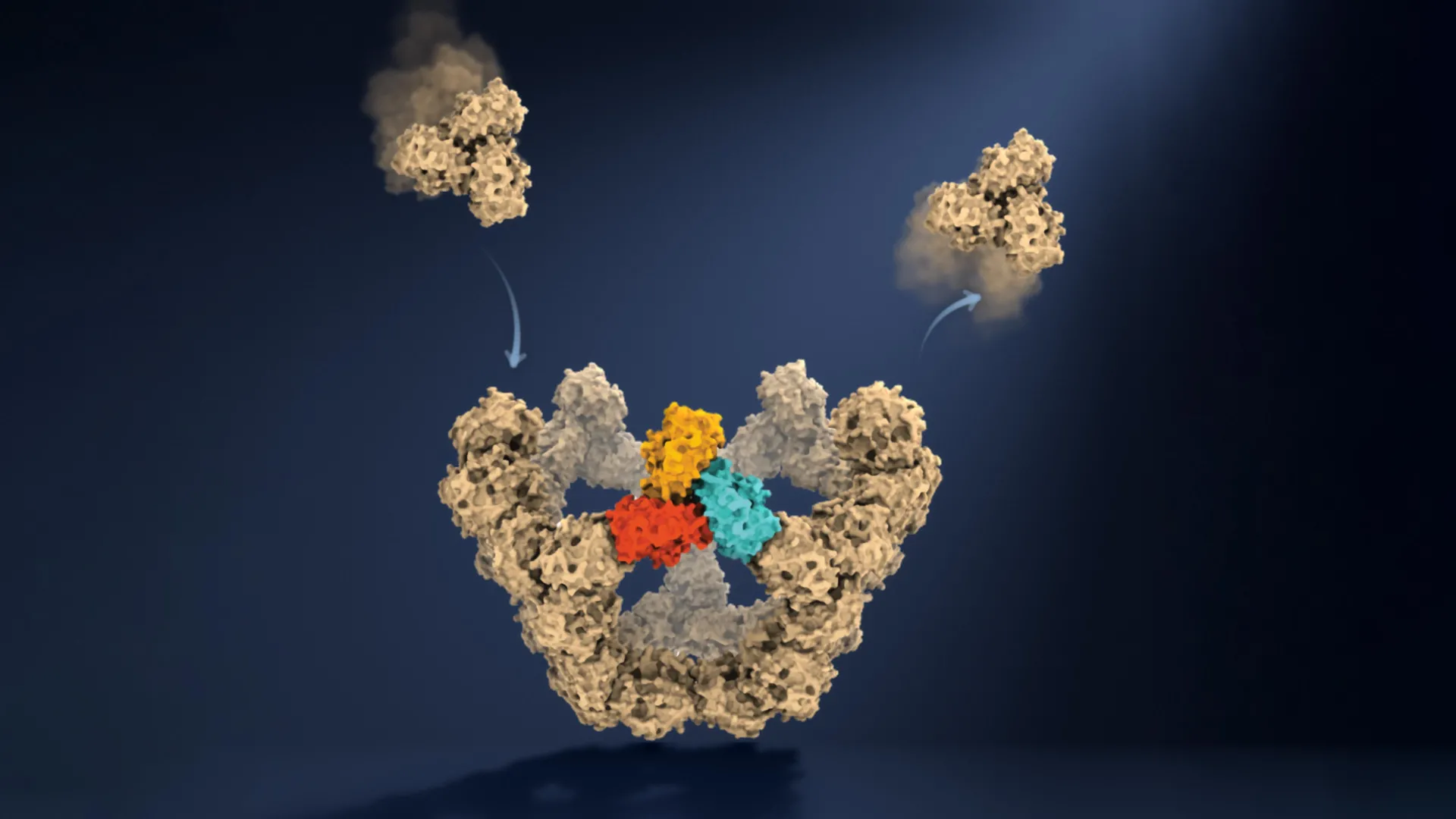
Researchers at the University of Oxford have observed virus-like particles assembling themselves one molecule at a time, uncovering the surprisingly simple rules that allow complex biological structures to form with remarkable reliability. The findings, published in Nature, offer a detailed look at a process that scientists have struggled to observe directly for decades.
Understanding how viruses construct their protective protein shells, and how that construction might be interrupted, could lead to new antiviral drugs, improved vaccines, and other medical treatments. The discovery helps explain how individual proteins consistently organize themselves into the correct structures despite having thousands of possible ways to connect.
The researchers found that viral assembly resembles navigating a complicated maze, where only certain paths lead to lasting progress. At first, protein components form weak connections that can easily break apart if the arrangement is unsuccessful. This flexibility allows the molecules to keep trying different combinations until they form particular closed structures. Once multiple connections hold these structures together, they become far more stable.
These stable arrangements serve as molecular checkpoints, narrowing the enormous number of possible assembly routes into a much smaller set of successful pathways. One especially important milestone occurs when five larger protein building blocks connect to form a closed pentagonal ring. This is the first highly stable structure in the assembly process. Once it forms, each subsequent stable stage requires fewer additional building blocks, allowing the particle to grow more quickly.
Co-lead author Dr. Roi Asor (Department of Chemistry and Kavli Institute for Nanoscience Discovery, University of Oxford) explained: “A virus has to solve an extraordinary construction problem. Its components somehow have to find the right arrangement among a huge number of possibilities, without a blueprint or machinery directing the process. We can now watch what happens molecule by molecule and see the physical rules that make it possible.”
Watching Virus Particles Assemble Molecule by Molecule
Viruses store and protect their genetic material within organized protein shells known as capsids. Depending on the virus, these shells may consist of tens or even thousands of individual protein components. Remarkably, in many cases, the proteins can arrange themselves into the correct structure without any external machinery directing their assembly.
Although scientists have investigated viral self-assembly for decades, capturing the process as it unfolds has been a major challenge. Many of the intermediate structures exist only briefly and appear in very small quantities. As a result, traditional methods have generally allowed researchers to examine the starting materials and finished particles without clearly showing how one transforms into the other.
To overcome this limitation, the Oxford researchers studied an engineered virus-like particle composed of 60 protein units. They used mass photometry, a technique developed at Oxford that determines the mass of individual molecules by measuring the light they scatter. By combining this technology with a new approach for keeping individual molecules confined and continuously observable, the team could repeatedly measure the mass of a growing particle as additional proteins attached.
This approach allowed the scientists to follow the construction process as it happened, effectively tracking the addition of individual molecular building blocks over time.
Co-first author PhD student Dan Loewenthal (Department of Chemistry and Kavli Institute for Nanoscience Discovery, University of Oxford) said: “This method lets us study the assembly process directly, we just take a video!”
Co-lead author Professor Philipp Kukura (Department of Chemistry and Kavli Institute for Nanoscience Discovery, Oxford University) said: “Until now, much of our understanding of how these structures assemble has had to be reconstructed from snapshots or theoretical models. Being able to both quantify the underlying interactions and follow one particle as it grows changes that. We can see the important intermediate structures appear and deduce a detailed model of the construction process.”
The Surprising Trick That Makes Viral Assembly Work
The results help explain how a process involving an overwhelming number of possible molecular arrangements can consistently produce the correct structure. Rather than exploring every possible route, the proteins progress through a relatively small number of stable intermediate stages that guide assembly toward completion.
The findings also clarify why the earliest stage of construction, called nucleation, is particularly difficult and why growth becomes substantially faster after the first stable structure appears.
A key part of this efficiency comes from the ability of protein building blocks to make mistakes without permanently disrupting the process. Weak initial connections allow incorrect combinations to separate, giving the proteins another opportunity to find a better arrangement. When enough components eventually connect in the correct closed configuration, the resulting structure becomes stable enough to support further growth.
Dr. Asor added: “The weak interactions give the system room to make mistakes. Most encounters don’t have to be successful: the components can separate and try again. But once enough of them come together in the right closed arrangement, the structure becomes stable, and assembly can move forward. That combination of trial and error followed by locking in successful structures is what makes the process so reliable.”
New Possibilities for Antiviral Drugs and Vaccines
By identifying the molecular interactions that control viral assembly, scientists may eventually be able to develop treatments that interfere with the construction of viral protein shells. The same insights could also support efforts to engineer virus-like particles for vaccines and other therapeutic applications.
Co-author Dr. Jack Tan (MRC Weatherall Institute of Molecular Medicine and CAMS-Oxford Institute) noted: “The ability to understand these processes at the molecular level could have important applications in vaccine development and antivirals that disrupt viral assembly.”
The implications may extend far beyond viruses. Self-assembly is essential throughout biology, helping create everything from the internal skeletons of cells to specialized molecular compartments and large protein complexes.
By making it possible to observe these intricate construction processes one molecule at a time, the Oxford team’s approach offers researchers a powerful new way to investigate how complex biological structures emerge from relatively simple interactions.
