


Welcome back to World Brief, where we’re looking at joint efforts to counter Houthi attacks on Saudi Arabia, the potential future of nuclear weapons in Lithuania, and espionage allegations against a former German spy chief.
Joint Deterrence
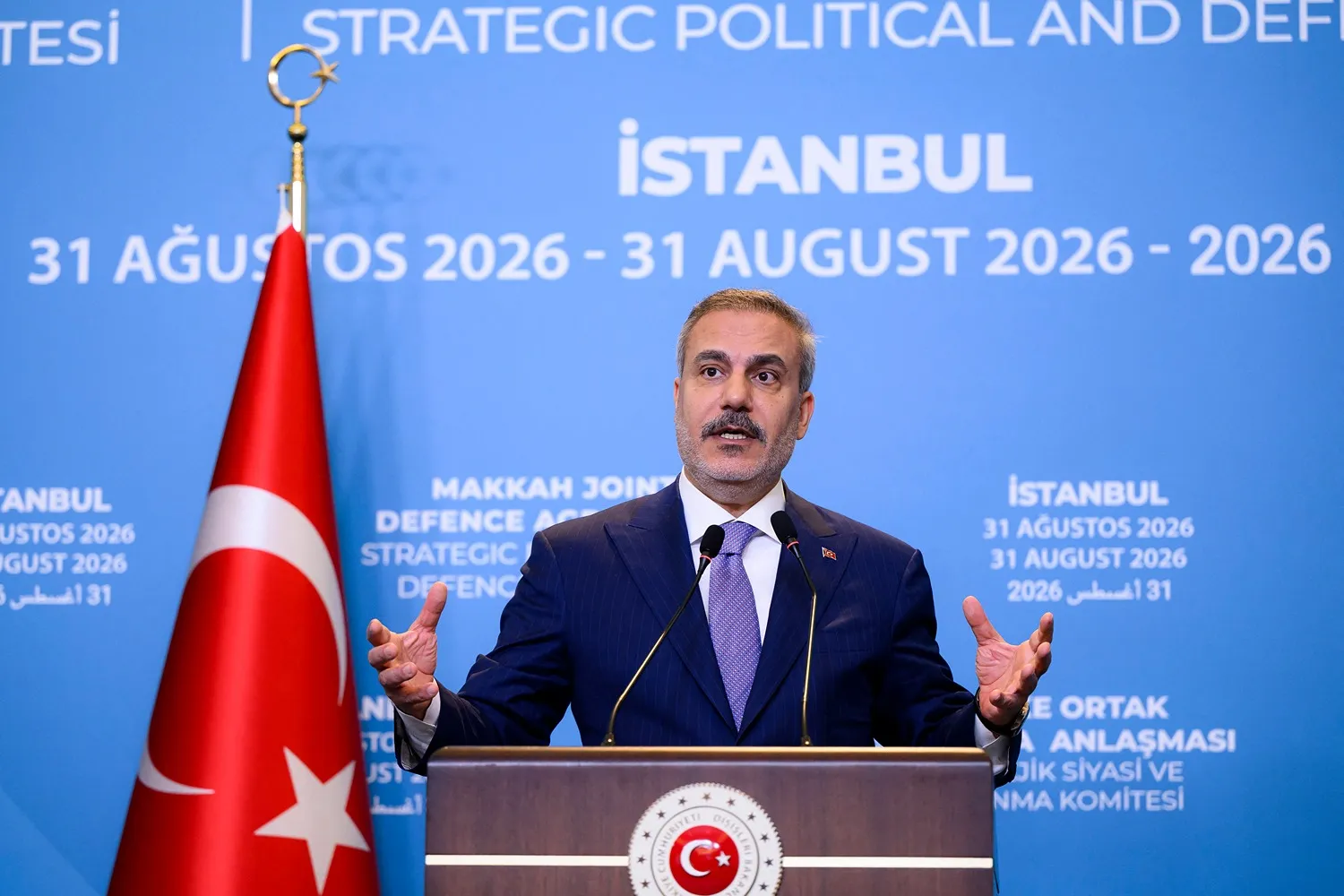
Pakistan, Saudi Arabia, and Turkey triggered a mutual defense pact on Monday in response to repeated Houthi strikes on Saudi infrastructure. The joint deterrence measures, which appear to include the “rapid deployment” of Pakistani and Turkish troops to the Persian Gulf kingdom, mark the first time that the Mecca Joint Defense Agreement has been invoked since it was signed in August.
Welcome back to World Brief, where we’re looking at joint efforts to counter Houthi attacks on Saudi Arabia, the potential future of nuclear weapons in Lithuania, and espionage allegations against a former German spy chief.
Joint Deterrence
Pakistan, Saudi Arabia, and Turkey triggered a mutual defense pact on Monday in response to repeated Houthi strikes on Saudi infrastructure. The joint deterrence measures, which appear to include the “rapid deployment” of Pakistani and Turkish troops to the Persian Gulf kingdom, mark the first time that the Mecca Joint Defense Agreement has been invoked since it was signed in August.
The Houthis have yet to comment on the activation of the mutual defense pact.
Under the trilateral, NATO-style agreement, “any armed attack against any one of the three states shall be regarded as an attack against them all.” Although military cooperation among the three Sunni Muslim-majority nations is nothing new, the timing of the pact’s creation was particularly notable, as it came less than one month after Yemen’s Houthi rebels began launching attacks on Saudi Arabia.
In recent weeks, fighting between the Iran-backed Houthis and the Saudi-backed, internationally recognized Yemeni government has only worsened. Houthi forces seized control of Yemen’s Red Sea coast, including the strategic Bab el-Mandeb strait, and targeted critical energy infrastructure and Muslim holy sites in Saudi Arabia. This week, the Houthis also claimed to have launched attacks on King Khalid International Airport in Riyadh, Saudi Arabia’s Aramco-associated Petro Rabigh refinery, and other locations.
In response, Saudi-led coalition forces in Yemen launched a counteroffensive on Monday in an effort to retake the coastal territory. Yemeni officials said the forces successfully recaptured several key towns near Bab el-Mandeb.
Meanwhile, Saudi Arabia has doubled down on the defense of its own territory by bringing Pakistan and Turkey further into the fold. A joint statement released by the three countries following Monday’s emergency meeting in Riyadh did not explicitly name the Houthis as the rationale for activating the pact, though it did cite recent attacks on the holy cities of Mecca and Medina.
It is unclear to what extent Islamabad and Ankara will aid Riyadh. The trio announced on Monday that they will “move immediately to the practical implementation of the collective defense commitments and to take the necessary measures to provide the agreed military forces and capabilities and ensure their rapid deployment in the kingdom.”
However, Pakistan said it will not release the details of its deployment, though Pakistani Defense Minister Khawaja Asif said on Monday that Islamabad and Ankara were already aiding Riyadh in a “supporting role,” including in the form of reconnaissance. And the Turkish parliament has yet to ratify the mutual defense pact.
Still, even the threat of joint involvement could dramatically shift the Saudi-Houthi conflict. The members of the Mecca Joint Defense Agreement boast a combined military strength of nearly 1.4 million active troops. That doesn’t include their 3,400 aircraft, 6,000 tanks, and more than 340 naval assets. Pakistan is the only nuclear-armed Muslim-majority nation in the world, and Turkey has NATO’s second-largest armed forces.
Today’s Most Read
What We’re Following
Risks of new escalation. Lithuania’s parliament voted in favor of a constitutional amendment on Tuesday that would lift a ban on nuclear weapons being stationed on the country’s soil. “With the current restriction, we cannot fully participate in NATO’s nuclear deterrence plans,” opposition leader Laurynas Kasciunas said. “Since nuclear deterrence is the queen of all deterrence, this decision is strategically important,” he added. Lithuanian Defense Minister Robertas Kaunas echoed that rationale, arguing that if “Russia had not started the war in Ukraine, we probably would not be having the discussions that we are having today.”
Article 137 of the Lithuanian Constitution prohibits the country from hosting nuclear weapons or foreign military bases on its territory. Tuesday’s amendment would only reverse the nuclear weapons ban, though U.S. President Donald Trump has recently proposed building a U.S. military base in Lithuania. Two ballots are required to pass for any change to take effect; the second vote is scheduled for Jan. 12.
Moscow did not take the news lightly. On Tuesday, Russia warned Lithuania that altering Article 137 to allow for nuclear weapons or a NATO base deployment would spark greater conflict in the region. “Neither of these developments will contribute to stability and predictability on the European continent,” Kremlin spokesperson Dmitry Peskov said on Tuesday. “On the contrary, they will, to our regret, mark yet another significant escalation of tensions.”
Espionage allegations. German police arrested former spy chief August Hanning on Tuesday on suspicion of espionage, disclosure of state secrets, attempted treason, and working as a secret service agent. It is unclear which foreign government German authorities believe that Hanning allegedly helped. A former chief of staff to one of Hanning’s successors was also arrested on suspicion of “aiding and abetting attempted treason and espionage against the state.” Germany’s federal prosecutor’s office alleges that the man, identified only as Manfred D., provided Hanning with approximately 2,000 government documents, many of which were classified, in the years after Hanning had left his post.
Hanning served as the head of Germany’s foreign intelligence service, the BND, from 1998 to 2005, after which he worked for the Federal Interior Ministry and eventually moved into the private sector as a consultant. He is the first former head of Germany’s intelligence agency to be accused of espionage. Hanning, who has denied the allegations, and Manfred D. are expected to appear before a judge later this week; Manfred D. has yet to comment on the charges.
Tuesday’s revelations come amid another scandal for Hanning. Evidence of the spy chief’s alleged actions was only discovered during a separate, unrelated investigation into a German steakhouse heiress who is on trial for the attempted kidnapping of her children from her estranged husband. Prosecutors in that case allege that Hanning helped connect the woman to the Israeli spy firm that is accused of carrying out the abduction; Hanning has denied any involvement in the kidnapping. His work as a consultant has also come under scrutiny in the past.
Growing Ebola outbreak. Kenya recorded its first case of Ebola on Tuesday, expanding the deadly outbreak in the Democratic Republic of the Congo into East Africa. According to local authorities, the man—a Kenyan national who had lived in Congo for the past seven years—became ill last month, traveled into Uganda via road, and then flew to Nairobi on Saturday. He died at a private hospital in the Kenyan capital late Monday.
Congo confirmed its first case of Ebola’s rare Bundibugyo strand on May 15. Since then, more than 8,400 cases have been reported, making this year’s outbreak the fastest-growing Ebola epidemic in the country’s history. Already, Ebola deaths in Congo have surpassed 4,000. Uganda and France have also recorded Ebola cases, though only three deaths have been confirmed outside of Congo—the third being this week’s incident in Kenya.
Congo’s neighbors have implemented strict travel restrictions to prevent the virus’s spread. Uganda closed its border with Congo in May, and Kenya has required all travelers from Congo to fill out an online questionnaire about their potential exposure and health status before being granted entry. This week’s case in Nairobi “underscores the importance of sustained preparedness across the region,” the Africa Centres for Disease Control and Prevention said in a statement.
Odds and Ends
This year’s Nobel Prize in physics went to Francis Halzen on Tuesday for his work pioneering a new type of astronomy known as neutrino astronomy. In the late 1980s, Halzen conceptualized using light sensors embedded deep within the South Pole’s ice to detect high-energy neutrinos originating from the distant cosmos. That work eventually led to the development of the IceCube Neutrino Observatory in Antarctica, where Halzen and more than 400 researchers from around the world use the information from the telescope to understand more about the inner workings of phenomena such as supermassive black holes.
