


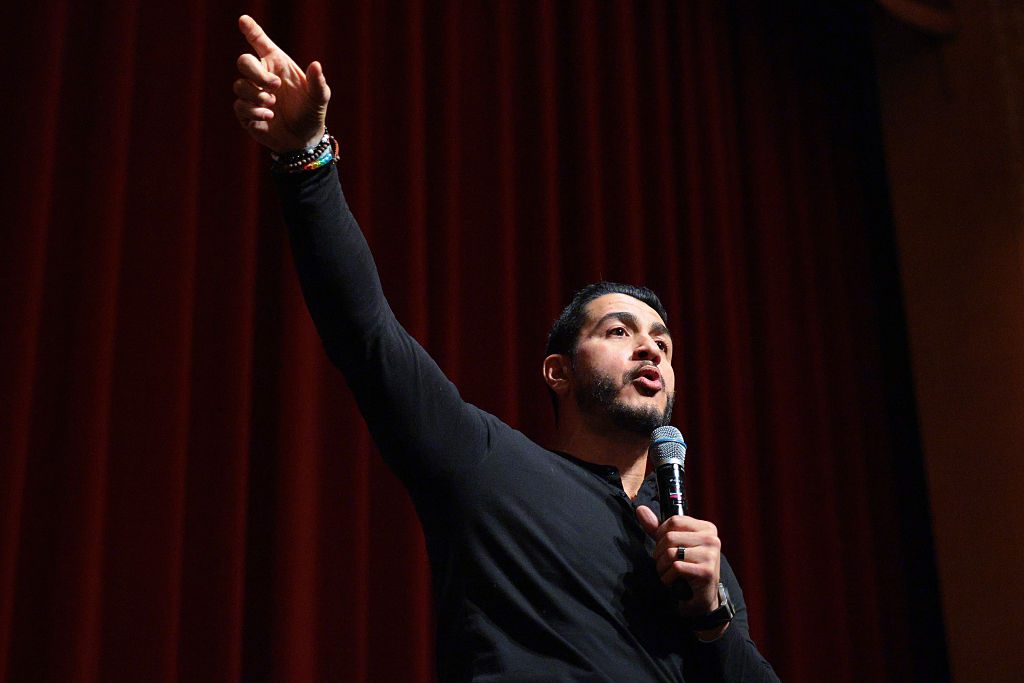
Outside groups have spent $92.4 million opposing Democrat Abdul El-Sayed’s Senate candidacy in Michigan. (Photo by Chip Somodevilla/Getty Images)
Roughly $1 of every $7 that super PACs and other outside groups have spent on federal races so far this election cycle has gone toward opposing just three Democrats running for battleground Senate seats.
With less than three weeks until the Nov. 3 general election, total outside spending – money spent independently of campaigns to support or oppose candidates – in federal races has grown rapidly and now tops $2.4 billion, according to an OpenSecrets analysis of Federal Election Commission data for 928 federal candidates through Oct. 13.
More than $330 million – nearly 14% – was spent to oppose those three Democratic Senate candidates: James Talarico in Texas, Sherrod Brown in Ohio and Abdul El-Sayed in Michigan.
Negative spending dominates those totals: More than 60% of it – nearly $1.5 billion – was spent to oppose candidates rather than support them. Roughly two-thirds of the money spent on Senate races is negative, compared with 53% in the House. And among Senate candidates, 79% of the outside dollars tied to Democrats are spent to oppose them, compared with 53% for Republicans. The three largest amounts spent for or against any candidate are attacks on those three Democrats: $130.4 million against Talarico, $110 million against Brown and $92.4 million against El-Sayed.
(function(){function e(){window.addEventListener(`message`,function(e){if(e.data[`datawrapper-height`]!==void 0){var t=document.querySelectorAll(`iframe`);for(var n in e.data[`datawrapper-height`])for(var r=0,i;i=t[r];r++)if(i.contentWindow===e.source){var a=e.data[`datawrapper-height`][n]+`px`;i.style.height=a}}})}e()})();
The totals include spending in both the primary and the general election campaigns. El-Sayed defeated Rep. Haley Stevens in an Aug. 4 primary in which outside groups had spent more than $50 million as of July. At the time, Wayne State University political science professor Marjorie Sarbaugh-Thompson described the contest to OpenSecrets as “PACs galore.”
The two Senate candidates in Texas have drawn the most outside spending, with Republican Attorney General Ken Paxton leading the way with $146.5 million. Outside groups have spent nearly $90.5 million to support him and $56 million to oppose him, much of it during his primary race against incumbent John Cornyn. Outside groups have spent about $14.1 million supporting Talarico.
The 13 congressional candidates who have drawn the most outside spending are all running for Senate, and only one of the top 25 is a House candidate. Both parties’ candidates in Texas, Ohio and Michigan lead the way, and the nonpartisan Cook Political Report rates all three races as toss-ups.
In Ohio, Sen. Jon Husted has drawn $125.6 million in outside spending, with $56.4 million supporting him. The $68.9 million spent opposing him is the most against any Republican candidate. The $116.6 million tied to his opponent, Brown, is far more lopsided: $110 million of it opposes him, while $6.6 million backs him.
A similar pattern emerged in Michigan, where former Rep. Mike Rogers (R) has drawn $69.6 million – $35.3 million for him and $33.3 million against – while the spending tied to El-Sayed was much more lopsided, with $16.2 million supporting him.
In the House, the two candidates who drew the most outside dollars will not appear on the general election ballot.
No House race drew more such spending than New York’s 12th District, which covers midtown Manhattan and parts of the Upper West and East sides of New York City. Of the $45.2 million independent groups spent there, nearly $31.4 million was tied to Democrat Alexander Bores, who lost the June 23 primary to Micah Lasher. More than $21.1 million of it was spent to support Bores. Lasher, meanwhile, has drawn nearly $13.8 million – $10.8 million backing him.
And in Kentucky’s 4th District race, $13.8 million in outside dollars was tied to Republican Rep. Thomas Massie. More than $10.1 million was spent attacking Massie – a critic of Trump during his second term – in the primary, won by Trump-endorsed Ed Gallrein.
