


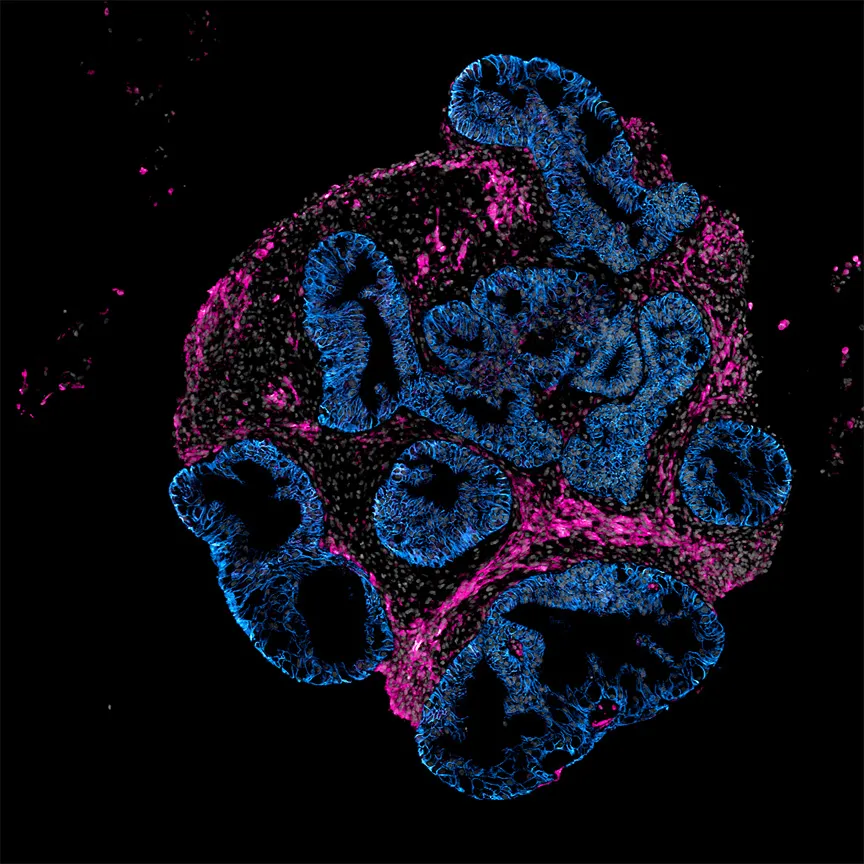
Drug development has long relied on animal models, but differences between species mean what works in animals doesn’t always translate to humans, and most drugs still fail during development. Intero Biosystems, a Denver-based startup, is developing human intestinal organoids, lab-grown tissue that mimics the gut, as another way to study how drugs and other compounds might affect the human body before they are tested in people. Researchers and pharmaceutical companies are increasingly looking for models that better reflect human biology to supplement animal testing and reduce their reliance on it.
Intero, which spun out of the University of Michigan, says its organoids differ from simpler models that replicate only part of the gut. They contain multiple cell and tissue types found in the human intestine, which the company believes makes them a more human-relevant model for testing drugs and other compounds, co-founder and CTO Madeline Eiken told TechCrunch.
“Most drugs fail clinical trials, and I think it’s pretty easy to appreciate that we are neither mice nor flat layers of cells,” Eiken said.
The startup’s flagship product, GastroScreen, is a human intestinal organoid model that it sells to pharmaceutical, biotech, food, and chemical companies for testing drugs and other compounds. Each organoid is about one millimeter across, and the company ships roughly 100 at a time in a tube, co-founder and CEO Charlie Childs said. Customers can use them as healthy intestinal models or induce disease-like conditions to test how the tissue responds to different compounds.
“We’re literally shipping mini living organs in the mail to people,” Childs said.
Beyond the organoids themselves, Intero sells the supplies needed to grow and work with them, such as the nutrient mixes that feed the cells and the chemicals used in experiments. It also runs studies for customers, including designing custom experiments, performing lab tests, and delivering the resulting data. Much of this work focuses on drug safety and disease research. For example, a customer can expose the organoids to a drug candidate to see whether it could harm the gut, or use organoids modeling a gut condition to see how the tissue responds to a compound.
Founded in 2024, the startup now has seven employees and just under 10 customers after raising a $2.3 million pre-seed round last year. It generated more than $400,000 in revenue from the fourth quarter of last year through the third quarter of this year, the CEO noted.
Regulatory changes have also helped drive interest in alternatives to animal testing. In April of last year, the U.S. Food and Drug Administration (FDA) laid out plans to reduce its reliance on animal testing in drug development, promoting alternatives including organoids, organs-on-chips (small devices that mimic organ functions) and AI-based computational models as potential alternatives.
In March of this year, the FDA issued draft guidance outlining how drug developers should validate new approach methodologies, or NAMs, a term of non-animal testing methods, when using them to support regulatory submissions. The guidance provides a framework for validation but doesn’t endorse any specific method. Whether a NAM can support a submission depends on factors including the method, how it is used, and the data provided.
Changes in U.S. law that allow drug developers to use non-animal testing methods in some cases have made pharmaceutical companies more willing to explore technologies such as organoids, Eiken told TechCrunch. Companies once hesitant about the technology are now looking to bring organoids in-house, she added.
Intero isn’t alone in trying to build more human-relevant models of the gut. Altis Biosystems develops stem cell-derived intestinal models, while InSphero offers patient-derived intestinal organoids for gastrointestinal toxicity testing. Other peers like MIMETAS take a different approach with organ-on-chip technology, using microfluidic systems to recreate aspects of the environment inside human tissues.
Intero says it sets itself apart from competitors in the complexity and scalability of its model. Unlike intestinal models grown from tissue collected through procedures such as colonoscopies, GastroScreen is derived from induced pluripotent stem cells, which are adult cells reprogrammed to become almost any cell type and can be generated from a blood sample, Eiken explained. That approach gives the startup the potential to personalize its models to different patients and scale production more easily, she added.
When asked what evidence shows GastroScreen can predict human drug responses more accurately than existing animal or cell-based models, Childs said the company is still building that evidence and is now in the second stage of a three-stage validation process. Having first shown that GastroScreen contains the key tissues of the human gut, Intero is now testing well-known drugs with documented effects in humans. GastroScreen has shown expected responses to drugs that reduce intestinal inflammation and to compounds known to damage the gut, Childs told TechCrunch. In the final stage, the company will compare GastroScreen’s results directly with pharmaceutical companies’ existing animal and clinical data. Those studies are underway with several pharmaceutical companies, using both existing compounds and new drug candidates, Childs said.
Intero doesn’t use AI to build its organoids. Instead, Childs sees an opportunity to use the organoids to generate the biological data AI models need, and the company plans to license such datasets to pharmaceutical and AI companies.
In the near term, Intero is focused on scaling production. It can currently make a few thousand organoids at a time and is working to automate manufacturing, with the goal of producing hundreds of thousands per batch, Childs said. Longer term, it wants to move into personalized medicine, using a patient’s cells to create organoids that could test different drugs before treatment. Its most ambitious goal is an artificial intestine, a vision that Childs said would build on the manufacturing scale and patient-specific data generated through its organoid technology.
Intero took the stage earlier Wednesday at TechCrunch Disrupt, where it’s one of 20 startups vying for this year’s Startup Battlefield title. Join us for the rest of the action: Disrupt runs October 13 to 15 in downtown San Francisco.
When you purchase through links in our articles, we may earn a small commission. This doesn’t affect our editorial independence.
