


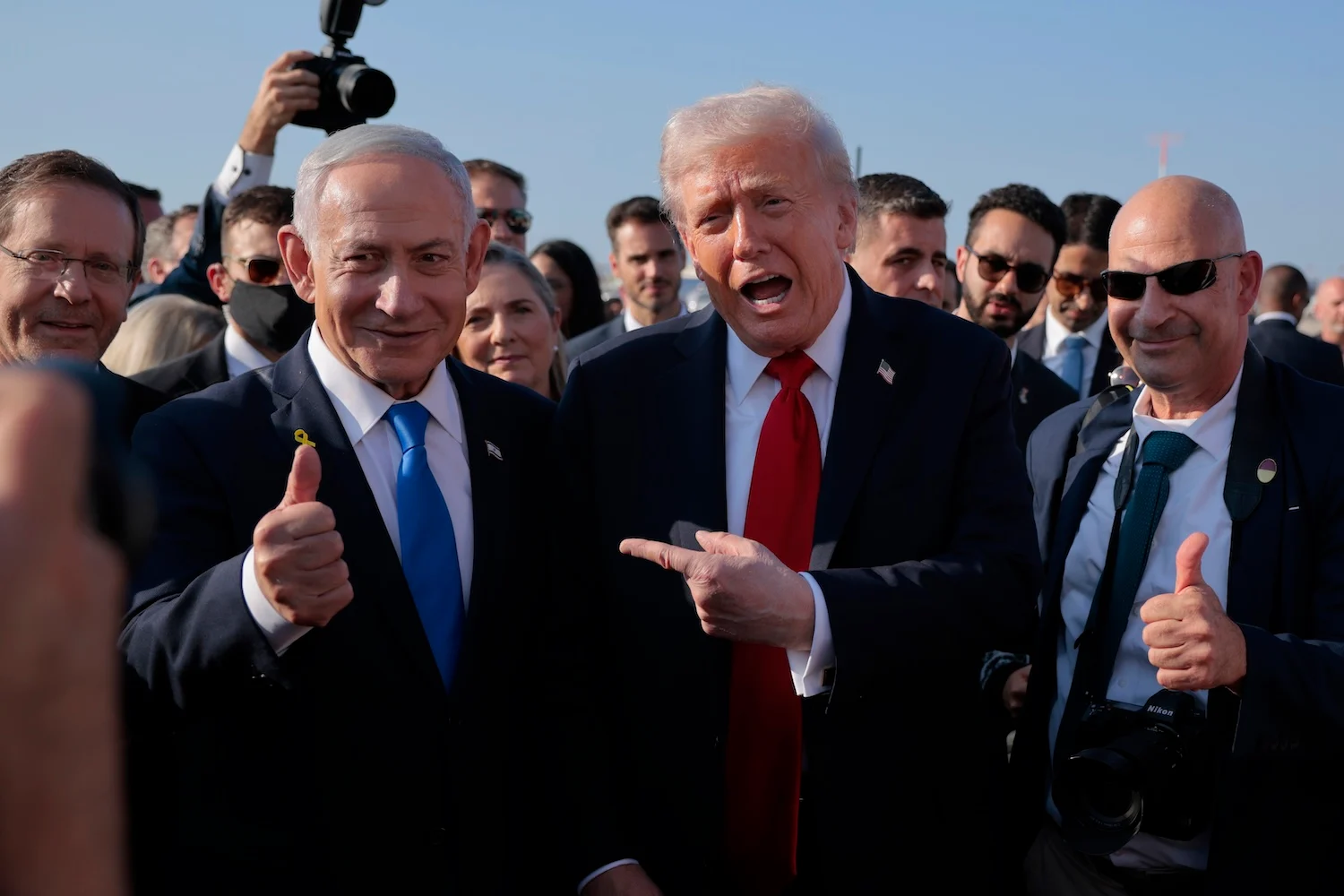
With just two months until arguably the most consequential election in his political life, Israeli Prime Minister Benjamin Netanyahu is asking himself what could prove to be a decisive question: Will he get the endorsement of U.S. President Donald Trump?
Netanyahu, Israel’s longest-serving leader, is struggling in his campaign. Recent polls suggest that his coalition of right-wing, religious, and ultra-nationalist parties may fail to get enough seats for a majority in parliament. Losing power would mean an inability to manipulate a justice system that has Netanyahu on trial for bribery, fraud, and breach of trust.
With just two months until arguably the most consequential election in his political life, Israeli Prime Minister Benjamin Netanyahu is asking himself what could prove to be a decisive question: Will he get the endorsement of U.S. President Donald Trump?
Netanyahu, Israel’s longest-serving leader, is struggling in his campaign. Recent polls suggest that his coalition of right-wing, religious, and ultra-nationalist parties may fail to get enough seats for a majority in parliament. Losing power would mean an inability to manipulate a justice system that has Netanyahu on trial for bribery, fraud, and breach of trust.
Trump enjoys wide popularity in Israel. While he alone can’t ensure Netanyahu’s reelection, an endorsement would likely give him a boost.
But the U.S. president has passed up several opportunities to champion Netanyahu, saying this week, “It’s most appropriate for me to stay out of Israeli elections, but I may endorse somebody.” While he’s known to like the Israeli leader personally, Trump is frustrated by his government’s policies. And while he hasn’t directly criticized Netanyahu for what many perceive as the prime minister’s role in pushing him into the Iran war, Trump must be disappointed and angry about the way that Netanyahu oversold the prospect of a U.S. and Israeli victory.
Trump probably hasn’t made up his mind yet. A number of factors in the next several weeks will determine if he weighs in to support Netanyahu. First, Trump is surely being briefed on the polls that indicate Netanyahu might lose the election to Gadi Eisenkot. Trump doesn’t know Eisenkot and cannot be sure that a new prime minister and a new cast of characters will be easier to deal with. But Trump doesn’t like losers and thus will weigh whether Netanyahu is a good bet to win the election.
Second, for a transactional president, the period between now and the Israeli election has given Trump a good deal of leverage. Jared Kushner has just concluded meetings in Cairo with Hamas and in Israel with Netanyahu on the Gaza demilitarization plan. Trump may see an opportunity to press Netanyahu to agree to the Gaza plan as a condition for Trump’s open support in the Israeli election. This would put Netanyahu into a position of overcoming his own reservations and his coalition’s strong objections to yield on Gaza. Because this election is so critical to Netanyahu—it could very well be the difference between his remaining in power or going to jail—Netanyahu might have to agree.
Third, the possibility exists that the bloom has finally come off the Netanyahu rose for Trump. This could lead Trump to conclude that no successor government would be as problematic as Netanyahu’s has been. There are reports that the opposition has sent messages to Trump’s inner circle to discourage him from endorsing Netanyahu. And yet, it would be unlike Trump to sit on the sidelines. However problematic Netanyahu has been, he and Trump have been through a lot together. As the self-styled senior partner in the relationship, Trump believes that he’s got Netanyahu’s number.
Both Trump and Netanyahu know that the former cannot singlehandedly determine the outcome of an Israeli election. But previous U.S. leaders certainly had some impact. President George H.W. Bush denied then-Israeli Prime Minister Yitzhak Shamir $10 billion in housing loan guarantees in 1992 because of Israeli settlement policies, aware that it would weaken Shamir politically at home and contributing to his electoral defeat in 1992. President Bill Clinton hosted then-Prime Minister Shimon Peres at the White House in 1996—months before his election against Netanyahu, demonstrating a clear preference for Peres. It didn’t help much—Peres ended up losing the vote.
By far, the gold medal for presidential interventions belongs to Trump. During his first administration, Trump quite purposely undertook a number of steps that drove support for Netanyahu. Billboards in Israel featuring Netanyahu and Trump validated Netanyahu’s claim that he was the leader who could ensure U.S. support. Trump recognized Israeli sovereignty over the Golan Heights, and he hosted Netanyahu at the White House 15 days before an Israeli election. During his second term, Trump has actively pressed for the president of Israel to pardon Netanyahu of the crimes for which he is standing trial.
That is why the question of whether Trump will fully endorse Netanyahu is so consequential. For Trump, the messes in Iran and Gaza, as well as Netanyahu’s pushback against U.S. efforts to resolve both crises, have exacerbated U.S. policy dilemmas. Trump is frustrated that Iran will not do his bidding and that Netanyahu will not agree to what Trump’s Board of Peace has decided for Gaza. When Trump gets angry, he needs to blame someone—usually former U.S. President Joe Biden—but in this case, it is also Netanyahu.
Trump, thus, has a Netanyahu problem. But Netanyahu’s Trump problem is far greater. Netanyahu cannot afford to run against a U.S. president or to allow the perception to grow that he is on the outs with Trump or that he has bungled the relationship.
For his part, Netanyahu will want something more than a mere verbal endorsement. There are any number of options, from pressing Trump to commit to another large 10-year memorandum of understanding on military assistance to hosting Netanyahu at the White House just before the Israeli election to make the announcement. Neither possibility would be easy for Trump, as opposition grows within the MAGA world—particularly from U.S. Vice President J.D. Vance, who has lost patience with Netanyahu—over Trump’s Middle East fixations and foreign aid in general.
At bottom, this question of Trump’s endorsement—so important to Netanyahu—is probably more of a nuisance to Trump, who is beset by his own issues and political battles at home, as well as seeing Netanyahu offer no help vis-à-vis Iran or Gaza. The most likely denouement—barring some major concession by Netanyahu—is for Trump to do the absolute minimum with respect to the Israeli election. If Netanyahu wins, Trump is sure to claim credit, citing all that he has done for Israel. And if he loses, Trump will almost certainly conclude that it was all Netanyahu’s fault for not doing the president’s bidding.
