


Welcome to Foreign Policy’s China Brief.
The highlights this week: Deadly floods on the Nepal-Tibet border exacerbate China-India tensions, the United States and China prepare for their upcoming summit on AI security, and a Chinese-born crypto billionaire’s personal essay sparks backlash.
Welcome to Foreign Policy’s China Brief.
The highlights this week: Deadly floods on the Nepal-Tibet border exacerbate China-India tensions, the United States and China prepare for their upcoming summit on AI security, and a Chinese-born crypto billionaire’s personal essay sparks backlash.
Deadly Floods on Nepal-Tibet Border
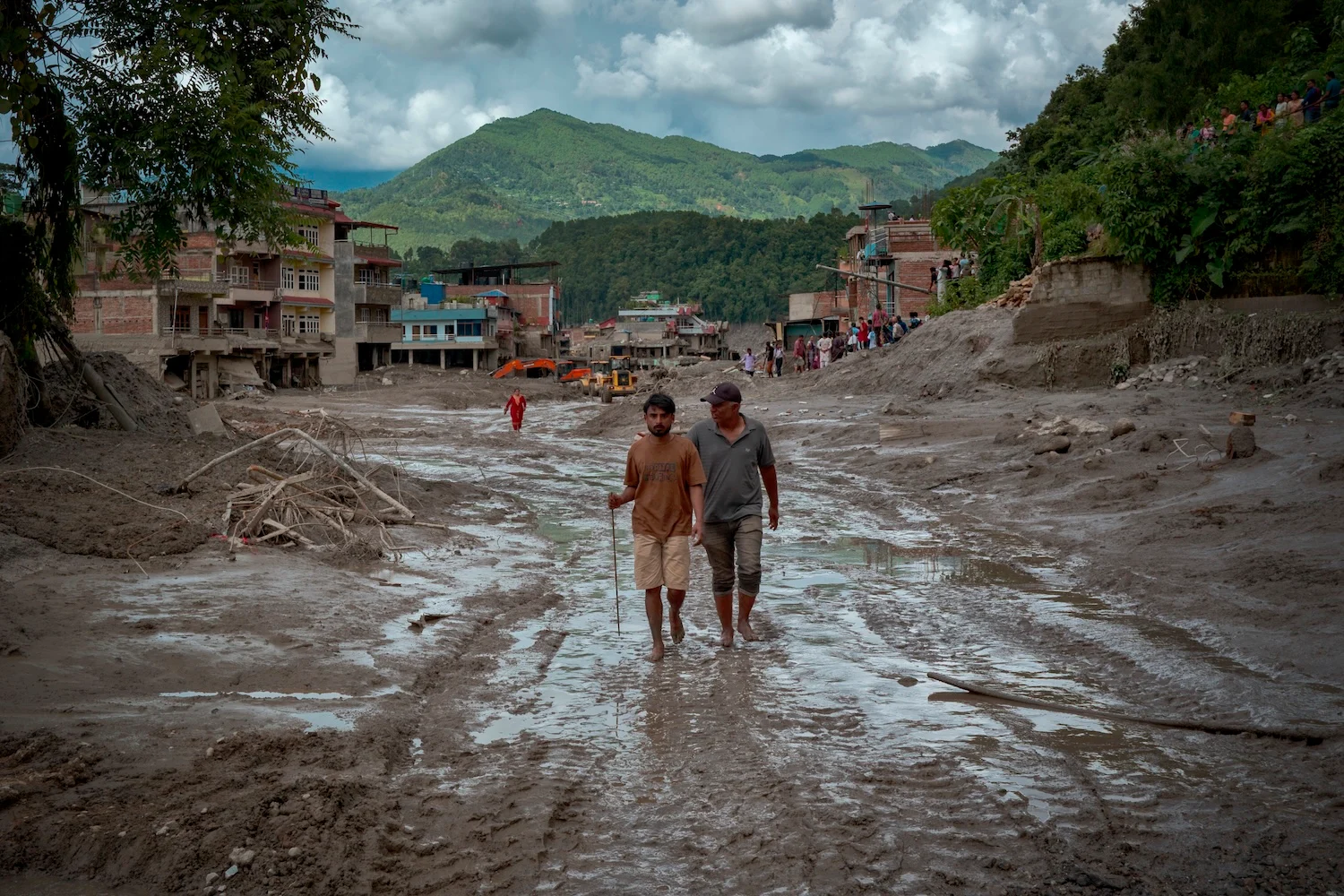
The catastrophic floods on the Nepal-Tibet border have become the latest flash point in China and India’s Himalayan dispute. In the wake of the disaster, Indian commentators initially blamed China and its mega-dam project in Tibet, prompting an angry response from Beijing.
The actual cause was a glacial collapse and landslide on the Nepali side of the border, which unleashed a tremendous surge of water that devastated villages and pilgrimage routes to Mount Kailash, a sacred site in Tibet. More than 1,000 people are dead, and thousands more are still missing.
It is unclear how badly the floods hit Tibet, in part because China has censored coverage and independent media has almost no access to the region. But this should not be mistaken for a cover-up. Chinese authorities automatically resort to censorship, especially on the issue of Tibet or after major disasters, which can derail the careers of local officials.
China and India have long-standing territorial disputes in the Himalayas, where China claims the Indian state of Arunachal Pradesh and India claims the Chinese-controlled territory of Aksai Chin. The countries fought a brief war over the territories in 1962, and today, the two sides are separated by the Line of Actual Control, where Indian and Chinese forces engage in sometimes-deadly clashes.
Part of the trouble is that mountain borders are tricky to demarcate, and GPS works poorly in mountain terrain, creating opportunities for conflict when both sides believe that they are operating in their own territory. That appears to have been a factor in the deadly incident in the Galwan Valley in 2020.
When China and India clash—in the Himalayas or elsewhere—the media on both sides often defaults to nationalism, becoming locked in a tit-for-tat exchange of accusations that is usually broken by the Chinese government stepping in and ordering its own media to stop.
However, Nepal is not buying India’s anti-China narrative this time around. After a brief period of speculation, public anger in Nepal has instead focused on Kathmandu’s initial refusal to accept foreign assistance for search-and-rescue operations.
Nepal, which borders the disputed territory, generally faces pressure from both China and India to legitimize their claims. Beijing and New Delhi have courted Kathmandu with foreign aid and investment since a reformist administration led by Prime Minister Balendra Shah took office in March. Both countries sent rescue teams to Nepal this week; they are likely to compete to demonstrate their generosity.
Shah has tried to walk a careful path of nonalignment, reversing the generally pro-Chinese orientation of his communist predecessors while still accommodating Beijing on sensitive issues. Last month, for instance, the Nepali government intervened to block a conference on Tibet following Chinese pressure.
The geopolitical conflict, however, will only get worse as the climate warms. Climate change is making it harder to tell where India ends and China begins, as retreating glaciers expose new terrain and landslides bury roads under rubble.
China is by far the world’s largest carbon emitter, producing roughly three times as much as the United States, though less per capita. India is the third largest emitter. Nepal, meanwhile, sits in the 95th spot, yet, as Bibek Bhandari reports, it is consistently one of the countries most affected by climate change.
As rising temperatures alter the landscape of the world’s highest mountains, disputed borders will become less clear, water will become scarcer, and clashes between the two Asian giants will become even more likely. And Nepal will remain caught in between.
What We’re Following
Xi, Trump gear up for summit. As Chinese President Xi Jinping and U.S. President Donald Trump prepare for their summit on artificial intelligence security, set for Sept. 24, Chinese state media has launched a rhetorical attack on U.S. firm Anthropic. The barbs send a clear signal that the United States cannot expect to impose rules that target Chinese firms but neglect its own.
China appears genuinely interested in finding some common ground with the United States on AI security, despite mutual distrust. Rapid advances in AI have exposed shared risks—for instance, the concern that offensive cyberattacks will become far easier than defensive measures and potentially accessible to ordinary users.
Trump, meanwhile, is busy posting AI-generated memes and trying to portray Beijing as responsible for Americans’ overwhelming opposition to data centers—an industry in which Trump’s family is heavily invested.
Taiwan included in regional forum. China is kicking up a fuss over the Taiwanese foreign minister’s attendance at the Pacific Island Forum, threatening vague “consequences.” This year’s meeting is hosted by Palau, one of just 12 countries that still recognizes Taipei over Beijing. Other attendees, including Australia, have also pushed back against China’s attempt to strong-arm the forum into excluding Taiwan.
China’s diplomatic campaign against Taiwan is often counterproductive because it is so aggressive that it often triggers backlash. But Chinese officials have little room to maneuver: Any concession on the issue can easily be turned against them by political rivals at home.
FP’s Most Read This Week
Tech and Business
Crypto billionaire melts down. Crypto billionaire Justin Sun, known for his publicity stunts, posted a bizarre essay claiming that he broke up with Chinese actress Jing Tian after she asked for $50 million as part of their plans to have a child together via surrogacy. He also said he was suing her to recover a 30-million-yuan ($4.5 million) dowry paid to her parents.
Rumors about powerful Chinese men engaging in high-end financial relationships with actresses are common, reflecting both sexist fantasies and the realities of an often-exploitative industry. (I’ve heard the Beijing Academy of Drama described as a “girlfriend factory for the rich” by one former student.)
The Chinese public has largely sided with Jing, who said that while her “judgment in men is still poor” she would never “sell” her “love for money.” Sun’s outburst—which spends pages dwelling on his extreme wealth—also seems to have further damaged cryptocurrency’s reputation in China.
Car troubles. China is still grappling with a domestic auto market battered by price wars and weak demand. Car sales have plummeted this year, and new regulatory measures aimed at raising production standards and curbing the race to the bottom on prices are hitting automakers hard.
There is one bright spot: Overseas, Chinese firms are rapidly expanding their market share and in some cases even surpassing their sales in China. U.S. protectionism could open up more markets, including in Canada, where Chinese automakers have shown interest in filling gaps left by U.S. companies amid the ongoing trade war.
