


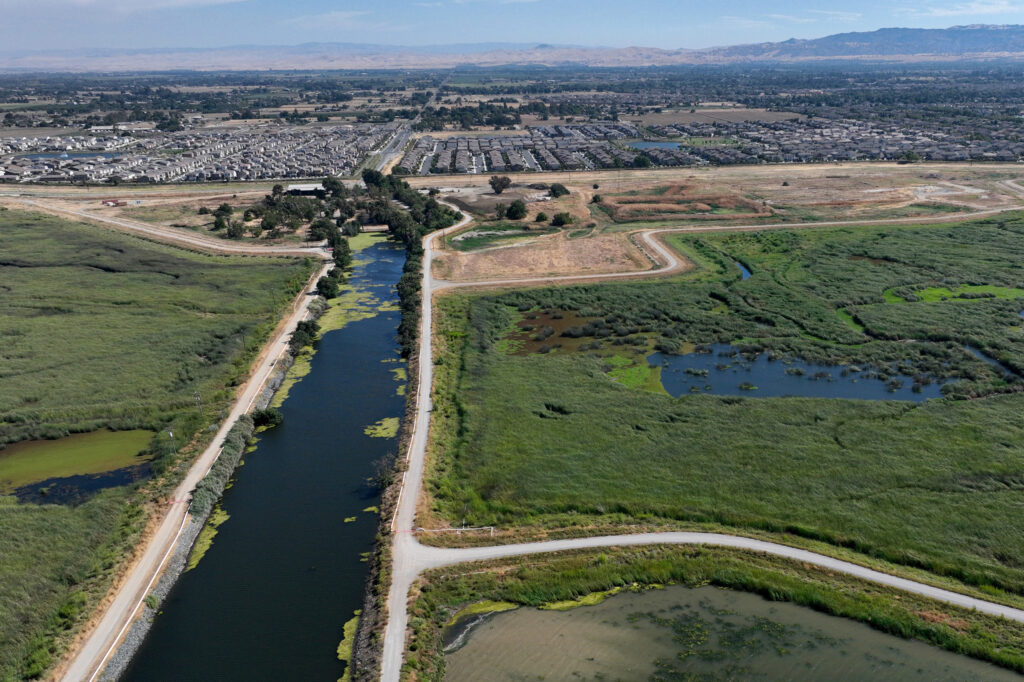
After years trudging through marshes around San Francisco Bay studying conservation practices, coastal ecologist Megan Kelso realized that one of the largest determinants of wetland health may not be an invasive species lurking with her among the sea grasses, but decisions made miles away in the executive suites of insurance companies.
Wetlands absorb massive volumes of carbon and are vital to combating climate change, Kelso said, and she saw her early field work as the most effective way to keep them healthy.
It wasn’t until she started working alongside Mike Beck, director of University of California Santa Cruz’s coastal resilience program, and was offered a grant to research how insurance can promote similar habitat restoration projects, that she had her “aha” moment.
“I was thinking, maybe there’s a way to align this huge sector of insurance with nature and conservation in a way that could have a bigger impact than what I was doing before,” Kelso said.
Now her research is the basis of a new study published in the science journal Nature by Kelso and five co-authors that outlines what these “nature-based” insurance policies would look like and how they could benefit both insurance companies and policyholders in the long run.
“It could be tens of billions of dollars going towards nature-based projects that reduce your risk,” Kelso told Inside Climate News. “It’s this big lever that hasn’t really been fully utilized yet.”
One set of policies are those designed to insure nature, such as a policy backed by insurance giant Swiss Re that provides payouts to local Mexican governments and businesses on the Yucatán peninsula when storms damage nearby coral reefs off the peninsula’s coast.
The other set, sometimes called resilience insurance, reduces policyholders’ premiums for mitigating the likelihood or severity of damage their property would incur from natural risks like wildfire, by using prescribed burns to sustainably manage surrounding forest, installing ember-resistant vents in buildings, or managing flooding by cultivating wetlands.
There are already models capable of calculating the cost savings natural features provide when calamity strikes, according to Kelso—one study found that salt marshes blunted Superstorm Sandy’s damages by 15 percent, and another estimated that natural fire buffers would have cut the financial toll of California’s 2018 Paradise Fire by 21 percent.
Instead of recreating those models, Kelso’s paper serves as a playbook illustrating how the insurance industry can incorporate risk reduction estimates into future policies, pass those savings on to consumers and fund new hazard mitigation projects, all at a profit.
“Your average person working in the insurance industry may think that it’s a small impact, but it can be very large in some circumstances, like 15 to 25 percent risk reduction from intact habitats,” Kelso said.
Nature-Based Insurance in Action
As insurance premiums across the U.S. continue to climb and wildfires engulf the Pacific Northwest, the promise of a solution that mitigates both in the face of climate change is especially significant.
Former California state Insurance Commissioner Dave Jones came to this realization nearly a decade ago when home insurance non-renewals began climbing after especially costly wildfires in 2016 and 2017.
Jones had addressed his initial climate concerns a couple years prior with policies that require insurance companies in California to disclose their investments in fossil fuel industries, but as non-renewals spiked, he convened home insurers once more and requested they voluntarily make significant investments in scientific research on wildfire risk mitigation.
“They looked at me like I was from Mars,” Jones recalled, adding that the insurance executives told him, “‘We’re not arguing with the science… but we’re in the risk transfer business, not the risk mitigation business.’”
“Sadly, that has continued to be the case,” Jones said.
After he left office in 2019, Jones set out to contribute to wildfire risk mitigation research with The Nature Conservancy.
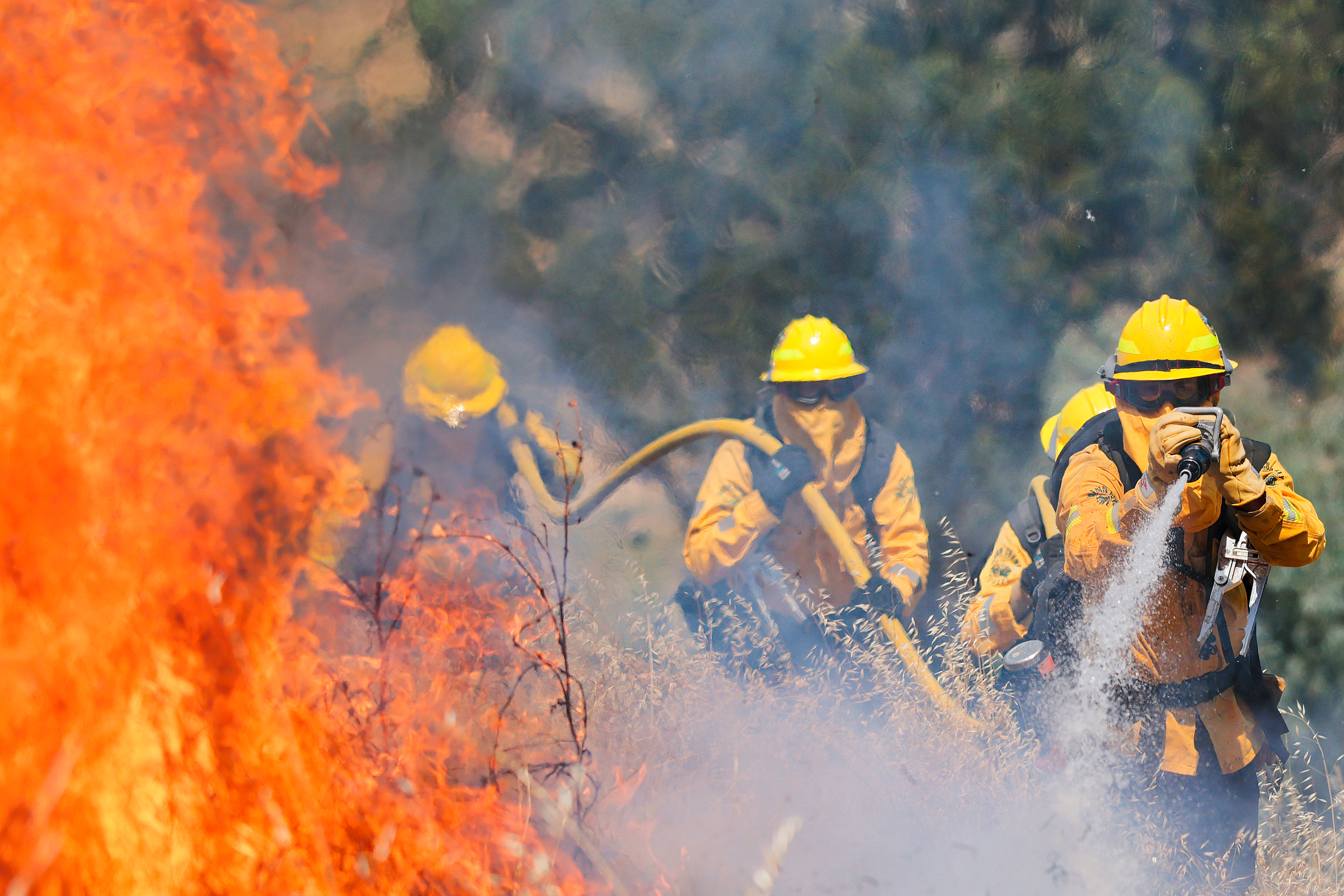
His first contribution was a groundbreaking 2021 study from TNC and multinational insurance broker Willis Towers Watson that projected forestry practices like prescribed fire and understory thinning had the potential to lower homeowner premiums in a northern California community by 20 to 40 percent, primarily by reducing the frequency and severity of potential wildfire.
The model was then adapted in 2025 to create a nascent wildfire resilience insurance policy for a 25,000-member homeowner association near Truckee, Calif. The model rewarded the Tahoe Donner Association’s historic wildfire mitigation efforts with a 39 percent lower premium price and 84 percent lower deductible for a policy covering over 1,000 acres of forest and recreation land.
“This is a geography where other insurers are declining to write or renew” insurance policies, Jones said. “It was an important demonstration that insurers can take landscape-scale, nature-based insurance into account and write insurance accordingly.”
To Kelso, the policy is proof that resilience insurance is feasible in real life and at a broad scale. The policy allows for the HOA to funnel its premium savings back into the forestry practices that initially earned it the discount and perpetually fund those practices into the future.
“The property insurance market is so huge that even if some small percentage of the money that goes into paying for premiums could be diverted towards reducing your risk… could be a game changer for conservation and restoration,” Kelso said.
A year later and a separate HOA down the Sierra Nevada mountain range closer to Lake Tahoe is working to adopt a similar policy, according to Jones.
He and Kelso are in agreement that the success of these insurance models is reliant on widespread customer demand and adoption. Absent that, insurers and risk modelers won’t be incentivised to gather data or fine-tune the models needed to put a dollar figure on the direct correlation between sustainable landscape management (i.e. prescribed burns or wetland restoration) and their corresponding risk reduction.
Public Policy at Play
In Colorado and California, state legislatures are attempting to catalyze that adoption through legislation.
A Colorado statute that kicked in this summer requires insurers to share any wildfire risk level they assign to homeowners and credit policyholders for significant measures they take to reduce that risk. Meanwhile, in California, a law enacted last fall requires insurers to publicize the same wildfire risk data and tasks the state with deploying a public wildfire catastrophe model that can be applied to policyholders statewide.
But public policy can only go so far to promulgate similar resilience insurance policies across the globe, according to insurance expert Carolyn Kousky, founder and executive director of the nonprofit Insurance for Good.
Although the Colorado and California statutes require insurers to publicize the risk scores they assign to certain properties, Kousky says that the most vital information needed to replicate resilience insurance elsewhere is hidden inside the catastrophe models that create the scores.
That’s because without assigning a clear, monetary value to specific restoration or conservation work, there won’t be the same financial incentive for policyholders to invest in nature.
“It’s really challenging because the catastrophe models used by the industry are proprietary black boxes,” Kousky said in an interview. “You want to be able to say when you do this restoration, it’s going to result in this change. And we’re just not there yet.”
Kousky recognizes that the insurance industry has gotten better at assigning values to wildfire mitigation efforts, but gaps remain in quantifying risk mitigation values provided by other ecosystems. Flood protection provided by wetlands, for example, is distributed across entire communities and more difficult to quantify for individual policyholders compared to home roof fortifications, she said, which provide them with a sizable and direct insurance discount.
“We don’t have an institutional mechanism to recoup all of those small changes in premiums to turn that into a funding flow,” Kousky said. “So even when we start to show these things in markets, it doesn’t necessarily mean that it’s unlocked the financing that everybody wants to find for these types of investments.”
One possible solution for that is incorporating the flood risk mitigation benefits that wetlands provide into existing public programs like federal flood insurance policies, said Janan Reilly, a climate resilience expert with New England engineering firm Fuss & O’Neill.
Before moving to the private sector, Reilly specialized in hazard mitigation programs as an official for the Federal Emergency Management Agency, which oversees federal flood insurance. She sees an opportunity to incorporate wetland savings directly into individual policies and through community-wide discounts FEMA offers to municipalities taking active measures to reduce local flood risks through nature-based solutions.
“If we can directly show how this will lower your insurance rate, that’s going to make it easier for communities to try to get their community members on board for these types of projects,” Reilly said.
This story is funded by readers like you.
Our nonprofit newsroom provides award-winning climate coverage free of charge and advertising. We rely on donations from readers like you to keep going. Please donate now to support our work.
However, Kousky said another weakness in the broader nature-based insurance model are the restraints around policies designed to insure nature, like the plan insuring coral reefs off the Yucatán peninsula.
The policy provides payouts to the nearby governments, businesses and organizations that rely on the reefs for tourism and storm protection, but only when they incur significant damage from hurricanes or tropical storms. That narrow coverage leaves the most significant existential threats that Kousky sees facing coral reefs—climate change and ocean acidification—unaddressed.
“Insurance is not going to help solve those two problems, which are the biggest problems facing our reefs,” Kousky said.
Fine-Tuning the Models
UC Santa Cruz coastal resilience expert Mike Beck, who co-authored the Nature article, regularly works with insurance and risk modeling companies to refine wetland models and says the industry has made significant progress over the past decade.
It was Beck and fellow researchers from UCSC and Moody’s Risk Management Solutions who laid the groundwork for wetland models in 2017 with the publication of their study on the role salt marshes played in reducing damages from Superstorm Sandy by $625 million.
Then, when the industry didn’t incorporate the paper’s models into their risk analysis at the rate Beck expected, he went back to collaborate with Moody’s on a study that found mangrove forests in Florida provided even larger damage reductions from hurricanes in 2021 and 2022.
“We showed in their models that wetlands really matter at a level you’d think would be relevant to the industry,” Beck said. “The industry should now start to include nature in their risk models, and that’ll cover it. Well, turns out that’s not correct.”
Part of the impetus behind their latest paper is to jumpstart industry adoption of nature-based models into insurance policies and risk ratings by breaking down potential obstacles and highlighting avenues for collaboration, according to Kelso.
“After a disaster there’s often this momentum to get something done,” Kelso said. “If the groundwork isn’t laid already, then that proactive energy that people have… goes towards what’s most familiar, and that is often infrastructure (like sea walls) rather than natural solutions like wetland or dune restoration.”
While Kelso sees interest in nature-based insurance from the analysts she’s worked with on her research, she said full adoption of those principles will now require winning over executives. The best way to do that, she said, is extolling the benefits in premium savings and risk reduction that such policies provide to some of their largest clients; HOAs and other communities.
About This Story
Perhaps you noticed: This story, like all the news we publish, is free to read. That’s because Inside Climate News is a 501c3 nonprofit organization. We do not charge a subscription fee, lock our news behind a paywall, or clutter our website with ads. We make our news on climate and the environment freely available to you and anyone who wants it.
That’s not all. We also share our news for free with scores of other media organizations around the country. Many of them can’t afford to do environmental journalism of their own. We’ve built bureaus from coast to coast to report local stories, collaborate with local newsrooms and co-publish articles so that this vital work is shared as widely as possible.
Two of us launched ICN in 2007. Six years later we earned a Pulitzer Prize for National Reporting, and now we run the oldest and largest dedicated climate newsroom in the nation. We tell the story in all its complexity. We hold polluters accountable. We expose environmental injustice. We debunk misinformation. We scrutinize solutions and inspire action.
Donations from readers like you fund every aspect of what we do. If you don’t already, will you support our ongoing work, our reporting on the biggest crisis facing our planet, and help us reach even more readers in more places?
Please take a moment to make a tax-deductible donation. Every one of them makes a difference.
Thank you,
