

Close Menu
NCIJ Network NCIJ Network
    What's Hot

    Renting Illinois farmland is slightly cheaper in 2026. But farming it remains costly.

    October 6, 2026

    Video of Elon Musk warning of water shortage deaths is a deepfake – Full Fact

    October 6, 2026

    Live: French PM denies ‘police repression’, suspends classes as clashes erupt at student protests

    October 6, 2026
    Facebook X (Twitter) Instagram
    Trending
    • Renting Illinois farmland is slightly cheaper in 2026. But farming it remains costly.
    • Video of Elon Musk warning of water shortage deaths is a deepfake – Full Fact
    • Live: French PM denies ‘police repression’, suspends classes as clashes erupt at student protests
    • Badenoch’s £10bn air defence plan points to growing concern over protecting UK’s skies
    • Effective supervision through timely remediation
    • Apple’s new Screen Time update is creating headaches for families with multiple devices
    • How to secure RMM software: 8 controls MSPs should test
    • Now Accepting Bitcoin: Buy Coffee And Bacon Across 200 Indiana Bitcoin Merchants
    • About
      • Our Team
      • Editorial Policy
      • Editorial Independence
      • International Support
    • Trust & Standards
      • AI Usage Policy
      • Conflict of Interest Policy
      • Corrections Policy
      • Ethics Policy
      • Fact-Checking Policy
      • Source Protection
    • Get Involved
      • Guide for Sources
      • Support Independent Journalism
    • Legal
      • Cookie Policy
      • Privacy Policy
      • Terms of Use
    Facebook X (Twitter) Instagram
    NCIJ Network NCIJ Network
    Tuesday, October 6
    • Home
    • World
    • Ai
    • Business
    • Politics
    • Health
    • Crypto
    • Science
    • Technology
    • Cybersecurity
    • Defense & Security
    • Economy
    • Energy
    • Europe
    • More
      • Fact Check
      • Investigations
      • Opinion & Analysis
      • Environment
    NCIJ Network NCIJ Network
    Home»Science

    NASA’s Webb Captures Commotion From Nebula’s Stellar Jets

    NCIJ NETWNCIJ NETWORKBy NCIJ NETWNCIJ NETWORKOctober 6, 2026 Science No Comments6 Mins Read
    Share
    Facebook Twitter LinkedIn Pinterest Email

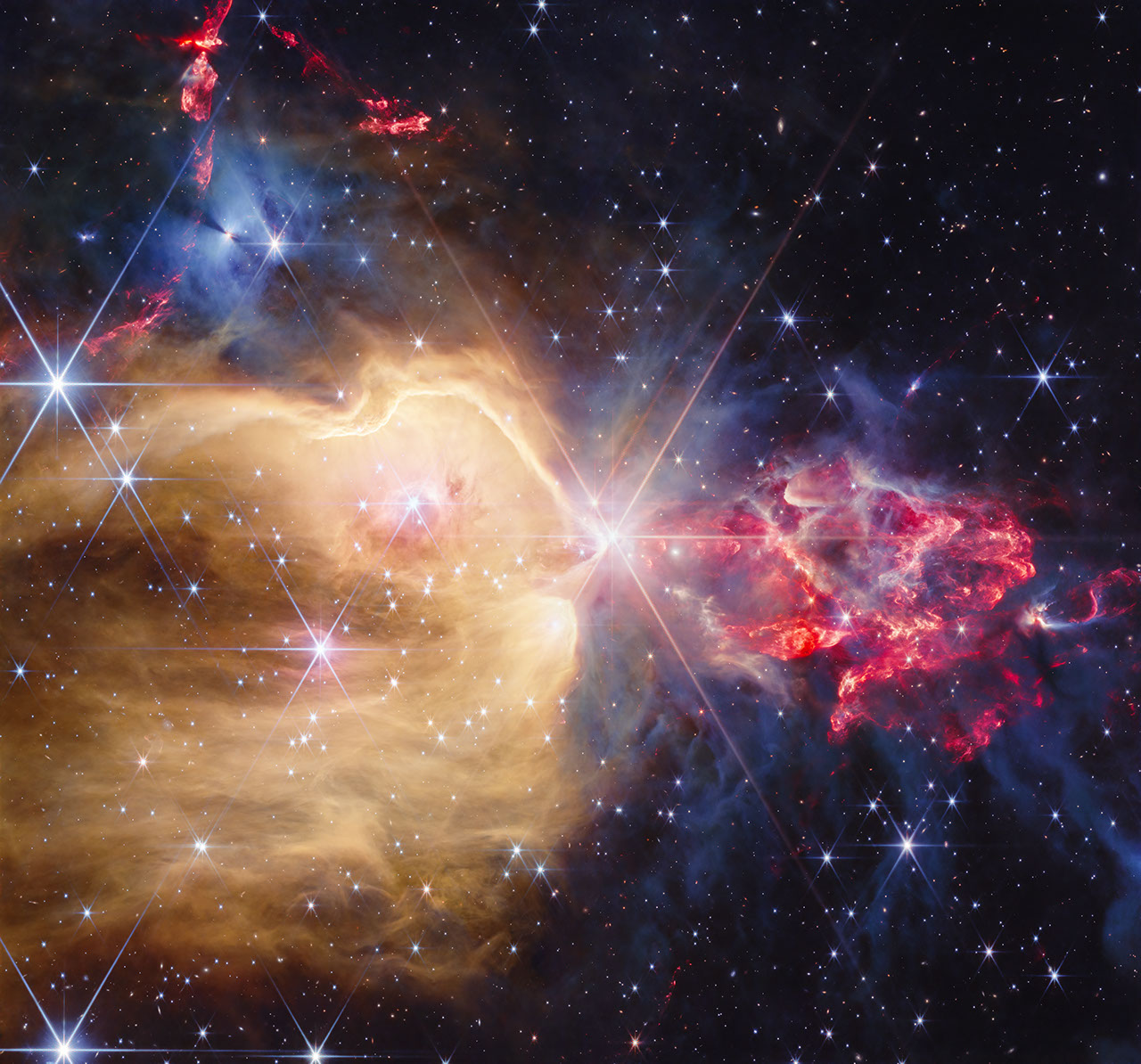
    NASA’s James Webb Space Telescope has revealed many protostars and stars within the glowing gases of NGC 7129. Hot, atomic hydrogen gas is shown here in the golden region, while cooler, molecular hydrogen gas, shocked by embedded protostars, is represented in red.

    Credits:
    Image: NASA, ESA, CSA, STScI; Image Processing: Alyssa Pagan (STScI)
    The headshot image of NASA Webb Mission Team

    NASA Webb Mission Team

    Goddard Space Flight Center

    Oct 06, 2026

    A cauldron of cosmic creation is being revealed in a new image from NASA’s James Webb Space Telescope. Webb has unveiled numerous stars formerly hidden by clouds of dust in a stellar nursery known as NGC 7129, which resides about 3,300 light-years from Earth.

    Stars, the engines of elemental creation, have life cycles that begin with their birth in molecular clouds – cold, dense regions of dust and gas. Because of these dusty cocoons, young stars are often impossible to view by many telescopes, particularly those incapable of capturing infrared light. Webb, however, has a high degree of infrared sensitivity, allowing astronomers to peer through that dust and study the beginning of the star life cycle.
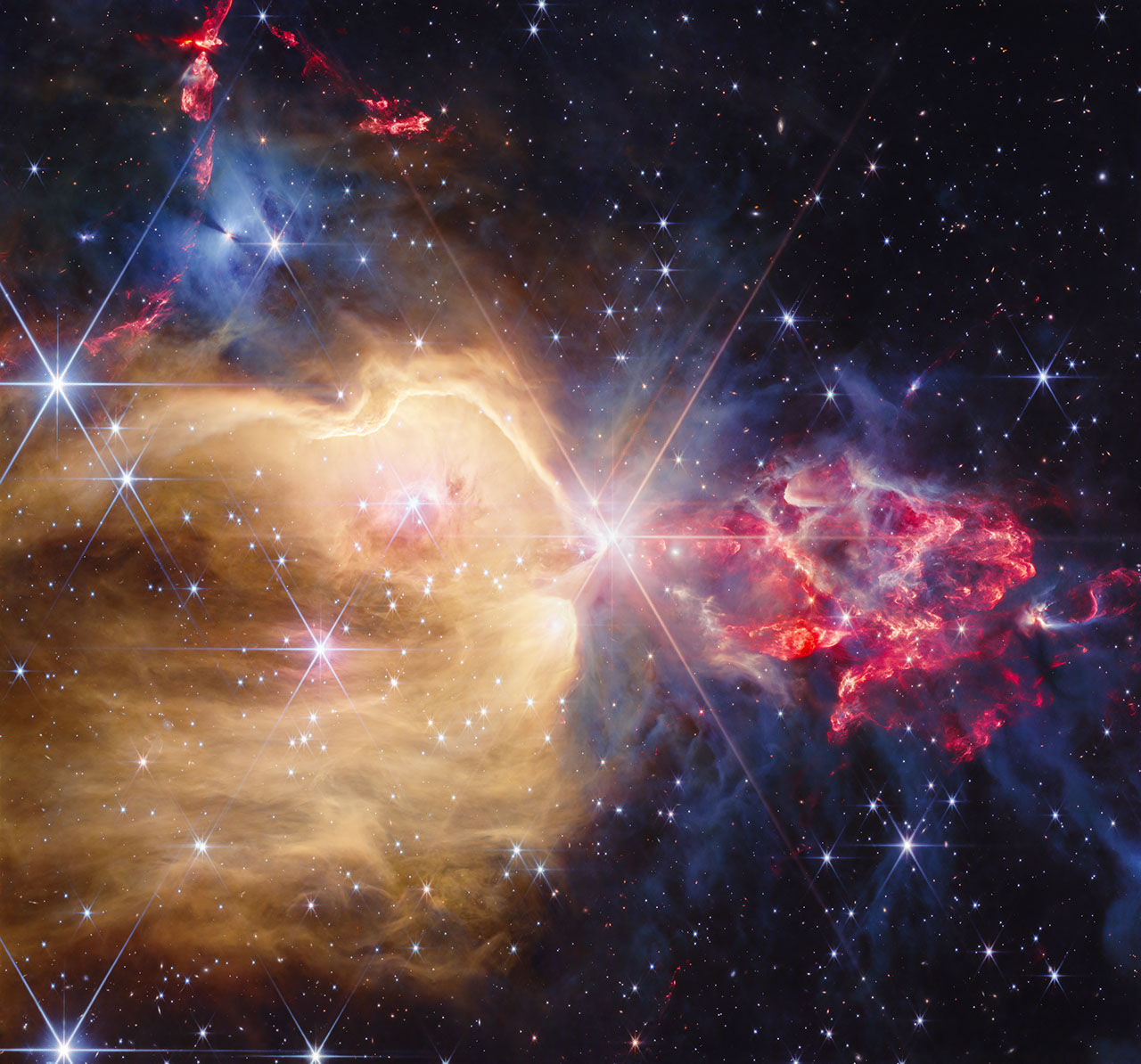
    A young star cluster filled with many stars that display Webb’s unique eight-pronged diffraction pattern. At its center is a yellow star that sports the largest diffraction pattern. To its left, there is a region filled with yellow dust and gas that extends from the star to the left and the bottom, covering about two-thirds of the frame. The yellow region has several embedded blue stars of different sizes. The top third, which lies outside the yellow region, has a few bright protostars, within dense gray gas. These stars illuminate the gas, making it appear blue. A few red outflows from other protostars are visible above this grayish-blue region. To the right of the central star, there is a clumpy, flame-like plume of red dust and gas with protostars that emit a soft white light within. The plume is surrounded by more dense gray gas and dust. It is about one third the size of the yellow region. There are several background galaxies strewn throughout.

    NASA’s James Webb Space Telescope has revealed many protostars and stars within the glowing gases of NGC 7129. Hot, atomic hydrogen gas is shown here in the golden region, while cooler, molecular hydrogen gas, shocked by embedded protostars, is represented in red.

    Image: NASA, ESA, CSA, STScI; Image Processing: Alyssa Pagan (STScI)

    The stars from this cluster are in different stages of their development, as the more massive stars form and evolve the fastest. The most massive (and the most mature) is the region’s luminous central star, LkH(alpha) 234 (pronounced Lick-H-alpha). This star, which sports the image’s most prominent diffraction pattern, is a pre-main-sequence star weighing around 5 to 8 times the mass of our Sun. Pre-main-sequence stars like these have mostly finished gathering mass and are contracting under the force of gravity, causing their temperatures to rise. In time, this star will fuse its own hydrogen like our Sun. 

    The cavity to its left, which appears in gold and spans about 3.5 light-years, is the largest demonstration of the central star’s impact. Outflows from an earlier stage of the star’s life cycle carve into the dense molecular cloud of hydrogen. Both the outflows and the star’s light energize the gas, causing it to glow. While much of this hydrogen gas is blown away, a large amount is also compressed, creating the conditions for even more stars to form. 

    A few of these stars are visible within the cavity. Several of them are also pre-main-sequence and emit stellar winds. The nearby bow shocks, the curved compressed gas that appears near the stars, are created as those winds push into the energetic gas and create their own, smaller cavities. 

    Together, the central and embedded stars also create the sharp ridge seen at the top of the golden cavity. Their light generates a hot environment that pushes against the colder and denser molecular gas outside the cavity, and creates a boundary known as a photodissociation region. In this region, the molecules of hydrogen break down into atoms. By influencing the temperature and chemistry of the region, this collection of stars offers insight into how these molecular clouds will gradually erode over millions of years. 

    The region to the right of the central star narrates a different, but equally chaotic tale. This clumpy matter represented in red hides much younger objects than those on the left: protostars. The protostar stage is earlier than the pre-main-sequence stage and occurs after molecular clouds of gas and dust initially compress and fragment.

    As the protostars accumulate matter and increase their mass, they eject outflows of superheated material. These outflows interact with the dense, gray, translucent matter the protostars are wrapped within, creating shocks that cause a textured appearance. The red glow is also the result of the interaction. Multiple outflows from multiple stars overlap from our point of view, leading to the scene’s chaotic look. 
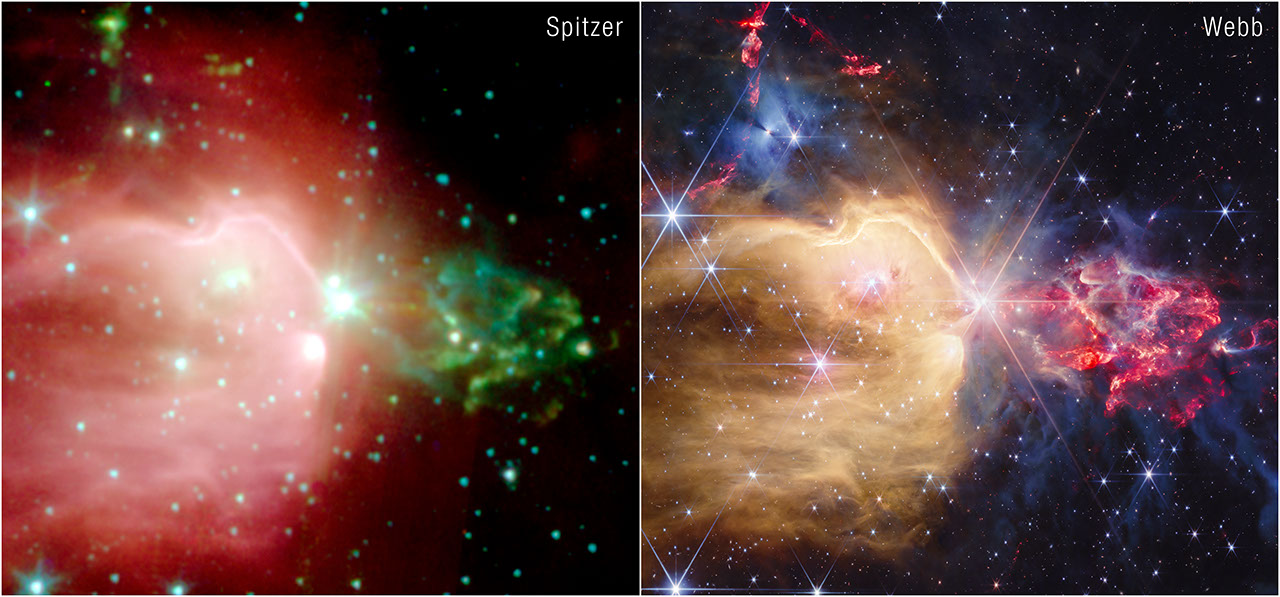
    Two images appear side by side. The left is labeled “Spitzer” and the right “Webb.” The Spitzer image, which is fuzzier and less detailed, shows two regions separated by a bright central object, a star. To the left of the star, there is a region filled with red dust and gas that extends from the star to the left border of the image. The red region extends from the bottom, covering about two-thirds of the image. To the right of the star is a large, irregular green blob. The Webb image shows the same two regions at both sides of a central star, but at a higher resolution. The left region is filled with stars and yellow dust and gas that extends from the star to the left border of the image. This yellow region extends from the bottom, covering about two-thirds of the image. The top left of the image holds a few bright protostars, within dense gray gas. To the right of the central star, there is a clumpy plume of red dust and gas, which is surrounded by more dense gray gas and dust.

    NASA’s retired Spitzer Space Telescope observed the gas and dust within NGC 7129; however, NASA’s James Webb Space Telescope’s improved resolution shows more detailed gas and dust filaments, along with many background galaxies.

    Image: NASA, ESA, CSA, STScI, NASA-JPL; Image Processing: Alyssa Pagan (STScI)

    More of these protostellar outflows can be seen at the upper left of the image, near a blue-colored nebula. The center of this blue region hosts a protostar surrounded by a donut-shaped disk of material. This disk casts a shadow against the surrounding nebula, reminiscent of a similar structure known as the “Bat Shadow” that was observed by NASA’s Hubble Space Telescope. 

    Webb’s high spatial resolution reveals many rich structures in the region’s gas, building on research done previously by NASA’s retired Spitzer Space Telescope. Astronomers will continue to use this Webb data to study how the stars and protostars in this region influence the surrounding gas and dust.

    The James Webb Space Telescope is the world’s premier space science observatory. Webb is solving mysteries in our solar system, looking beyond to distant worlds around other stars, and probing the mysterious structures and origins of our universe and our place in it. Webb is an international program led by NASA with its partners, ESA (European Space Agency) and CSA (Canadian Space Agency). 

    To learn more about Webb, visit:

    https://science.nasa.gov/webb

    The following sections contain links to download this article’s images and videos in all available resolutions followed by related information links, media contacts, and if available, research paper and Spanish translation links.

    Related Images & Videos

    A young star cluster filled with many stars that display Webb’s unique eight-pronged diffraction pattern. At its center is a yellow star that sports the largest diffraction pattern. To its left, there is a region filled with yellow dust and gas that extends from the star to the left and the bottom, covering about two-thirds of the frame. The yellow region has several embedded blue stars of different sizes. The top third, which lies outside the yellow region, has a few bright protostars, within dense gray gas. These stars illuminate the gas, making it appear blue. A few red outflows from other protostars are visible above this grayish-blue region. To the right of the central star, there is a clumpy, flame-like plume of red dust and gas with protostars that emit a soft white light within. The plume is surrounded by more dense gray gas and dust. It is about one third the size of the yellow region. There are several background galaxies strewn throughout.

    NGC 7129 (NIRCam Image)

    NASA’s James Webb Space Telescope has revealed many protostars and stars within the glowing gases of NGC 7129. Hot, atomic hydrogen gas is shown here in the golden region, while cooler, molecular hydrogen gas, shocked by embedded protostars, is represented in red.

    Two images appear side by side. The left is labeled “Spitzer” and the right “Webb.” The Spitzer image, which is fuzzier and less detailed, shows two regions separated by a bright central object, a star. To the left of the star, there is a region filled with red dust and gas that extends from the star to the left border of the image. The red region extends from the bottom, covering about two-thirds of the image. To the right of the star is a large, irregular green blob. The Webb image shows the same two regions at both sides of a central star, but at a higher resolution. The left region is filled with stars and yellow dust and gas that extends from the star to the left border of the image. This yellow region extends from the bottom, covering about two-thirds of the image. The top left of the image holds a few bright protostars, within dense gray gas. To the right of the central star, there is a clumpy plume of red dust and gas, which is surrounded by more dense gray gas and dust.

    NGC 7129 Side-by-Side (Spitzer and Webb Image)

    NASA’s retired Spitzer Space Telescope observed the gas and dust within NGC 7129; however, NASA’s James Webb Space Telescope’s improved resolution shows more detailed gas and dust filaments, along with many background galaxies.

    Read more: Webb’s Star Formation Discoveries

    Explore more: Image Tour: Herbig-Haro 46/47

    Watch: Herbig-Haro 49/50 Stellar Jets Visualization

    Explore more: Star formation in the Eagle Nebula

    Watch: Celestial Lightsabers: Stellar Jets in HH24

    More Webb: News | Images | Science | Home Page

    Keep Exploring

    Related Topics

    captures Commotion jets NASAs Nebulas Stellar Webb
    NCIJ NETWNCIJ NETWORK
    • Website

    Keep Reading

    The world’s loudest bird could drown out a rock concert

    Your voice is more than sound. It’s part of who you are

    The Beaver Brown Waters of Rupert Bay 

    UK oil refinery broke toxic pollution limits dozens of times

    This mysterious hole on the Moon may open into a giant cave

    A Journey to the Depths of Ancient Mars?

    Add A Comment
    Leave A Reply Cancel Reply

    Editors Picks

    Renting Illinois farmland is slightly cheaper in 2026. But farming it remains costly.

    October 6, 2026

    Video of Elon Musk warning of water shortage deaths is a deepfake – Full Fact

    October 6, 2026

    Live: French PM denies ‘police repression’, suspends classes as clashes erupt at student protests

    October 6, 2026

    Badenoch’s £10bn air defence plan points to growing concern over protecting UK’s skies

    October 6, 2026
    Latest Posts

    4 Best Compression Boots: Therabody, Hyperice, and More (2026)

    August 9, 2026

    Former Iraqi provincial governor arrested as graft crackdown continues | Corruption News

    August 9, 2026

    The culture surrounding ‘ideal’ childbirth has to evolve | Childbirth

    August 9, 2026

    Subscribe to News

    Get the latest sports news from NewsSite about world, sports and politics.

    NCIJ Network is an independent digital news platform delivering trusted investigative journalism, European and global news, in-depth analysis, and fact-based reporting with accuracy, transparency, and integrity.

    Facebook X (Twitter) Instagram Pinterest YouTube

    Renting Illinois farmland is slightly cheaper in 2026. But farming it remains costly.

    October 6, 2026

    Video of Elon Musk warning of water shortage deaths is a deepfake – Full Fact

    October 6, 2026

    Live: French PM denies ‘police repression’, suspends classes as clashes erupt at student protests

    October 6, 2026

    Subscribe to Updates

    Get the latest creative news from FooBar about art, design and business.

    Type above and press Enter to search. Press Esc to cancel.