


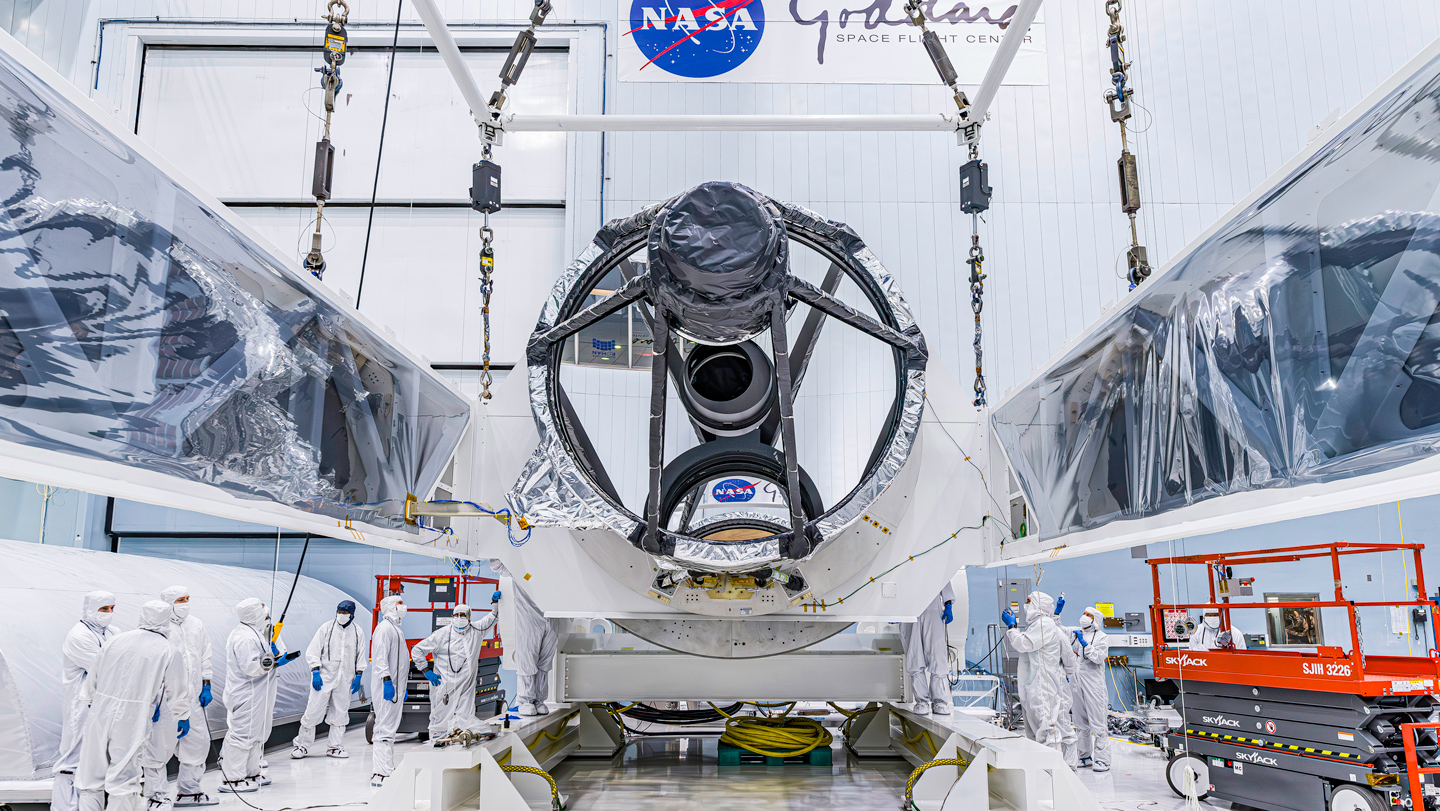
NASA is ready to explore the cosmos in a whole new way, thanks to its next-generation Nancy Grace Roman Space Telescope.
Scientists and engineers have spent some twenty years designing and building the observatory, which weighs as much as a Tyrannosaurus rex and is the size of a tour bus. Now, NASA aims to launch the telescope as early as August 30, with plans to start delivering a flood of cutting-edge astronomical data early next year.
Within the mission’s first five years, scientists expect the Roman Space Telescope, named for NASA’s first head of astronomy and a vital advocate for the Hubble Space Telescope, to unlock mysteries about the enigmatic dark matter and dark energy that dominate our universe. It will also detect tens of thousands of alien planets, paint interactions between galaxies and spot exploding stars — and much, much more.
“Anywhere you point Roman, somebody’s going to be able to say, ‘I discovered something,’” says cosmologist Jason Rhodes of NASA’s Jet Propulsion Laboratory (JPL) in Pasadena, Calif. “Roman is going to touch or affect nearly all areas of astrophysics.”
Roman’s promised abundance of riches comes courtesy of the mission’s approach. The Hubble Space Telescope and other NASA observatories see only a small fraction of the sky. Not so Roman. “Roman’s superpower is our surveys,” methodically covering territory without specific targets, says astrophysicist Julie McEnery of NASA’s Goddard Space Flight Center (GSFC) in Greenbelt, Md. The telescope is built with a massive field of view — 100 times larger than Hubble’s — and it can agilely pan across the sky to rapidly sweep the cosmos.
“Roman is going to unlock huge corners of science by really turning that sharpness over vast areas of the sky,” says astrophysicist Erik Rosolowsky of the University of Alberta in Edmonton, Canada, who is not formally affiliated with the Roman mission.
With such broad vision, it doesn’t make sense to study specific objects the way Hubble and the James Webb Space Telescope do. Instead, astronomers of all stripes collaborated on Roman’s observing plan to ensure the telescope gathers widely-applicable top-tier data while optimizing for groundbreaking discoveries in three key fields.
A vast view will shine light on the dark universe
The Roman Space Telescope traces its origins to the early 2000s. At the time, cosmologists had known for a couple of decades that the matter we experience every day and observe with telescopes accounted for only a fraction of the universe’s matter, with huge amounts of so-called dark matter gluing the cosmos together. The late 1990s brought a second shocking space oddity — that the universe isn’t just expanding, but expanding faster and faster as time passes, driven by another incomprehensible phenomenon astrophysicists dubbed dark energy.
Until now, understanding these two mysteries has been a steep challenge because both enigmas unfold on a huge scale, calling for observations of huge regions of the universe, says cosmologist Katarina Markovic of JPL. “It requires a very new kind of astronomy which is not focused on looking at individual objects,” she says.
That’s where Roman comes in, ready to observe several signatures of the dark universe during its massive survey. It will detect tiny changes in the shapes of millions of galaxies caused by dark matter passing between these objects and the telescope. Like window glass that has been warped by age, dark matter distorts distant objects, letting science map the invisible. Roman will also spot some 21,000 stellar explosions of a type so predictable that scientists can calculate their exact distance from Earth. And Roman will map billions of galaxies, stretching back in cosmic time, betraying patterns in how these objects have clumped together and spread apart over the eons.
All told, scientists hope that these observations will be powerful enough to confirm or disprove current suspicions that dark energy may be more complicated than previous evidence suggested — a question upon which the ultimate fate of the universe hangs.
Dual strategies could discover a deluge of alien planets
Roman’s second key project will be discovering exoplanets by the tens of thousands. To date, scientists have identified just over 6,000 planets orbiting other stars, mostly in our own neighborhood. Roman will use two techniques to take the hunt to a totally new region, the Milky Way’s bulge.
The largest trove of Roman’s exoplanets — perhaps as many as 200,000 — will come via transits, when astronomers clock the periodic dip in a star’s brightness caused by a planet passing in front of its sun. This approach has been most fruitful so far, but it’s best at spotting very large planets orbiting very close to their star — something like a planet the size of Jupiter in the orbit of Mercury.
Importantly, Roman will also excel at a second technique, called microlensing, which will allow it to hunt down some 1,400 planets farther out in their stellar systems, says astrophysicist and exoplanet specialist Elisa Quintana of GSFC, who previously worked on Roman. Microlensing relies on the way large objects in space bend light around them. In the relatively rare cases when two stars align perfectly along Roman’s viewing angle, the background star briefly flares because of this phenomenon. If a planet is secretly orbiting the foreground star, it causes a second, smaller flare from which scientists can calculate the planet’s size and orbital distance.
Roman’s ability to see planets at such a wide range of distances from their stars should show us how typical our own solar system is. Although finding alien Jupiters may not sound as exciting as finding alien Earths, the presence and dynamics of giant planets shapes where terrestrial planets form, Quintana says. “It’s all tied together — it’s all one story.”
Scientists will savor a cosmic array of astronomy
There’s no way to draw boundaries on the discoveries Roman will make. With its powerful optics and carefully planned surveys, the telescope will observe practically anything scientists can dream of.
Across the universe, Roman will see countless stars flare and fade and be shredded by black holes. In our own solar system, fast-moving asteroids will streak across its view, informing scientists’ evaluation of the threats to Earth posed by nearby space rocks. And Roman will regularly check up on the very heart of our Milky Way galaxy, where a gigantic black hole invisibly churns.
The observatory will also offer scientists their first good look at the galaxy’s bulge, which includes the majority of the Milky Way’s stars but is wrapped in a haze of dust that most telescopes can’t see through. “It’s where most of the galaxy lives, and it’s just severely underexplored,” says astrophysicist Gail Zasowski of the University of Utah in Salt Lake City, who served on the committee governing Roman’s overall observation time budgeting. “All the extremes happen there.”
Of course, launch is only the next step for Roman. The telescope must fully deploy, trek out to its perch nearly 1.5 million kilometers away from Earth on the side opposite the sun and get up and running, a more-than-three-month-long process that mission members will be watching with bated breath.
But despite scientists’ grand agenda for Roman, they are perhaps most eager for what can’t be predicted — the “absolute surprises,” as McEnery calls them, “the things that don’t yet have a name because they haven’t yet been found.” It’s these discoveries that only Roman will be able to reveal — and that will shape scientists’ explorations for decades to come.
