


Welcome to Foreign Policy’s Southeast Asia Brief.
The highlights this week: Myanmar junta leader Min Aung Hlaing visits Bangkok as part of an ongoing diplomatic push; the Philippines’ growth slumps; and a school shooting puts Thailand’s gun culture in the global spotlight.
Min Aung Hlaing in Bangkok
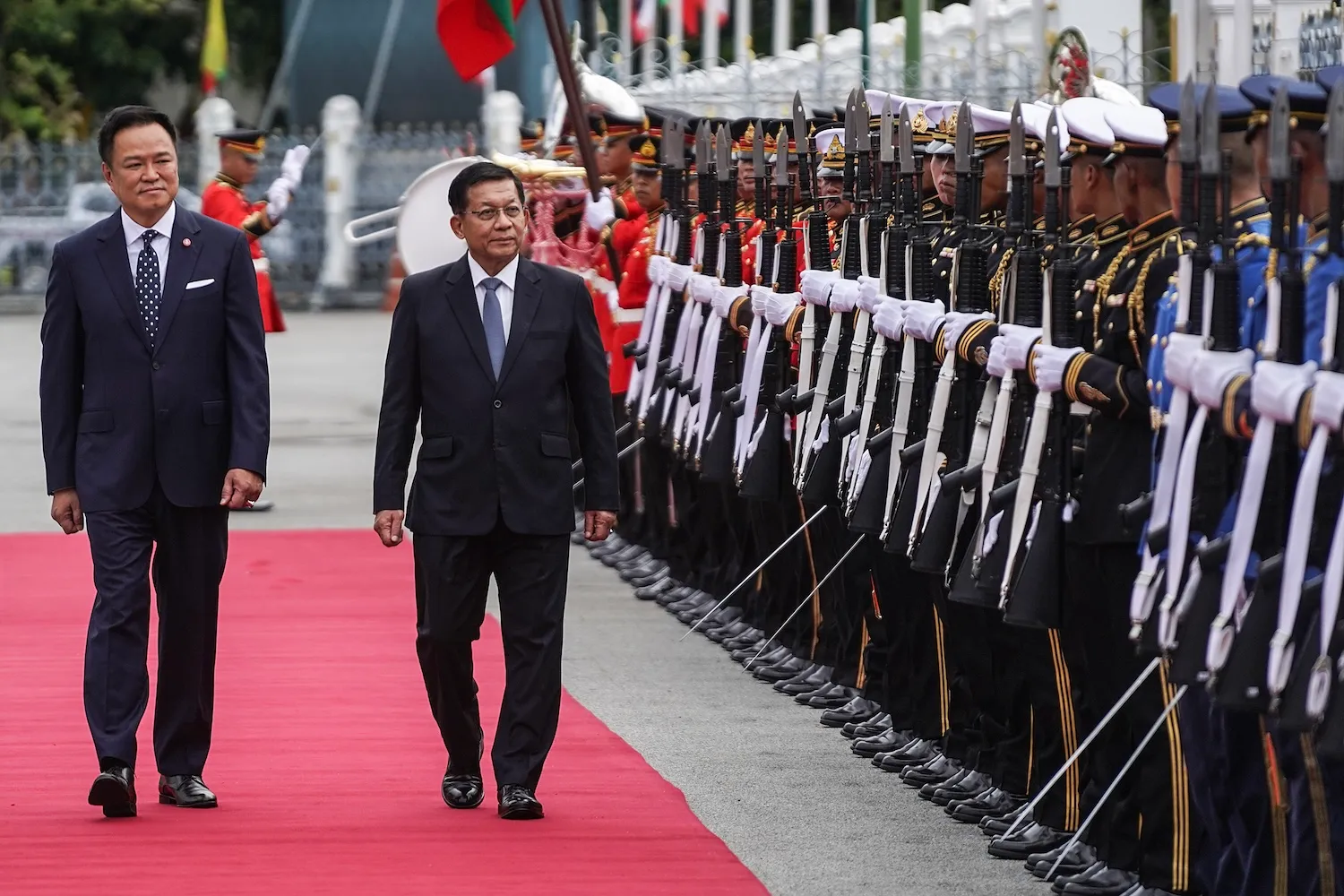
Myanmar junta leader Min Aung Hlaing visited Bangkok last week, part of an ongoing and successful diplomatic push following sham elections held in 2025-2026 and his own inauguration as president in April.
The visit to Thailand follows an official visit to India from May to June, China in June, and Laos in July. It marks the latest phase in Thailand’s continued normalization of relations with Myanmar. Sharing a 1,500-mile border with the country, Thailand’s foreign minister has said they need to be realistic in their dealings. (But not everyone is on board.)
The trip is also part of the push for Myanmar to normalize relations with the Association of Southeast Asian Nations (ASEAN), which has excluded Myanmar’s leaders from its summits since the 2021 coup. Thailand has been a key backer of this push. In July, it hosted an informal meeting between Myanmar’s foreign minister and ASEAN foreign ministers.
The joint statement issued by the two country’s foreign ministries included a laundry list of topics. These included more cooperation against transnational crimes, including drug smuggling and scams; cooperation against transboundary pollution such as haze and water pollution; a push to boost bilateral trade to $12 billion; and memorandums of understanding on labor, tourism, and space.
With the exception of tourism and space—the former peripheral given the civil war, the latter fanciful—these are all important issues for Thailand. Transnational crime affects Thai citizens. Water pollution linked to rare-earth mining in Myanmar is poisoning its most important rivers. And some 4 million citizens of Myanmar work in Thailand.
Whether this meeting will have any real effect, though, is doubtful. Myanmar is making a show of cracking down on some issues such as scams. Its parliament recently voted to impose the death penalty for those who coerce people to work in scam centers.
But many of the damaging activities take place in areas controlled not by the military government but by Myanmar’s multitude of armed groups. Here, I am told, the Thai military has done its own quiet outreach with limited success.
On ASEAN normalization, Myanmar has made progress. Thailand pledged in the joint statement to support Myanmar’s “full and equal participation in ASEAN.”
And in May, at the ASEAN leader’s summit in Cebu, Philippines, the rotating chair—President Ferdinand Marcos Jr. of the Philippines—spoke of the need for a new approach.
But Myanmar’s newfound confidence is also encouraging a truculence that could backfire.
Following the meeting in Bangkok, the Philippines called for the “complete and unconditional release” of opposition leader Aung San Suu Kyi. This was rebuffed by Myanmar’s Foreign Ministry.
To be accepted as a full member again, Myanmar also needs to overturn the five-point consensus.
Agreed to by ASEAN leaders as well as Min Aung Hlaing in the aftermath of the 2021 coup, the five-point consensus lays out the following principles: an end to violence in Myanmar, “constructive dialogue among all parties,” a special ASEAN envoy to help with talks, humanitarian aid, and an ASEAN delegation to the country.
To date, there has been basically nil progress on these points. So if the consensus stands, it impedes normalization.
In July, as Myanmar’s government began to see diplomatic breakthroughs, its parliament voted to formally to reject the five-point consensus. And on July 31, Min Aung Hlaing gave a speech criticizing it as “discriminatory” and “not the consensus of all ASEAN member states.”
Singapore, which will serve as ASEAN chair next year, will be one stubborn opponent. East Timor is another. Its history means that it places a strong emphasis on human rights in its diplomacy.
Growth slump. The Philippines’ GDP growth has dropped to 2.3 percent in the second quarter of this year. Excluding the COVID-19 pandemic, this is the slowest that the Philippines has grown since 2009. And it is well below the 5.3 percent growth that the World Bank predicted for 2026.
The government has tried to brush off the slowdown as “temporary.” However, the fact is that after a period of strong growth, the Philippines’ economy has seen sharp and continuous weakening since the third quarter of 2025.
Two major factors are at play. First is the flood control corruption scandal that broke last year. Increased scrutiny around infrastructure spending has had the unfortunate result of slowing investment by the government and the private sector alike. (The government says that this is being dealt with and that infrastructure spending should increase in the third quarter.)
Second is the massive disruption to global energy markets following U.S. attacks on Iran and Iran’s closure of the Strait of Hormuz. The Philippines’ heavy reliance on oil imported from the Middle East means that it has faced a nasty spike in inflation and a sharp slowdown in consumer spending.
This figure makes the Philippines one of the worst—possibly the worst—performing economy in the region. Indonesia, Malaysia, Singapore, and Vietnam have all released figures showing second quarter growth above 5 percent.
To Lam Down Under. Vietnamese President To Lam visited Australia and New Zealand on a four-day trip starting Sunday. The president has been on a diplomatic blitz, visiting 11 countries—including the United States, China, and India—this year, even as he consolidated power at home.
The meetings in Australia produced joint statements on deepening the two countries’ strategic partnerships as well as cooperation on economic resilience and science and innovation.
These declarations included promises to increase cooperation on transnational crime such as scams and people smuggling, environmental protection and climate change, and research. They also expressed concern about growing strains on the global trading system and highlighted defense ties and cooperation on critical minerals.
This is all fairly boilerplate, but the visit comes as Vietnam and Australia both look to diversify their foreign-policy options at a time of increasing uncertainty about the international system.
As one analyst at the Australian Strategic Policy Institute put it, Vietnam is looking to avoid coercion by engaging with the United States and China while finding new partners, whereas Australia wants to strengthen the U.S. alliance but wants partners to hedge against growing U.S. unreliability.
At time of writing, the results of the New Zealand leg of the trip have yet to be announced.
Israel-bound cargo seized. On Saturday, Malaysia seized a container in the port of Tanjung Pelepas, Johor. The vessel was suspected of carrying merchandise intended for export to Israel.
Since December 2023, Israeli vessels have been banned from using ports in Malaysia, which does not recognize Israel. The ban on docking and loading cargo also applies to vessels bringing shipments to Israel.
In a social media post, Malaysian Prime Minister Anwar Ibrahim said the actions were also “in line with Malaysia’s commitments under The Hague Group.”
The group is a bloc of eight countries—Bolivia, Colombia, Cuba, Honduras, Malaysia, Namibia, Senegal, and South Africa—formed in January 2025 to take “coordinated legal and diplomatic measures” against Israel over its alleged violations of international law and genocide.
In his post, Anwar declared that the cargo seizure “demonstrates Malaysia’s firm stance to ensure that our country will never serve as a conduit for trade that could support or contribute to the Israeli regime’s atrocities against the Palestinian people.”
The move could spark tensions with the United States. The recent kerfuffle over suspected illegal entry of Israeli citizens into Malaysia caused a small row with Washington by drawing attention to Malaysia’s long-standing policy of refusing entry to Israelis.
Firefighters carry out operations to extinguish a forest fire in a wooded area of South Sumatra province, Indonesia, on Aug. 8.Muhammad Fajri/Anadolu via Getty Images
FP’s Most Read This Week
Jeff Nielson shines a light how the Indonesian government’s multibillion-dollar “Red and White Village Cooperatives” project has turned into a fiasco with sinister military overtones, in New Mandala.
Unstable governments have empowered Malaysia’s sultans, write Ushar Daniele and Iman Muttaqin Yusof in South China Morning Post.
Fake think tanks may be acting as fronts for spying in Singapore, Sophie Chew writes in Channel News Asia.
In Focus: Massacre Puts Thailand’s Gun Culture in the Spotlight
On Friday, a school shooter in Thailand left nine dead, including his grandparents, before killing himself. The massacre shocked the country and has put a spotlight on its gun culture.
A 2017 Small Arms Survey estimated that there were more than 10 million guns in Thailand, or about 15.1 firearms per 100 inhabitants. By comparison, in Cambodia, which has the next-highest ratio in the region, the estimated figure was 4.5.
Go to certain shopping areas in Bangkok and you can see rows of gun shops, while government programs have subsidized arms purchases by civil servants and officials.
Gun violence is all too common. On Monday, in the same province as the massacre, a former member of the Thai parliament allegedly shot dead a former police officer. (In a surreal twist, the gunman then confessed on a YouTube livestream.)
Thailand has also seen numerous mass shootings. Most infamously, in 2022, an ex-policeman killed 37 people, including roughly two dozen children.
Gun laws have been tightened in recent years. Anutin led the charge on a lot of this, having served as interior minister largely uninterrupted since 2023. (He still holds that office.)
After a shooting at a mall in 2023, Anutin issued a short-term ban on new licenses, imposed import restrictions on weapons, and then banned people under 20 from shooting ranges. Conditions for purchasing guns are also quite strict.
And following last week’s shooting, Anutin has promised new gun laws, including restrictions on carrying firearms in public.
Yet big gaps remain. Despite repeated proposals, comprehensive mental health checks have yet to be implemented. And licenses are not subject to regular renewal processes.
Furthermore, the Small Arms Survey estimated that 4.1 million of the guns in the country were unregistered. Many of these unregistered guns are bought under the subsidy scheme and then quietly sold on for a profit.
The gun that the teenager brought to his school was reportedly legally registered.
