


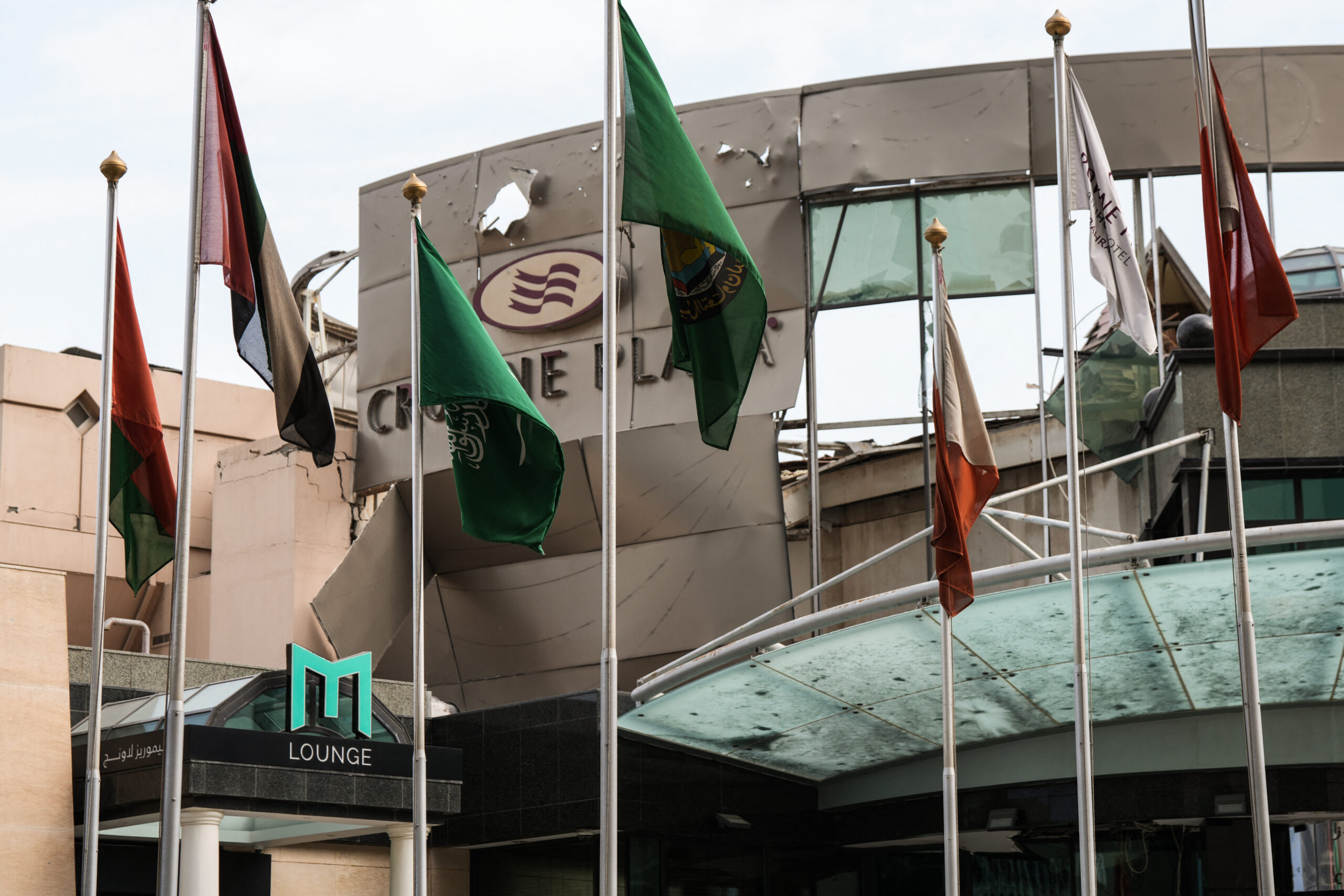
Over the last several decades, the Gulf states have used their oil and gas riches to transform their economies into global powerhouses. Many have built gleaming new cities and some of the world’s best airlines—and turned to the United States for security to make sure the party kept going. The Iran conflict has thrown most of those plans into flux. The latest example of this state of uncertainty could be the Mecca Joint Defense Agreement, a pact between Turkey, Pakistan, and Saudi Arabia to treat an attack on one of them as an attack on them all—language that is reminiscent of NATO’s Article 5.
On the latest episode of FP Live, I dug into the nature of this new defense agreement and how the Gulf countries are rethinking their security and economic frameworks. I spoke with Allison Minor, a director at the Atlantic Council who previously served as a U.S. deputy special envoy to Yemen and also as a director at the National Security Council focused on the Arabian Peninsula.
Over the last several decades, the Gulf states have used their oil and gas riches to transform their economies into global powerhouses. Many have built gleaming new cities and some of the world’s best airlines—and turned to the United States for security to make sure the party kept going. The Iran conflict has thrown most of those plans into flux. The latest example of this state of uncertainty could be the Mecca Joint Defense Agreement, a pact between Turkey, Pakistan, and Saudi Arabia to treat an attack on one of them as an attack on them all—language that is reminiscent of NATO’s Article 5.
On the latest episode of FP Live, I dug into the nature of this new defense agreement and how the Gulf countries are rethinking their security and economic frameworks. I spoke with Allison Minor, a director at the Atlantic Council who previously served as a U.S. deputy special envoy to Yemen and also as a director at the National Security Council focused on the Arabian Peninsula.
The full conversation is available on the video box atop this page or wherever you get your podcasts—on YouTube, Spotify, Apple, or anywhere else. (Follow the FP Live podcast to automatically download it for free.) What follows here is a transcript of an excerpt of our discussion.
Ravi Agrawal: So let’s just start with what’s being called the Mecca Joint Defense Agreement. How do you see this? Is it an attempt at building a regional NATO, or is it not as significant as that?
Allison Minor: I think it’s a very significant development, but I don’t think it’s going to translate into the truly operational security alliance that we see with NATO and particularly the NATO Article 5 condition. There is a mutual defense commitment in the Mecca Agreement, but I don’t think it’s going to look like what we would expect a NATO response to look like for an attack on a NATO member.
RA: Yes, and the Article 5 clause you’re pointing to, of course, is that an attack on one is an attack on all. And the added factor that makes this more interesting is that Pakistan is a nuclear state.
AM: Exactly. But Saudi Arabia and Pakistan have had a defense agreement, including a mutual defense pact since September of last year. That was before the Iranian attacks on the Gulf, including Saudi Arabia. And Pakistan’s response to those attacks have been relatively muted from the pure security perspective. They sent about 8,000 troops and air defense support. It was not game-changing.
What was very significant from the growing Saudi-Pakistani relations was the way that Saudi Arabia leaned on Pakistan for negotiations, both to help de-escalate directly between Riyadh and Tehran and so that the Saudis could help shape negotiations between the United States and Iran—because Pakistan was serving as a mediator—without actually having to be directly involved in those negotiations themselves. So when you add Turkey, another regional heavyweight and a NATO member, into this grouping, it becomes quite significant, and it projects this position—particularly for Riyadh, who is the host of this agreement—and their ability to demonstrate that they are a force for stability in the region.
So I think that’s significant, but viewing this as a discrete military access, or a new camp that is forming in the Middle East, would be shortsighted. In reality, the situation is much more diverse. The Saudis also have the Gulf Cooperation Council defense agreement, which also includes a mutual defense commitment with all of the other Gulf states. We’re looking at this diversifying web of relations as all the countries across the region try to navigate a very turbulent period, and this idea of diversification on all levels is part of that strategy.
RA: I’m curious how you see its posture. Is it anti-Iran in posture? Clearly, it is at least partly in response to the events of the last few months. Is it anti-Israel? Is it an indictment of U.S. policy in the region? Many of these countries have U.S. bases. What is this exactly?
AM: Officials have said that negotiations on this agreement have been ongoing for over a year. So it’s not immediately a response to just this most recent confrontation with Iran that escalated earlier this year. But it isn’t surprising that it happened after Operation Midnight Hammer last year, which kicked off this escalation that we’re seeing now. It’s not a surprise that it’s happening after the Israeli strike on Doha last year as well, which really shook the Gulf region to see Israel conducting a strike directly on a Gulf capital. So it’s not necessarily an alliance against Iran or Israel; it’s a new security grouping that’s just trying to manage what they know are going to be shifting regional threats.
As it comes to the United States, this is a reflection that the idea of a U.S. security guarantee is just not as appealing or credible as it was before. For a long time, the Saudis’ strategy was to pursue an explicit U.S. security guarantee, an Article 5-esque commitment from the United States for Saudi Arabia. There’s been this sense of an implicit U.S. security guarantee in the Gulf going back to the Carter Doctrine, and that was reinforced in the past with the U.S. response to things like the Gulf War. But in recent years, it’s become increasingly clear that the United States is not necessarily willing or able to provide that kind of security guarantee. And Gulf countries have become increasingly uncertain about whether or not they want to hitch themselves solely to U.S. policy in the region.
All of these factors have been fluctuating for some time now, and the Iran war has escalated that conclusion—and unfortunately exposed the limits both of U.S. deterrence in the region and of U.S. capabilities. Because we’ve seen not just U.S. military actions against Iran but even earlier, in 2024 and early 2025, U.S. attempts to push back against the Houthis’ attacks in the Red Sea that did not purport to be conclusive. There’s a growing recognition that you need a diversity of security partnerships. The United States is going to be part of that, and perhaps the Mecca Agreement could actually be consistent with the U.S. effort to recalibrate its role in the region and lean more on partners to take the lead in their own defense. I hope that Washington can view that in that way, but it will require us to change our assumptions and how we operate because we’re no longer selling a U.S. security guarantee for pure Gulf compliance with U.S. policy.
RA: I have to ask, what is your current assessment of the likeliest way this war is actually going to end?
AM: It’s incredibly tough to say when you’re dealing with unpredictable actors on multiple sides, but I think something that’s missing from the conversation is the prospect that the war will not end. This is actually just backed up by data. Most wars over the past 80 years do not end. Less than 20 percent end in a decisive military victory; less than 20 percent end in a negotiated settlement; and over 60 percent simply do not end. They settle into a kind of cold peace that can often be quite exacting for all the parties involved and breed continued conflicts across the region. And I think we’re gearing toward a situation where the U.S.-Iran conflict could settle into something that looks a lot like that.
Read More
-
Commercial vessels are pictured offshore in Dubai on March 11. Commercial vessels are pictured offshore in Dubai on March 11. A Saudi-Emirati Thaw Can Help Contain Iran
The Gulf needs a joint front on deterrence, engagement, and freedom of navigation.

-

A wide shot shows two men standing on a reflective stage in front of large electronic screens. The man on the left wears a dark suit with a bright pink tie and stands next to a podium labeled “U.S.-SAUDI INVESTMENT FORUM 2025.” The man on the right wears a traditional brown bisht, ghutra, and agal. To their right, a massive green screen displays white Arabic calligraphy above a white sword graphic, with all elements mirrored on the glossy floor below. A wide shot shows two men standing on a reflective stage in front of large electronic screens. The man on the left wears a dark suit with a bright pink tie and stands next to a podium labeled “U.S.-SAUDI INVESTMENT FORUM 2025.” The man on the right wears a traditional brown bisht, ghutra, and agal. To their right, a massive green screen displays white Arabic calligraphy above a white sword graphic, with all elements mirrored on the glossy floor below. Economic Integration in the Middle East Is a False God
Washington loves the idea but would see few benefits.
-

A man in a dark blue suit, tie, and dress shoes walks across a paved asphalt area, giving two thumbs-up gestures toward the camera. A man in a dark blue suit, tie, and dress shoes walks across a paved asphalt area, giving two thumbs-up gestures toward the camera. How to End the Iran War
Trump needs to learn the diplomatic art of losing well.
RA: That’s such a terrifying thing that you’re putting on the table here. What does this cold peace even look like?
AM: I think it means the Strait of Hormuz being compromised for the foreseeable future. This gets to the recent article I wrote in Foreign Policy about Gulf countries trying to find workable solutions around continued instability in the Strait of Hormuz. The idea that the strait will return to prewar levels is just highly unlikely at this point. I think we will see potentially some increase in traffic but not a full prewar level. The prospects for a negotiated settlement that is blessed by Tehran, Washington, and the international community is appearing increasingly unlikely.
My hope is that that status quo can mean some traffic through the strait and that it results in very limited or none of the attacks on the Gulf that we have been seeing, whether they’re from Iran directly or from Iranian-backed groups and have some degree of plausible deniability. But regardless, there will be economic consequences for the Gulf, Washington, and the broader global economy.
RA: So, in your base case scenario where we don’t truly end the war and there’s some sort of uneasy peace that we’re living with, how do Gulf countries even begin to rethink their strategies?
AM: You’re completely right. And I think the Gulf’s solution will be to diversify as much as possible. There’s no single industry that is resilient against continued disruptions from Iran, whether it be attacks on the Gulf or disruption in the Strait of Hormuz. The unfortunate thing about warfare today is that it doesn’t take a catastrophic attack with advanced weapons to have those consequences. Even just errant strikes of low-cost drones can overwhelm Gulf air defenses, disrupt investor confidence, dissuade tourists, and threaten critical infrastructure, including energy and digital infrastructure. So the best that Gulf countries can do is to diversify across as many sectors as possible with as many partners as possible and try to ride out that instability.
This is something that Gulf countries have been doing for some time. We’ve seen most Gulf countries shift so that most of their GDP is actually no longer coming from the hydrocarbon sector. That’s not across the board but has been the trend line. I think that that will only continue. We’ve seen the Saudis really try to present themselves as a new logistics hub, taking advantage of the disruption of Hormuz to present their ports on the Red Sea as a new center of global commerce because the Middle East is a keystone between major markets in Asia and Europe, and there’s no way around that. You’ll see more of that kind of opportunism. You’ll see Gulf countries have significant capital, so they can be on the cutting edge of counterdrone technology and initiatives to make things like data centers resilient against drone warfare. You’ll see a lot of investments, perhaps even furthering some innovation in these sectors in ways that could be interesting.
But there will be no perfect solution. The results of prolonged conflict with Iran will be higher risk premiums, decreased investor interest, and costs for all Gulf countries across multiple domains.
