


Unlock the Editor’s Digest for free
Roula Khalaf, Editor of the FT, selects her favourite stories in this weekly newsletter.
The Bank of Japan needs to raise interest rates further to ensure it does not fall behind the curve on fighting inflation, one of its board members has said, as US Treasury secretary Scott Bessent intensifies pressure on Tokyo to tighten monetary policy.
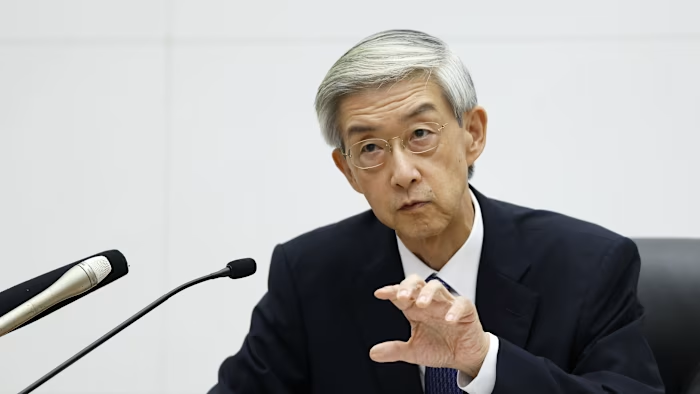
The comments made on Thursday by Kazuyuki Masu, who sits on the BoJ’s Monetary Policy Committee, come ahead of a meeting next week when the bank is widely expected to raise rates to their highest level in more than 30 years.
Japan has come under US pressure to raise rates and strengthen the yen, which tumbled to a 40-year low this year. Bessent said on Tuesday that he had “pretty good insight into what the Bank of Japan is going to do”.
In a speech to Japanese business leaders in Fukui, Masu said the BoJ “might inevitably need to implement a rapid policy interest rate hike” if inflation accelerated.
“To complete the normalization of monetary policy in Japan, I am convinced that the Bank needs to raise the policy interest rate further,” Masu added. “What is most vital from now on is to ensure that the underlying inflation rate does not significantly exceed 2 per cent.”
Market participants overwhelmingly expect the BoJ to raise its policy rate by 0.25 percentage points to 1.25 per cent next week, as it continues to “normalise” monetary policy following decades of deflation and negative rates. The bank last raised rates in June to around 1 per cent, its highest level in 31 years.
Masu said Japan’s negative real interest rates “should be addressed as soon as possible”, with the country no longer in deflation.
Bessent’s claim that he had “asymmetric information” about Japanese monetary policymakers’ intentions has increased expectations for a rate increase.
In July and August, the US assisted Japan in a $96bn currency intervention, the first such joint action in almost three decades. Analysts said the move was partly aimed at keeping Japan from selling US government bonds to support the yen.
As Japanese inflation remains elevated and the US piles pressure on the BoJ to act more assertively, speculation is mounting that the bank might consider a larger rate increase or that it will signal the possibility of another increase when it meets again in October.
Since the US-Japan intervention, the yen has strengthened significantly and is trading at a six-month high of ¥153.30 to the US dollar, having been as weak as almost ¥164 in July.
The yield on 10-year Japanese government bonds has also surged above 3 per cent, a three-decade high, as part of a global bond market sell-off. Bond yields move inversely to prices.
The yen was flat at ¥153.45 on Thursday following Masu’s speech.
Masu, who was considered a centrist when he joined the BoJ’s board last year from trading house Mitsubishi Corp, had “been less outspoken” than his more hawkish colleagues, said Stefan Angrick, head of Asia-Pacific economics at Moody’s.
But he has turned increasingly outspoken alongside a general shift in tone at the central bank.
“This speech is another sign they are heading to a rate hike,” said Angrick. He said he expected the BoJ “to accelerate the pace of hiking to every three months”, rather than push for a bigger increase next week. “The BoJ changes slowly.”
