


Unlock the Editor’s Digest for free
Roula Khalaf, Editor of the FT, selects her favourite stories in this weekly newsletter.
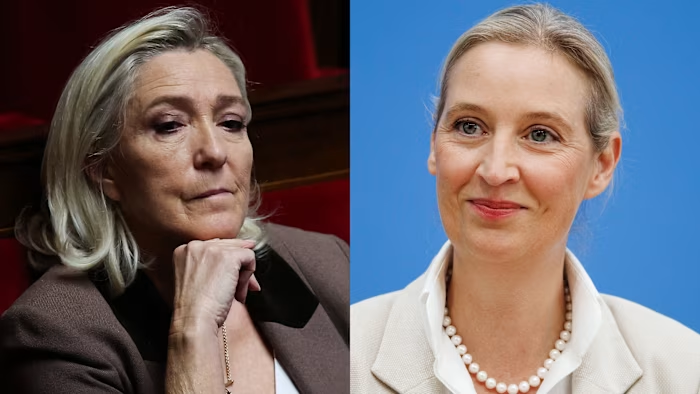
As plaudits from Donald Trump and his Maga movement rolled in for the far-right Alternative for Germany’s recent win in regional elections, France’s Marine Le Pen was notably silent.
Rather than celebrate a breakthrough by a party with similar views on immigration and national identity, the French far-right leader sent allies on to the airwaves to stress that her Rassemblement National was not the AfD.
Jean-Philippe Tanguy, a senior RN lawmaker, sought to strike a balance between repudiating AfD for condoning Germany’s Nazi past while seeking not to stigmatise its voters who swept them to a historic election victory in the eastern state of Saxony-Anhalt.
“It shocks me because they voted for people who downplay Germany’s Nazi past, who argue that you could be in the SS without being a bad person. It’s outrageous,” he told BFM on Tuesday.
But voters did not back the AfD “because they themselves are Nazis”, he added, they did so because “they can no longer afford to pay their electricity bills”.
By contrast the US president on Tuesday night wrote on his Truth Social platform: “Wow! The Populist Party in Germany just had a really big night. They finally got tired of the absolutely horrible Immigration rules and regulations which have hurt Germany so badly. THEY ARE ON THE RISE, and not going to take it anymore! MGGA [Make Germany Great Again]!!!”
Le Pen, who is leading in opinion polls ahead of the April presidential election, has distanced herself from the AfD because her central campaign strategy rests on persuading voters that the RN is a political force that can be trusted with power.
Although it still presents itself as an “anti-system” party bent on removing entrenched elites from government, the RN has softened some of its positions, notably on the EU. It no longer calls for France to leave the bloc or the euro, arguing instead that they should be transformed from within.
The AfD has taken the opposite bet: that its radical stance on leaving the EU, migration, Russia and the country’s history is the route to broader support.
The RN officially broke with the AfD just before the European elections in 2024 after the German party’s lead candidate Maximilian Krah alleged that members of the Nazi SS were “not all criminals”.
Before that they were allies in the European parliament from 2019, when the RN and AfD were founding members of the Identity and Democracy (ID) group.
Another factor in the split was a media report that AfD lawmakers and officials had attended a secret meeting with Martin Sellner, an Austrian far-right ideologue, to discuss plans for mass deportations under the euphemism of “remigration”. The idea was later taken up by Trump and his Maga movement.
Within the RN, deporting citizens with foreign backgrounds was seen as too extreme, with party officials privately saying they would be mad to remain tied to the AfD.
After the EU election, which the RN won handily in France, the two parties went their separate ways to sit in two rival EU parliament groups. Germany’s domestic intelligence service labelled the AfD as “rightwing extremist” in May 2025 — potentially paving the way for a ban.
Le Pen has spent more than a decade trying to “detoxify” the French far right, first by ousting her father, Jean-Marie Le Pen — who was convicted of hate speech for downplaying the Holocaust — from the party he founded, and later by shedding its old name, Front National.
Over time Le Pen has successfully broadened the party’s electoral appeal, building a solid base that now hovers around 30 per cent, according to polls of first-round voting intentions for the presidential race.
The RN leadership has sought to clean out the ranks, yet incidents have repeatedly surfaced of members or candidates making xenophobic or racist comments. On Wednesday, the RN expelled a police officer from Carcassonne, who was also a volunteer member of its security team, after a video was revealed of him using racist and misogynist slurs while on patrol.
Gilles Gressani, political analyst at Grand Continent journal, saw in the different strategies of the RN and AfD a broader lesson about the splintering of far-right movements as they rise in popularity. The “global national-populist wave” is splitting into “two very different forms”, he told France Inter.
On one side are “far-right forces that are coming to power, or trying to come to power, through ambiguity — essentially playing the system, pursuing normalisation and institutionalisation.” On the other are “forces that are more reactionary”, as in the US under Donald Trump or the AfD in Germany.
Sébastien Chenu, a senior RN lawmaker, presented the party’s path to the Élysée Palace as part of a broader rise in nationalist movements, while drawing a careful parallel with the AfD’s success.
“We are not allied with them, their statements from some of their leaders are unacceptable,” he said. “But there is a parallel here: wherever you sow despair, wherever you harm your people, wherever you erase their identities, you open the door to being thrown out.”
