


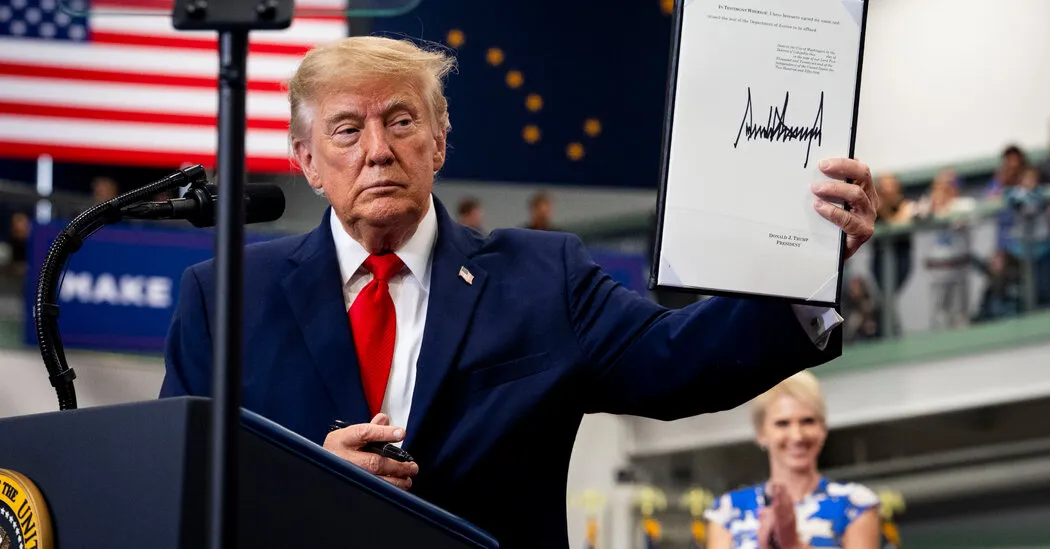
The Justice Department is sharply intensifying efforts to intervene in the midterm elections, goaded by a president unfettered by even the limited restraints of his first term.
The next several weeks represent a critical moment for federal law enforcement, a test of whether a department repurposed by President Trump as an instrument of unmediated executive power will be effectively mobilized as a guarantor of his political power.
In recent weeks, the department has taken several new steps, including an extraordinary effort to invalidate any potential Democratic victory in the Alaska Senate race, that reflect Mr. Trump’s growing agitation as his party faces the possibility of losing control of Congress precipitated by his sagging popularity.
On Thursday, the department asked a federal court to block certification of the election if the incumbent, Senator Dan S. Sullivan, were to lose narrowly, claiming that the presence of another candidate with a nearly identical full name tainted the election. The move, the first of its kind in generations, came in response to the president’s rants about the issue, officials said.
Hours after the papers were filed, Mr. Trump abandoned any pretext that department officials had acted without his say-so, telling reporters, “I’m the one that said do it.”
Mr. Trump has grown increasingly agitated about the dueling Sullivans, among other election-related grievances. He has demanded the department take legal action, even as some department officials raised concerns about the merits and constitutionality of the case, according to two people with knowledge of the situation, speaking on the condition of anonymity to avoid retribution.
The episode comes amid the department’s widening push to exclude large batches of mail-in votes on suspicion that some had been cast by noncitizens, despite evidence that such voting is exceedingly rare. At the same time, Attorney General Todd Blanche has abandoned departmental norms by promoting prosecutions and investigations of politicians, mostly Democrats, within 60 days of the election.
Late Friday, the department escalated the fight, sending letters to local election officials across California demanding that they help identify potential noncitizens on their voter rolls and set aside their ballots. The letters came with a threat. Those who failed to comply would “risk significant federal scrutiny.”
All of this has administration critics, and even some in the department, asking: Just how far are Justice Department leaders willing to go?
“The department is taking commands from the president and throwing spaghetti at the wall to file meritless lawsuits,” said Vanita Gupta, the No. 3 official at the department under President Joseph R. Biden Jr. “The ultimate goal is undermining faith in the election, intimidating voters and discrediting results the administration doesn’t like.”
It is by no means certain that any of these legal actions will ultimately succeed. But election officials from both parties have expressed concerns that it represents a dangerous effort to discredit functional election systems administered by the states.
Democrats on the Senate Intelligence Committee have grown increasingly worried that Mr. Trump may claim foreign interference in the election as a reason to seize voting machines, citing Mr. Trump’s dubious claims in a speech over the summer.
Over the past year, the department’s civil rights division, under an outspoken Trump ally, Harmeet Dhillon, has undertaken a series of actions intended to demonstrate they would aggressively pursue his agenda. This included an unsuccessful legal effort to obtain sensitive state voter data and dispatching 1,000 federal monitors to oversee elections, all the while sowing broader doubts about election integrity.
This has apparently not been enough for Mr. Trump, who has become increasingly impatient. He was especially fired up after a meeting in the Oval Office this month with election deniers, including Tina Peters, a former Colorado election official who was imprisoned for her role in a security breach of election systems before obtaining a pardon, two people with knowledge of the meeting said.
Lauren Bis, a White House spokeswoman, said in a statement that Mr. Trump “has done more than any other President to ensure our country has free and fair elections” and that “the Trump administration has been clear that anyone who illegally votes in our elections will be held accountable.”
Responsibility for executing this agenda has fallen to Mr. Blanche, who espoused a maximalist vision of executive power as Mr. Trump’s lead defense lawyer. He has charted a course of calibrated ambiguity when asked about the election, issuing words of reassurance even while plowing ahead with the new lawsuits.
Mr. Blanche has maintained that he will be guided by evidence, citing federal statutes that prohibit illegal voting by immigrants and others that require retention of records by state and local elections officials.
He defended the department’s actions in a statement to The New York Times, saying the suit relied “solely on federal law” and was not intended to benefit any candidate or party.
“The Department of Justice does not seek to stop any ballot from being cast or to stop the certification of Alaska’s election,” he wrote. “This litigation seeks to ensure that after Alaskans cast their ballots, they are preserved in a manner so that only Alaska’s governing officials have the information necessary to make a determination as to whether Alaskan voters were confused or misled.”
Days before one of his deputies filed the Alaska suit, Mr. Blanche cast the department’s recent lawsuits as a good-government effort and dismissed the likelihood of a department effort to block certification of the results in any given state as a “doomsday scenario.”
Yet Mr. Blanche’s presence atop the department is itself significant. While he has pushed back on some White House directives, he is operating at the pleasure of a president who will not tolerate the institutional guardrails that existed in his first term and personally steered the department’s legal campaign to punish his perceived enemies.
And he has made it clear that he believes Mr. Trump has the right to dictate department actions against the advice of officials, including himself, provided the president is not violating laws or the Constitution. In a recent interview, he claimed there was a “misperception that there’s this separation and independence between the Department of Justice and the White House,” and said he worked for Mr. Trump.
Many of Mr. Blanche’s predecessors pushed back harder. An antagonist of the first term, in Mr. Trump’s view, was former Attorney General William P. Barr, who refused to deploy the vast powers of federal law enforcement to pursue fabricated claims about a rigged election after the 2020 race.
Mr. Barr quit in December 2020 after publicly dismissing the baseless claims of election fraud that have animated the department in Mr. Trump’s second term.
“There’s a growing tendency to use the criminal justice system as sort of a default fix-all, and people don’t like something they want the Department of Justice to come in and investigate,” he said at the time, referring to the president and his allies.
The president has never forgiven him. At an event at the White House in late 2025, he stunned a gathering of federal prosecutors in a vulgarity-laced tirade against Mr. Barr, according to two attendees, speaking on the condition of anonymity to disclose details of a meeting intended to remain private.
Mr. Trump’s cardinal rule in staffing up his second-term Justice Department, according to current and former officials: no more Bill Barrs.
The White House has found two particularly cooperative partners in Mr. Blanche’s top two deputies, Trent McCotter and Stanley Woodward. Mr. McCotter who has worked in the past with Stephen Miller, the president’s top domestic policy aide, the official pushing the department to crack down on alleged voting by unauthorized immigrants, those people said.
Both are in frequent contact with top West Wing officials, as many of their predecessors have been, often through the White House Counsel’s Office.
Mr. Woodward’s name was affixed to the lawsuit in Alaska federal court seeking to block certification of the coming Senate election in the state. At times, Mr. Woodward’s name on a legal filing indicates that subordinates were unwilling to do so themselves, former officials said.
Legal experts are dubious about the prospects of the Alaska suit succeeding. One described it as “one of the weakest election lawsuits I’ve ever seen.”
The only known effort by the Justice Department to preemptively block certification came nearly six decades ago, in a very different time and place. In 1968, the department sought to block an election by the Barbour County Democratic Committee in Alabama because white members changed the rules to exclude Black candidates who had been denied their voting rights in the Jim Crow South.
Earlier this month, Mr. McCotter — who helped draft the $1.8 billion “anti-weaponization” fund proposal so toxic it imperiled Mr. Blanche’s nomination as attorney general — was the signatory on a suit seeking to block the counting of 20,000 mail-in ballots in California. It claimed, without providing detailed evidence, that many were not U.S. citizens.
One name conspicuously absent from both suits: Ms. Dhillon, whose staff would typically be responsible for overseeing election integrity cases. It was not clear why Ms. Dhillon was not listed on the lawsuit.
Ms. Dhillon, appearing in an interview on “60 Minutes” in the past week, downplayed the possibility that the department would interfere with the election.
“I can tell you that absent some shocking contingency that is unexpected, there should be no interruption in the usual course of counting and certifying the results in the states,” she said.
She went on to dismiss the proposal of deploying agents from Immigration and Customs Enforcement at polling places, even though Mr. Trump told a reporter this month that he had not yet made up his mind.
“Is the administration planning to send ICE agents out to the polling places?” asked the correspondent Lesley Stahl.
“There is no plan to do that,” Ms. Dhillon replied.
Her response was noted in the White House, which had enlisted Ms. Dhillon to appear on the show in the first place.
Mr. Trump watched the interview and was upset that Ms. Dhillon underplayed the threat posed by illegal voting and let other administration officials know about it, according to two people with knowledge of the situation.
