

Close Menu
NCIJ Network NCIJ Network
    What's Hot

    Google DeepMind Releases Gemini 3.8 Flash and Gemini 3.8 Flash Cyber: One Core Model, Two Access Envelopes

    September 2, 2026

    Rockwell Automation Patches Over a Dozen Vulnerabilities Across Products

    September 2, 2026

    New Jersey Officials Petition US Supreme Court over Prediction Markets

    September 2, 2026
    Facebook X (Twitter) Instagram
    Trending
    • Google DeepMind Releases Gemini 3.8 Flash and Gemini 3.8 Flash Cyber: One Core Model, Two Access Envelopes
    • Rockwell Automation Patches Over a Dozen Vulnerabilities Across Products
    • New Jersey Officials Petition US Supreme Court over Prediction Markets
    • Interstellar solar sails hit a strange problem at 75% of light speed
    • Why Montana Firefighters Are Intentionally Burning Areas Around Two Wildfires
    • Milwaukee limits Flock cameras, leaving other license plate reader rules unclear
    • The Guardian view on Kemi Badenoch and the economy: a plan stuck in the Tory comfort zone | Editorial
    • What to know about EPA approving pesticide trifludimoxazin
    • About
      • Our Team
      • Editorial Policy
      • Editorial Independence
      • International Support
    • Trust & Standards
      • AI Usage Policy
      • Conflict of Interest Policy
      • Corrections Policy
      • Ethics Policy
      • Fact-Checking Policy
      • Source Protection
    • Get Involved
      • Guide for Sources
      • Support Independent Journalism
    • Legal
      • Cookie Policy
      • Privacy Policy
      • Terms of Use
    Facebook X (Twitter) Instagram
    NCIJ Network NCIJ Network
    Wednesday, September 2
    • Home
    • World
    • Ai
    • Business
    • Politics
    • Health
    • Crypto
    • Science
    • Technology
    • Cybersecurity
    • Defense & Security
    • Economy
    • Energy
    • Europe
    • More
      • Fact Check
      • Investigations
      • Opinion & Analysis
      • Environment
    NCIJ Network NCIJ Network
    Home»Science

    Interstellar solar sails hit a strange problem at 75% of light speed

    NCIJ NETWNCIJ NETWORKBy NCIJ NETWNCIJ NETWORKSeptember 2, 2026 Science No Comments4 Mins Read
    Share
    Facebook Twitter LinkedIn Pinterest Email

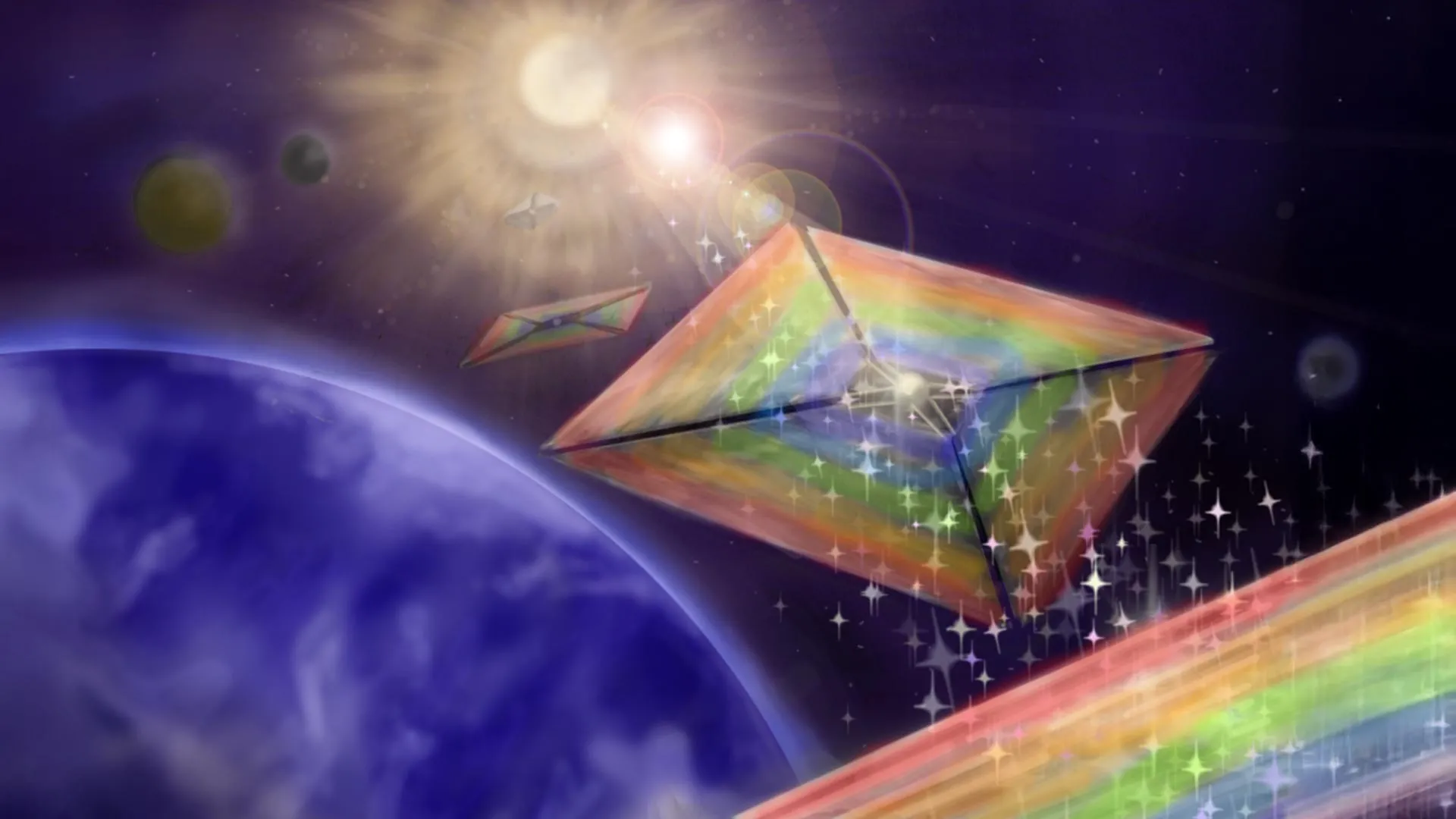
    Reaching another star within a practical amount of time will require something far more capable than chemical rockets. One of the leading ideas is a solar sail, a large reflective structure that can be pushed by light. If extremely powerful lasers are aimed at such a sail, they could accelerate it to speeds well beyond what current propulsion systems can achieve.

    But there may be an unexpected problem once a lightsail begins traveling at a significant fraction of the speed of light. According to a new paper on arXiv by Chao Shen and Jiaze Li of the Harbin Institute of Technology, the same light used to propel the sail could eventually produce a drag effect.

    How Light Pushes a Solar Sail

    The researchers separate the forces produced by photons striking a solar sail into three categories.

    The strongest contribution comes from incident light (that raw momentum of the photons hitting the sail). Next is specular reflection (momentum imparted when photons bounce perfectly off the sail). The weakest contribution comes from diffuse scattering (momentum from photons that are absorbed by the sail then reemitted in random directions).

    At relatively low speeds, these effects all contribute to pushing the sail forward. The situation becomes much more complicated once the spacecraft reaches relativistic velocities.

    The Doppler Effect Weakens the Push

    As the sail races away from the laser source, the light reaching it undergoes an increasingly strong Doppler shift. The frequency of the incoming light decreases, reducing the amount of thrust produced by all three components.

    As a result, continued acceleration becomes progressively less efficient. The faster the sail travels, the harder it becomes for the laser to keep increasing its speed.

    The situation changes even more dramatically once the lightsail reaches about 75% of the speed of light.

    When Scattered Light Starts Creating Drag

    At that speed, relativistic light aberration becomes important. From the viewpoint of a stationary observer on Earth, diffusely scattered light begins to be directed forward, toward the direction in which the sail is traveling.

    Because every action has an equal and opposite reaction, that forward-directed radiation produces a force in the opposite direction. This means diffuse scattering (admittedly the weakest of the three forces) begins acting as drag once the sail passes roughly 75% of the speed of light.

    The laser is still pushing the sail forward overall, so the total force does not become negative. However, the efficiency of the propulsion system drops substantially.

    Real Solar Sails Would Face Even More Challenges

    The study is focused specifically on radiative dynamics. It does not include nonradiative effects such as collisions and drag from interstellar gas or dust.

    It also leaves out the thermal limits of real sail materials. A sail exposed to an extremely powerful laser could potentially overheat or even melt.

    For simplicity, the researchers model the lightsail as an idealized mirror. Real spacecraft would likely use much more sophisticated materials.

    Engineers are already investigating advanced metamaterials and photonic crystals designed for specific laser wavelengths. In principle, these materials might even take advantage of the aberration effects described in the study. They could help a lightsail automatically correct its orientation and stabilize its trajectory so that it remains centered within the laser beam.

    The Long Road to Interstellar Flight

    A fully operational interstellar solar sail is still far from becoming reality. Traveling across interstellar distances introduces many additional complications, including the curvature of spacetime, which the paper also simplifies out.

    Even so, understanding these high-speed effects is an important part of determining how such spacecraft might eventually work. If humanity someday sends a probe to another star, engineers will need a detailed understanding of every force that could affect its journey.

    hit interstellar light problem sails solar Speed strange
    NCIJ NETWNCIJ NETWORK
    • Website

    Keep Reading

    NASA Rocket Takes First Multi-Point Look Inside Radio-Disrupting Clouds

    Trump’s Speed on the White House Ballroom Threatens to Outpace the Courts

    “Broken heart syndrome” can look just like a heart attack. This test can tell them apart

    Israel ‘organised and prepared’ to remove Gaza population if US gives green light, Katz says

    BTC Will Hit $1M By 2030… But Arthur Hayes Is Buying ETH Instead

    Devastating Floods Hit Nepal as Climate Change Bites

    Add A Comment
    Leave A Reply Cancel Reply

    Editors Picks

    Google DeepMind Releases Gemini 3.8 Flash and Gemini 3.8 Flash Cyber: One Core Model, Two Access Envelopes

    September 2, 2026

    Rockwell Automation Patches Over a Dozen Vulnerabilities Across Products

    September 2, 2026

    New Jersey Officials Petition US Supreme Court over Prediction Markets

    September 2, 2026

    Interstellar solar sails hit a strange problem at 75% of light speed

    September 2, 2026
    Latest Posts

    Australia news live: Reformers member tells hearing he used factional funds to pay for bucks night; Taylor refuses to answer multiple Icac-related questions | Australia news

    July 31, 2026

    Trump administration to end Medicare Part D subsidy program. Will costs increase?

    July 31, 2026

    FP Live: Daniel Yergin on Why Energy Prices Didn’t Soar Higher This Year

    July 31, 2026

    Subscribe to News

    Get the latest sports news from NewsSite about world, sports and politics.

    NCIJ Network is an independent digital news platform delivering trusted investigative journalism, European and global news, in-depth analysis, and fact-based reporting with accuracy, transparency, and integrity.

    Facebook X (Twitter) Instagram Pinterest YouTube

    Google DeepMind Releases Gemini 3.8 Flash and Gemini 3.8 Flash Cyber: One Core Model, Two Access Envelopes

    September 2, 2026

    Rockwell Automation Patches Over a Dozen Vulnerabilities Across Products

    September 2, 2026

    New Jersey Officials Petition US Supreme Court over Prediction Markets

    September 2, 2026

    Subscribe to Updates

    Get the latest creative news from FooBar about art, design and business.

    Type above and press Enter to search. Press Esc to cancel.