


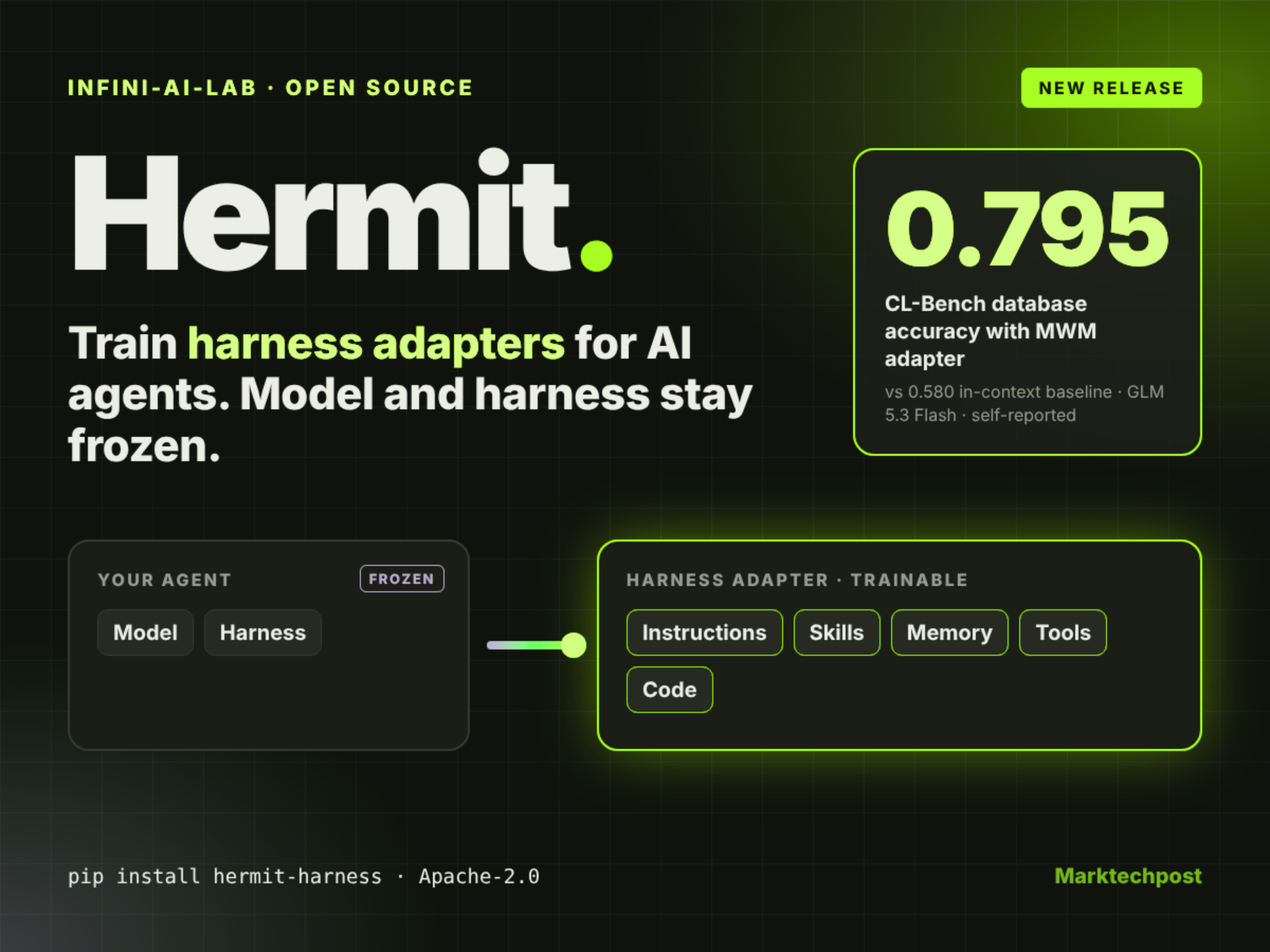
Infini-AI-Lab has released Hermit, an open-source harness adapter framework for AI agents. Hermit is a framework from Infini-AI-Lab that trains an external ‘harness adapter’ while the agent’s model and harness stay frozen. The first release, v0.1.0, shipped on October 25, 2026. CMU postdoc Haizhong Zheng announced it on X on October 27. For developers, the pitch is simple: adapt Codex or Claude Code agents to new tasks without fine-tuning or forking the harness.
TL;DR
- Footprint: A Python framework. No parameters of its own. Apache-2.0,
pip install hermit-harness. - Runs on: The offline Quick Start needs no GPU, model account or dataset. Real runs use any API backend or a local vLLM, SGLang or Ollama server.
- Performance: Reported gains over no-adapter baselines on OfficeQA, CL-Bench and ServeLearnBench, all with GLM 5.3 Flash.
- Best: MWM adapter hits 0.795 accuracy on CL-Bench database exploration, vs 0.580 for the in-context baseline.
- Worst: The prompt-only adapter scores 0.470 on the same venue, below that 0.580 baseline.
- Bottom line: Best: one training loop for 5 harness evolution methods. Worst: most results are single runs, self-reported.
What is a harness adapter?
A harness adapter is a trainable external harness. It works like a plugin with training support built in. A model adapter, such as LoRA, adapts a model. A harness adapter adapts an existing agent instead.
The adapter can hold instructions, skills, memory, tools, executable code and agent coordination logic. It can even be a whole repository. Its specification says which parts are learnable and how updates get checked. The base model and harness never change.
The team gives 3 reasons for this design. Many harnesses are closed-source. Editing open ones can break carefully tuned component interactions. And a learned adapter can move between compatible models and harnesses.
How does Hermit train an adapter?
Hermit uses an RL-style training loop. A Trainer runs a batch of tasks through the acting agent with the current adapter. A judge scores the outputs. An Evolver reads the trajectories and feedback, then proposes a new adapter. The Trainer checks it against the template and commits it as the next version.
Every adapter version lives in a git tree. You can inspect, roll back or ship any version. Learner programs can run sandboxed, which requires Linux with bubblewrap.
Five evolution methods ship today: GEPA, SkillOpt, MetaWorld Model (MWM), Harness² and Continual Harness. ACE and ReHarness are listed as coming soon. You can also write your own Evolver.
