


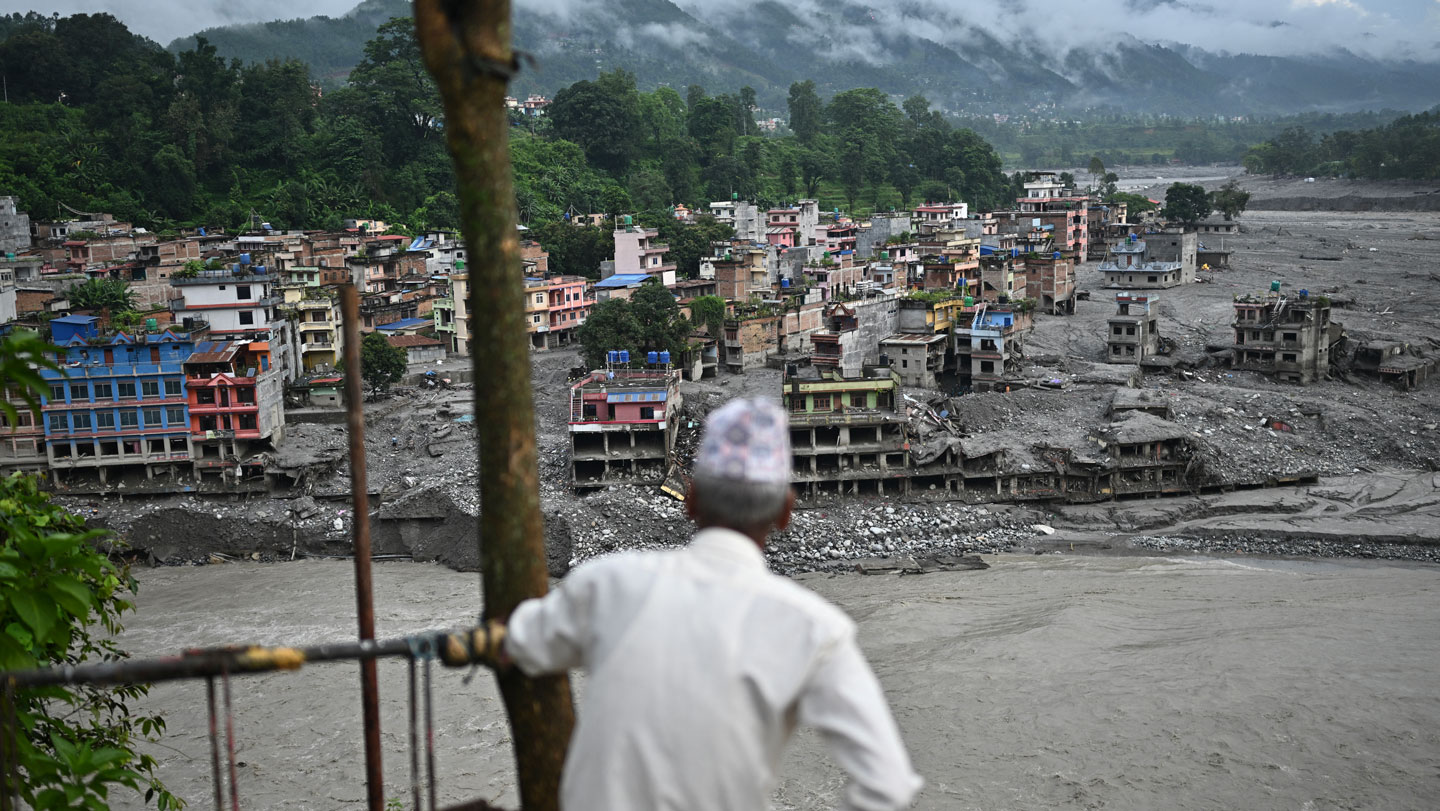
Wednesday, August 26 began as a regular day for Prakash Pyakurel, a 43-year-old shopkeeper in the bustling town of Dhunge Bazaar in the northern belt of Central Nepal. Then sometime around 9:10 a.m. came the muffled crackle of a police loudspeaker. The words were “impossible to hear” over the noise of the town, he says.
Pyakurel took a couple of minutes to piece together that the announcement was calling for evacuation. He lost time closing the shop before sprinting home to alert his parents and daughter. In their living room, just a few hundred meters from the Trishuli River, they spent more vital minutes arguing over whether to head for higher ground.
It was too late. At 9:15 a.m., a towering wall of water and debris surged in, forcing the family to the second floor. Then the third, and finally the fourth. Trapped at the top of their home, they could only pray as the flood obliterated the town around them. “We had lost all hope,” Pyakurel says.
After more than an hour of terror, the Pyakurels narrowly survived. Their “miracle green house,” as it came to be called in videos that went viral on social media, somehow remained standing. Thousands of others in towns along an almost 100-kilometer-stretch of the river weren’t as lucky.
Though the rock-ice avalanche that caused the Himalaya flash flood in late August occurred at 8:37 a.m. local time, many people downriver had only a few minutes of warning or less before the debris flow arrived. The flow destroyed four river gauge sensors before they could signal an alarm. Local authorities who learned of the flow by word of mouth scrambled to send SMS alerts and to reach riverbank towns with handheld megaphones. “The police officer [who made the announcement] was swept away by the floodwaters himself,” Pyakurel says.
The initial avalanche released an energy that equaled an atomic blast, and the resulting debris flow killed at least 1,400 people with more than 5,000 still missing as of September 24. Scientists are calling it one of the most catastrophic geohazards in recorded history.
But despite the magnitude of the event, it didn’t have to be so deadly.
Survivors and scientists say that the fragility of Nepal’s early warning systems and the lack of coordinated community responses probably upped the number of lives lost. The disaster is spurring conversations about how Nepal should prepare for future glacier-related failures. Such events are becoming increasingly common across high mountain regions including the European Alps, Andes, Karakoram and the Himalaya. But because of its high slopes and steep valleys, says Christian Huggel, a geographer at the University of Zürich, “everything is much bigger in the Himalaya.”
The challenges of prediction
Predicting an event like Nepal’s rock-ice avalanche in advance is “likely impossible,” says Ashim Sattar, a cryosphere scientist at the Indian Institute of Technology in Bhubaneswar. Because events of such magnitude are rare, there isn’t a lot of existing data to go on.
Satellite images taken weeks before the avalanche show signs of cracks opening up, but those cracks are nothing special. “There are probably hundreds of cracks opening in the Himalaya,” Huggel says. It’s not clear which cracks pose a serious risk.
Most current glacier monitoring in the Himalaya focuses on the threat of a glacial lake outburst flood, or GLOF. An influx of meltwater is increasing the size of highland lakes, which can suddenly burst and flood downstream villages. A mix of satellite monitoring, which can track the size of lakes, and on-the-ground field stations can warn of such hazards in advance. “If glacial lakes are forming rapidly, scientists can detect that a few weeks before possible outburst,” Huggel says. Even here, though, only 21 of some 40,000 glacial lakes across the Himalaya are actively monitored via on-the-ground stations.
Rock-ice avalanches are harder to predict, largely because it is difficult to study the fracture zone hidden beneath the surface and thus to know what volume of material will break off.
Despite these challenges, scientists have managed some similar avalanche predictions. In May 2025, a massive glacier collapsed in southwestern Switzerland, triggering an ice and rock avalanche that destroyed the village of Blatten. The possibility of the avalanche, which ended up being a tenth the size or smaller of the Nepal avalanche, was recognized by a local hazard observer who was assigned to monitor the mountains and knew them well.
“He observed something strange as the mountain seemed to move and alerted the local and district authorities,” Huggel says. They brought in various sensors and monitoring systems to measure the movement of the slope and executed a quick evacuation around a week in advance of the failure, saving hundreds of lives.
Whether similar local hazard observers could have spotted a potential disaster in Nepal and called on the necessary resources for early evaluation is far from clear. The terrain is difficult to access, and its location near the border between Nepal and China adds a layer of political complexity. “Monitoring these slopes is nobody’s job,” says Kshitij Dahal, a hydrologist at the University of Kansas in Lawrence who is originally from Nepal. Most of the monitoring in Nepal is reactive rather than anticipatory, he adds.
Are early warnings possible?
Without the ability to predict such catastrophes, early warning systems are the primary line of defense. In the Himalaya, river gauge sensors are commonly deployed to warn of coming floods. These sensors monitor the water level in the river and send out an alarm if there is a substantial rise.
But these sensors, including the ones installed in Trishuli River, are primarily used for monsoon season flooding, when the water level tends to increase gradually. They transmit flood data every 10 minutes. Nepal’s flood hit with such sudden intensity that sensors located between nine and 100 kilometers from the avalanche site were wiped out before they could report high water.

Other technologies are available or in development. Early warning systems that rely on seismometers might offer a workable solution. After Nepal’s massive earthquake in 2015, Basanta Raj Adhikari, an engineering geologist at the Tribhuvan University in Kathmandu, Nepal, and his team installed six seismometers along Bhotekoshi River in a nearby valley of Central Nepal.
Placed a couple of kilometers above the riverbank, the sensors were intended to assess how long it took for the landscape to become stable again after such a major geological event. In July 2016, when a glacial lake in Tibet burst open, the resulting flood destroyed hydropower stations, highways and buildings — and produced distinct seismic signals picked up by those Bhotekoshi River sensors. Adhikari thinks that if such systems are set up to operate in real-time, they could detect and warn of floods in advance.
Researchers studying seismic signals after historic and deadly flooding in western Germany’s Ahr Valley in 2021 also determined that seismic monitoring could have provided an early warning. The signals revealed details about the likely height of the water, the velocity of the sediment, the spread of the flood and the types of debris. Inexpensive seismic stations can cost somewhere around a couple thousand dollars, the researchers say, with some citizen-science seismographs available for costs below $500.
Putting eyes on the landscape is another approach. Ólafur Stitelmann, a geomonitoring expert at the Zürich-based company Geoprevent, deploys tools that can scan and monitor glaciers for deformations of millimeters per day or per hour. Some of these tools, including interferometric radars, camera systems and satellite-based navigation sensors, were used to assess the ice before the Blatten collapse, and they could form the basis of early warning systems.
Stitelmann’s team is now working to deploy high-resolution cameras, weather stations, lake level sensors and water temperature sensors at two sites at risk from GLOFs in the state of Sikkim, India. Once a day, the data is sent via satellite to local authorities who can analyze conditions and take timely action if needed.
Yet early warning systems are far from plug-and-play solutions, and they are too costly to deploy en masse. What works in the Alps may not automatically work in the Himalaya, in part because these systems need to be integrated into the local infrastructure. “If you have very good sensors but suddenly don’t have power to turn it on, then it’s worthless,” Stitelmann says. Similarly, there needs to be a network available to transmit the data that can trigger the warning. And every step needs to have backups, he adds.
It is important to have more than one sensor, says Huggel, who would complement any seismic stations with wire-based sensors stretching across the river. Installing backup sensors at different elevations could also buy crucial time if primary riverbank stations are wiped out.
Such dream systems are expensive, ranging from tens of thousands of dollars to costs in the millions for a multi-sensor set of stations when the necessary infrastructure and backups are included, Stitelmann says. When the World Bank financed the setup of an early warning system downstream of a glacier lake, Tsho Rolpa in Nepal, in 1998, the cost was over a million dollars.
In the case of Nepal, officials are discussing some relatively simple steps. One is putting backup sensors on the cliffs, since systems on bridges were quickly wiped out. Another is changing the design of river gauges so they transmit data once the water reaches a threshold level, rather than after a 10-minute interval.
Community awareness
Even if the technology works perfectly, there are social aspects to consider, including who decides when an alarm is issued, what message is delivered and how, and who coordinates evacuation. False warnings are also a problem, because people who have received them before may not trust that the next warning is genuine. “Technologies alone are no magical solutions,” Stitelmann says.
After GLOF events in the village of Lunana in Bhutan in 2019 and 2023, Sattar and his team interviewed residents about the community response. Although an automated siren had been installed in the region, it wasn’t triggered in either case. Locals instead relied on environmental cues including the sound of the river, ground vibrations and phone calls from friends and family to evacuate.
Locals also reported being aware of the potential danger because of past flooding and ongoing government outreach. Sattar’s team also learned that disaster response could have been improved if the community had regular mock drills and if families prepacked evacuation bags with medicines, food, lights and warm clothes in case of an emergency.
In Nepal, many people probably lost their lives because of confusion and lack of awareness, says Pyakurel, the Dhunge Bazaar shopkeeper. For most, it was the biggest flood that they would have encountered in their lifetime. In July 2025, a glacial lake in Tibet burst open, leaving nine dead and 20 missing in Nepal, but it didn’t affect this area as dramatically. “Last year’s flood barely touched the bridge, so [we] assumed this flood wouldn’t reach high ground,” he adds.
The disaster highlights the need for better education about the potential dangers and preparation so people can act quickly, says Sattar.
Stories of survival also offer insights into what matters most in an emergency. On the morning of August 26, Rajendra Dawadi, a principal at the Tribhuvan Trishuli Secondary School, received a verbal warning from another school staffer about rising waters upstream. Even without official confirmation, he acted instantly. He asked to ring the school bell, instructed teachers to evacuate classrooms, and called drivers carrying buses with students to head to higher ground — saving more than 900 students.
It wasn’t a sophisticated system that made the difference in this case, but a quick decision to evacuate. “I thought that even if the warning turned out to be wrong, the worst it would cost us was one day of study,” Dawadi told the New York Times. “But taking it lightly could mean the loss of hundreds of lives.”
