


- Avocados are grown year-round in the southwestern Mexican state of Michoacán, which exports more than 1 million metric tons of avocados annually.
- A recent study in Michoacán found that between 2001 and 2018, soils with high avocado productivity lost 38 liters per cubic meter of water annually.
- Illegal logging of high-altitude forests to accommodate new avocado plantations simultaneously depletes the aquifer, as avocado trees consume 4-5 times more water than native pines.
- If the trend continues, Michoacán’s avocado-growing areas are expected to suffer increased water stress in the short term, negatively affecting both agricultural production and drinking water access in the region.
MEXICO CITY — In the heart of Mexico’s southwestern state of Michoacán, Juan Madrigal spends his free time organizing to protect the city of Uruapan’s urban ecological park, a 50-hectare (124-acre) plot of land at the edge of the Río Santa Bárbara. A state-protected area since 1995, the park’s marshlands help to purify the surrounding Cupatitzio watershed, where nine natural springs provide drinking water to approximately half a million people.
According to Madrigal, the park, a habitat of the ruddy-capped nightingale-thrush (Catharus frantzii), the endangered Michoacán pocket gopher (Zygogeomys trichopus) and the endemic Pátzcuaro frog (Lithobates dunni), is a victim of neglect. “The authorities have never paid any attention to it, and it’s us citizens who’ve been speaking out,” Madrigal, who in 1993 founded Ecocentro del Río Cupatitzio, a nonprofit educational center, tells Mongabay by phone.
The movement to protect the park gained momentum after it involved the ranchers that grow fruit and corn downstream, Madrigal says. “They realized the importance of us supporting each other in defending the vital sources of life,” he says. “Without trees, there is no water.” For a certain type of tree, however, the inverse occurs: Without water, there are no avocados.
Defending native forests, urban or otherwise, is a small but important fight in Michoacán, where avocado orchards have replaced nearly 700,000 hectares (1.7 million acres) of tree cover, an area almost three times the size of Cape Town, between 1993 and 2023. Michoacán is the top avocado exporter in Mexico and the only place in the world where the fruit is grown year-round.
The rush to grow avocados was, in part, motivated by the opening of the U.S. export market for Hass avocados, the most common variety of commercially grown avocados, in 1997. It has led to the expansion of organized crime in Michoacán and neighboring Jalisco and, more recently, heightened conflicts over water.
“The avocado growers are claiming the aquifers as their own,” Madrigal says. As a result of increased water demand, scientists say the ground in Michoacán is starting to dry up and that Michoacán’s native temperate forests and surrounding communities will face greater hydrological stress as global demand for avocados continues to increase. Mexico’s avocado exports are forecast to triple by 2030, while rainfall in Michoacán, according to USDA, could decrease by up to 15% in the coming three decades owing to climate change.
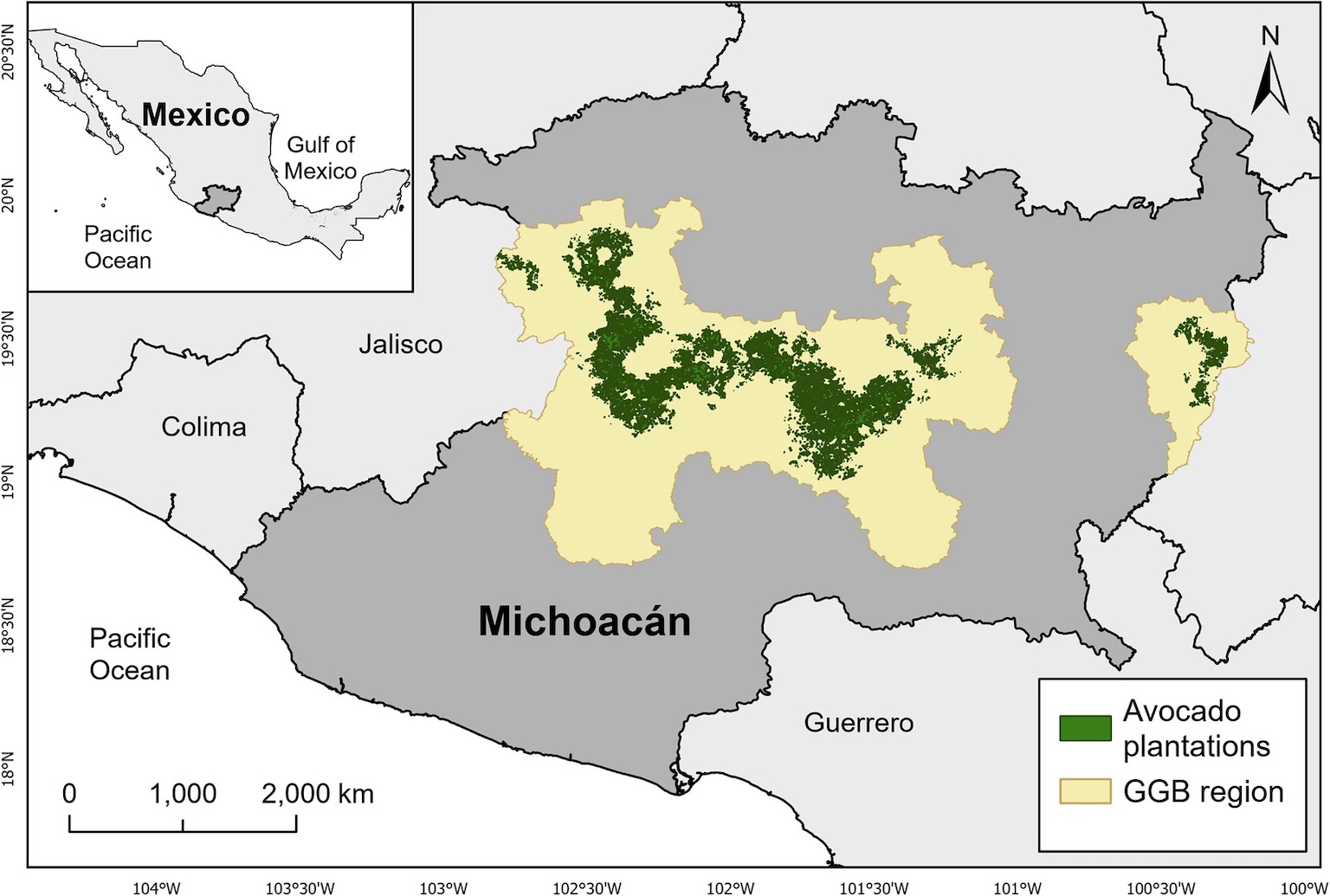
Every year between 2001 and 2018, moisture in soils with high avocado productivity dropped at an annual rate of about 38 liters (10 gallons) per cubic meter (35 cubic feet), according to a study that looked at Michoacán’s “green gold belt”, the area with the largest industrial production of avocado in the world. The study published in March finds that about 50% of the region was at high risk of losing soil moisture.
With a fine, shallow root structure, avocado trees growing in hot climates require around 45 l (12 gal) of water per day in spring, 136 to 220 l (36 to 58 gal) per day during summer and 121 l (32 gal) perday in autumn. To prepare for Michoacán’s six-month annual dry season, major producers collect rainwater for irrigation in hoyas or human-made ponds. In 2024, a significant drought year in Mexico, the mayor of Pátzcuaro, a town in central Michoacán, claimed there were some 800 illegal and unauthorized water collection points surrounding the Pátzcuaro lakebed, and an estimated 4,000 avocado “ponds” statewide.
Between 2001 and 2018, land within the GGB lost a total of 68.4 billion liters of topsoil moisture, researchers found. This means that under current conditions, each year about 110,000 people are losing access to the optimal daily quantity of water, said Alma Vázquez-Lule, study co-author and a researcher at the National Autonomous University of Mexico (UNAM). “When you break it down to the number of people who are potentially affected or who would potentially benefit from this water, it’s not a trivial matter,” Vázquez-Lule said. “That’s 2.3% of the state’s population (4.7 million) each year.” The number of people who are losing water access is even higher if you reduce daily water intake from 100 liters to 20 liters (basic access as defined by the World Health Organization). Using this metric, the study’s authors estimate that over 17 years, at least half a million people (approximately 11.3% of the state’s population) are suffering the consequences of topsoil moisture loss each year.
“For us, the avocado, far from becoming a source of strength, has turned into a plague. Its cultivation is a direct threat to the very existence of the forest,” says Arturo Chacón Torres, a limnologist at the University of Michoacán, who independently reviewed and supported the results of the study. According to Chacón Torres, the oyamel fir (Abies religiosa) population has severely declined in Michoacán’s highlands owing to droughts in 2023 and 2024. As avocado growers face lower soil moisture, they are moving their orchards onto steeper slopes. The problem is compounded by the unregulated avocado ponds in previously forested areas, Chacón Torres says, “You can imagine the thousands or millions of cubic meters that are being stored and that are preventing the water from reaching the ravines, the rivers and the lakes.”

Deforestation in the region, which destroyed 20,000 hectares (49,400 acres) of native tree cover between 2018 and 2025, also causes groundwater to evaporate more quickly. “When you remove the layer of leaf litter, it’s easier for moisture to be lost from the soil,” Vázquez-Lule says. “You affect soil bacterial communities; you affect soil respiration processes; you change the entire water cycle.”
In the past four decades, Michoacán’s Lake Pátzcuaro and Lake Cuitzeo, both important sanctuaries for migratory birds and home to endemic amphibians such as the achoque or the Lake Pátzcuaro salamander (Ambystoma dumerilii), have halved in size.
On May 5, the Supreme Indigenous Council of Michoacán published a direct notice to the avocado industry, lamenting an “accelerated environmental degradation associated with the expansion of avocado orchards.”
“Eighty communities of the P’urhépecha, Otomí or Hñahñú; Matlazinca or Pirinda; Mazahua; Nahua; and Afro-Mexican peoples are speaking out collectively in the face of the critical situation facing our territories, our forests and our water sources,” the statement reads.
Michoacán’s cash crops, such as avocados, berries and limes, are not the sole culprits of the state’s environmental challenges. Vázquez-Lule notes that the research would greatly benefit from localized soil moisture sensors, as well as current data on climate change and land management. “Michoacán has a complex territorial process, one that goes back a long way,” she says. “Not just from 2001 to 2018, but rather a process of governance, access to resources and many other factors that go beyond the scope of the study.”
In a statement responding to the study, the Agricultural Association of Avocado Producers of Uruapan says the authors are contributing to a narrative that discredits the state’s avocado sector. Among the association’s requests is that future studies “distinguish between historical producers, who had been growing the fruit since before the international market opened [in 1997], and those who joined later” and between different types of orchards, production scales and agricultural practices.
The association also called on the government to stop deforestation and promote more sustainable growing methods. One such initiative is Guardián Forestal (Forest Guardian), a state-sponsored digital platform that monitors satellite imagery to make immediate reports of deforestation. In the two years since it started operating in Michoacán, the system has channeled 1,000 such reports to authorities while simultaneously blocking avocado orchards on deforested land from using certified packing houses to export their avocados. As of January 2026, two industry associations declared that avocados grown on illegally deforested land would no longer be eligible for export. The voluntary Proforest Avocado certification, introduced by Michoacán’s governor in 2024, identifies orchards where no deforestation has occurred since 2018.
Experts say a 2018 threshold could be too recent: Vázquez-Lule showed Mongabay aerial imagery of several sections of the green gold belt that saw obvious land use change starting earlier, in 2011.

Local growers also say the industry hasn’t changed its procedures. Arturo Troyo, who has been growing avocados near Uruapan for 40 years and is a member of the Association of Avocado Producers and Packers of Michoacán, says he has not received training on how to adapt his farming given the threat of water stress.
According to Chacón Torres, the first step would be to regulate production so that avocado cultivation does not take place on slopes. “Those mountainous areas are precisely where water is generated,” he says. “So what needs to be done at the micro level would be to determine the land’s suitability for avocado growing through environmental impact studies and ecological planning. And then it would no longer be an avocado belt; it would be an avocado mosaic.”
Furthermore, producers would ideally have to commit to offset their environmental impacts, for example by planting an area of forest depending on the size of their avocado orchards.
Since Mexico’s last major drought in 2024, it’s taken Troyo’s trees two full years to recover. Occasionally, he gives the smaller tree trunks an “emergency” shower. “It still surprises me,” Troyo says in an interview with Mongabay. “You never used to water avocado orchards.” This year, his trees are full of fruit, but he said it’s the result of all the extra care he gave his 18-hectare (44.5-acre) orchard to survive its worst crisis in decades. “I’ve spent a big part of my life working in this, but different things are happening because of climate change,” he says. For Troyo, Michoacán’s avocado heyday has come and gone.
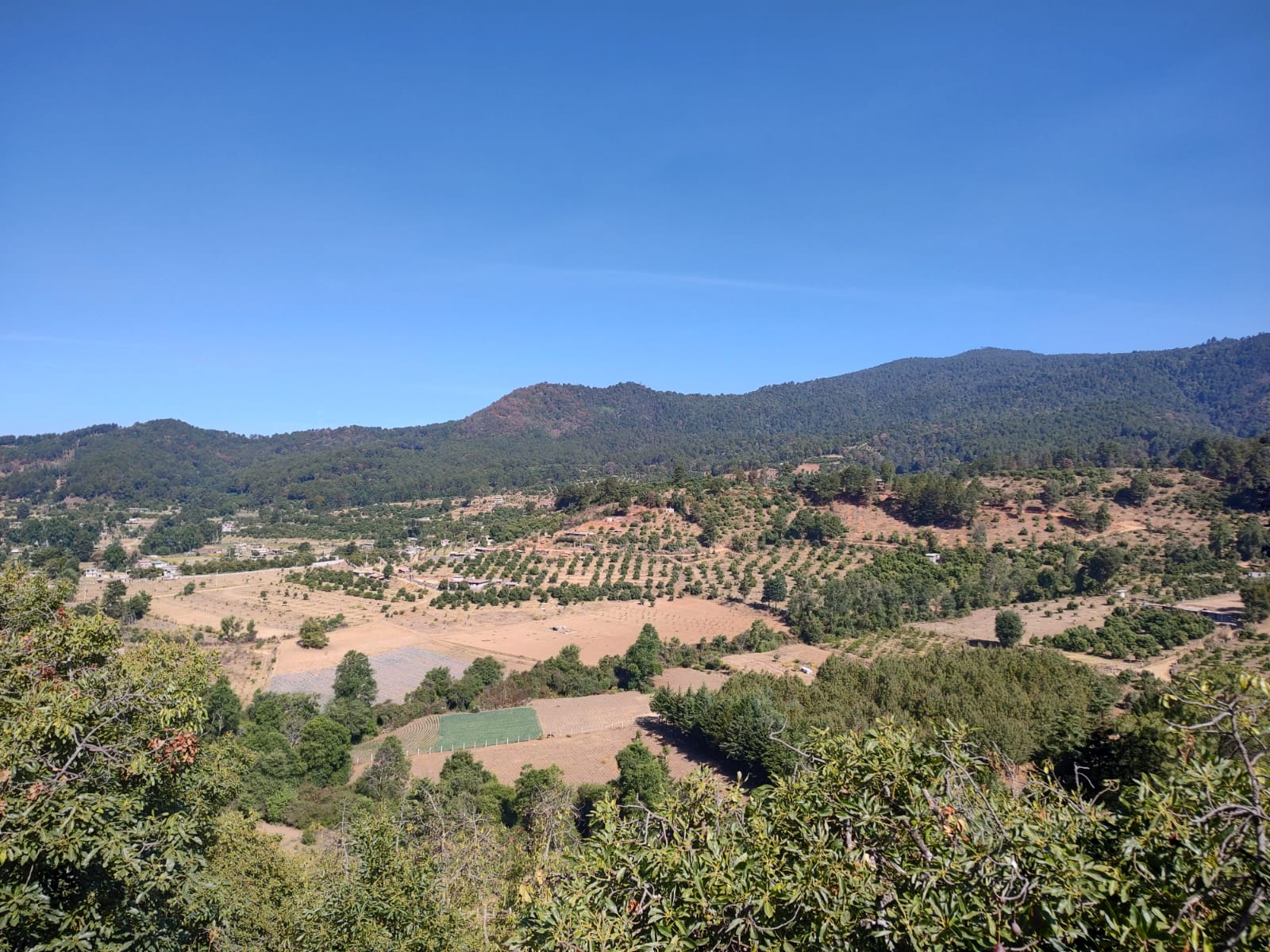
Banner image: Avocado plantations seen from the basin surrounding Lake Zirahuén, Michoacán. Image courtesy of Arturo Chacón.
Citations:
Barreras, A., Gutiérrez, S., Vázquez-Lule, A., Gómez-Tagle, A., Delgado, T., Kolb, M., … Guevara, M. (2026). Soil moisture decline across the avocado “Green gold belt” in central Mexico. npj Sustainable Agriculture, 4(1). doi:10.1038/s44264-026-00138-9
Contreras Figueroa, P. (2025). UN paisaje lacustre cambiante: Urandén Y el desecamiento del Lago de Patzcuaro (1980-2022). Relaciones Estudios de Historia y Sociedad, 46(182). doi:10.24901/rehs.v46i182.1035
FEEDBACK: Use this form to send a message to the author of this post. If you want to post a public comment, you can do that at the bottom of the page.
Cite this article
Caitlin Cooper (2026). In Michoacán, Mexico, drying soil threatens water supplies and avocados, says study. Mongabay Conservation news. DOI: https://doi.org/10.66709/news-324409

