


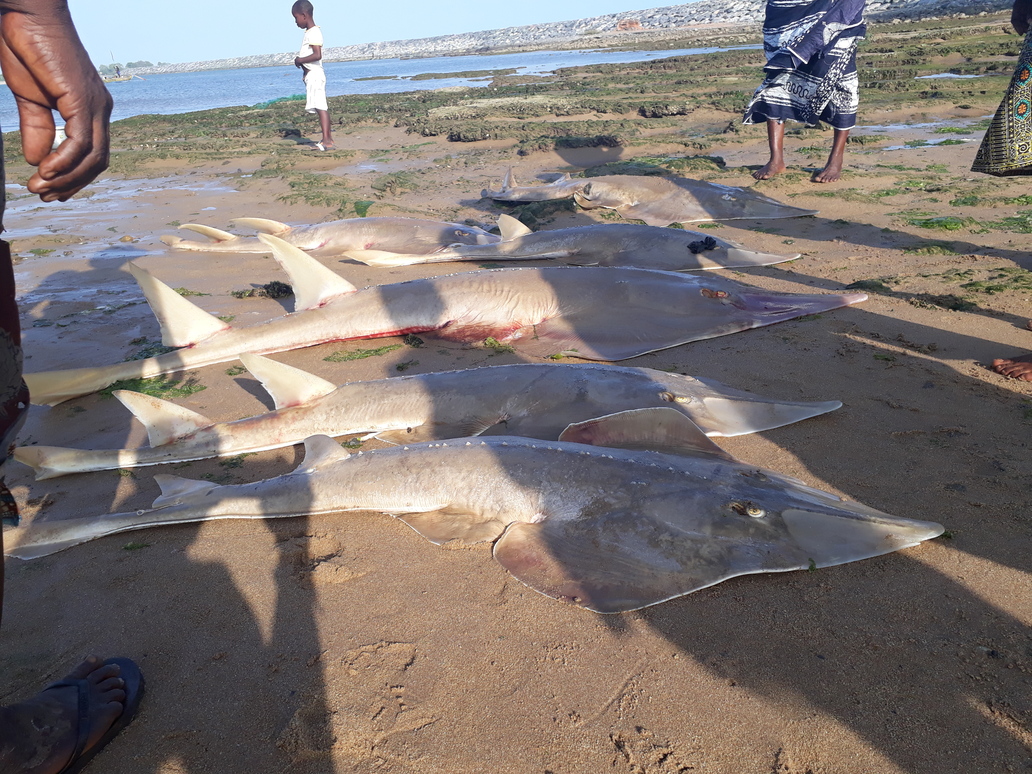
- Fishers from Ghana travel the length of the West African coastline to find the richest fishing grounds, but the availability of this vital source of protein is under threat from a number of sources.
- Declining catches of bony fish like tuna and mackerel have put elasmobranch populations — sharks and rays — under increasing pressure by fishers, who seek them not just to supply local markets for their meat, but to meet lucrative demand for their fins from Asia.
- Sawfish and wedgefish species have now been fished to local extinction in Ghana, and marine biologist Issah Seidu warns guitarfish will be next.
- Earlier this year, Seidu was the recipient of a Whitley Award, which will support the work of his NGO alongside Ghanaian fishing communities to research and protect guitarfish.
Fishers from western and central Ghana are renowned in the region, traveling the length of the West African coastline to cast their nets in the richest fishing grounds. These migrant fishers, relying on beach and purse seining, dry their catch to preserve them for transport to distant markets. Fish is an important dietary component for West Africans, according to Ghanaian marine biologist Issah Seidu, but its availability is under threat.
“There has been a tremendous decline in fish like the tunas, anchovies, mackerel,” he told Mongabay. “And in response, the fishermen have switched gears from the traditional fishing tools to now using gillnet to target these species as their last safety net to support their livelihood.”
As well as bony fish, elasmobranches — like sharks and rays, whose skeletons are made of cartilage — are much sought after. Fifty years ago, sawfish and wedgefish were widely found in shallow water along Ghana’s coast; today, both groups of elasmobranches have been fished to local extinction. Seidu, the founder of a marine conservation NGO called AquaLife, said fishers he’s interviewed for his research say sawfish haven’t been seen in Ghanaian waters since the 1980s, and it’s now been more than eight years since wedgefish were last caught.
He said guitarfish, a group of rays, could be next.
“Guitarfish are at a tipping point,” Seidu told Mongabay in an interview in March, “owing to their lucrative and high-value white fins and the general eagerness of local markets to buy their meat. These threats notwithstanding, little to no data are available to guide conservation decision-makers in Ghana and across West Africa.”

For a journal paper published in 2022, Seidu and his co-authors surveyed landing and market sites, finding the most frequently landed species of guitarfish was the spineback guitarfish (Rhinobatos irvenei) — and more than half of the specimens they saw were not yet sexually mature. Interviews with fishers confirmed that catches of two larger species of guitarfish, blackchin (Glaucostegus cemiculus) and common guitarfish (Rhinobatos rhinobatos), had collapsed by up to 90% by their reckoning. Worryingly, the fishers also said catches of the smaller related species had also fallen by as much as half.
According to Stephen Kankam, deputy director of Hen Mpoano, another conservation organization working to protect Ghana’s marine life, multiple factors have contributed to the decline of guitarfish. Kankam said the most significant of these is weak fisheries governance: there’s limited landing data and no management plan for guitarfish and related species, and the authorities are hampered by inadequate monitoring and enforcement capacity.
He told Mongabay that overfishing has caused a decline in populations of fishers’ main target species, and shrinking catches have in turn reduced incomes and the availability of high-quality but cheap protein for fishing communities.
In his work with AquaLife, Seidu engages with the men who set up fishing camps at sites along the coast to catch guitarfish.
“They come to different communities within the country, target them, then after some seasons, they move outside Ghana to some neighboring countries like Ivory Coast, Togo, Benin, Nigeria, and they go as far as Gambia to target these guitarfish. They have a specialized gillnet to target the guitarfish, so that is how severe the issue is,” he said.
“They target the bigger individuals and sell their fins to the international market. The fins are called the white fins and they are very lucrative in the international fin market, so they get high prices on the fins of the guitarfish.”
Seidu said fishers sell the fins to traders who come from across the region: Gambia, Senegal, even landlocked Mali. These traders then sell the fins onward to markets in Asia.

Seidu has been studying and working to protect elasmobranches for a long time. When he secured funding from the Save our Seas Foundation, based in Switzerland, and the New England Aquarium’s Marine Conservation Action Fund, based in the U.S., in 2022, he chose guitarfish as a focus because the group was on the verge of going locally extinct.
AquaLife works with both resident and migrant fishers in five communities in Ghana’s Ahanta West district, collaborating with them to gather data about guitarfish breeding and aggregation sites, raising their awareness of guitarfish species ecology, and exploring alternative livelihoods.
Seidu said some fishers are using damaging techniques, including fishing with lights or dynamite, and nets with small mesh sizes. AquaLife has linked up with the Ghana Fishery Commission at the national, district and regional levels to educate fishers on best practices.
Hen Mpoano’s Kankam said conservation of guitarfish needs to be embedded in broader fisheries management. “This means improving governance of all coastal fisheries, protecting critical coastal habitats, strengthening co-management institutions, and integrating guitarfish conservation into initiatives such as the Greater Cape Three Points Marine Protected Area.”
The marine protected area at Cape Three Points, Ghana’s first formally designated sea reserve, was declared in April 2026. It spans just over 700 square kilometers (270 square miles) in the Western region, and is intended to protect crucial spawning grounds for small pelagic fish, rocky reefs, and mangroves across 21 coastal communities.
Kankam said that to secure the support of fishing communities, conservation measures must be accompanied by realistic livelihood support, so that fishers can see viable economic alternatives.

AquaLife’s work also includes training fishers as amateur conservation biologists. The NGO lacks the resources and equipment to carry out wider systematic surveys of shark, ray, and guitarfish populations in the sea, so it relies on the men who make their living on those waters.
“Because the fishermen themselves know where to target the species, we give them tracking device and GPS device and together with them we go to the sea to track and map the various areas where the species are mostly found,” Seidu said.
When AquaLife’s researchers asked fishers what they would do if catching and selling sharks or guitarfish was banned, Seidu said many replied that they would look for jobs driving commercial transport vehicles, while others said they would go into rearing large edible snails. AquaLife recruited 43 fishers for a pilot program on snail farming, run alongside a project to provide women who trade the fish with an alternative income.
“We trained them and gave them the setup resources. For the women, only 20 fish traders were recruited and were supported and trained in organic soapmaking and gave them the startup resources,” he said.
Seidu told Mongabay that the women are now selling their soap in markets in the area, and the snail-rearing participants are also earning some income from their new line of business.
“My vision is to secure the long term conservation of guitarfish in Ghana and across West Africa,” Seidu told Mongabay, “and my major aim is to raise the conservation profile of guitarfish through awareness-creation campaigns such as radio programs and conservation evangelism, where we go to the various churches and mosques to preach to them about the extinction rate of the guitarfish.”
Seidu’s work on guitarfish in Ghana’s waters received welcome recognition and support earlier this year, when he was named the recipient of a Whitley Award, sometimes referred to as the “Green Oscars.”
The award, from the U.K.-based Whitley Fund for Nature, will allow AquaLife to expand its work to four additional communities, and continue to explore ways that human and elasmobranch communities alike can flourish on Ghana’s coastline.
Banner image: Blackchin guitarfish at a landing sight in Ghana. Image courtesy of the Whitley Foundation.
Citation:
Seidu, I., Cabada-Blanco, F., Brobbey, L. K., Asiedu, B., Barnes, P., Seidu, M., & Dulvy, N. K. (2022). “Every fish in the sea is meat and so are guitarfishes”: Socio-economic drivers of a guitarfish fishery in Ghana. Marine Policy, 143, 105159. doi:10.1016/j.marpol.2022.105159
In Senegal, artisanal fishing kills a surprising number of sharks and rays: study
Cite this article
Awudu Salami Sulemana Yoda (2026). One scientist’s mission to save Ghana’s disappearing guitarfish. Mongabay Conservation news. DOI: https://doi.org/10.66709/news-324489

