


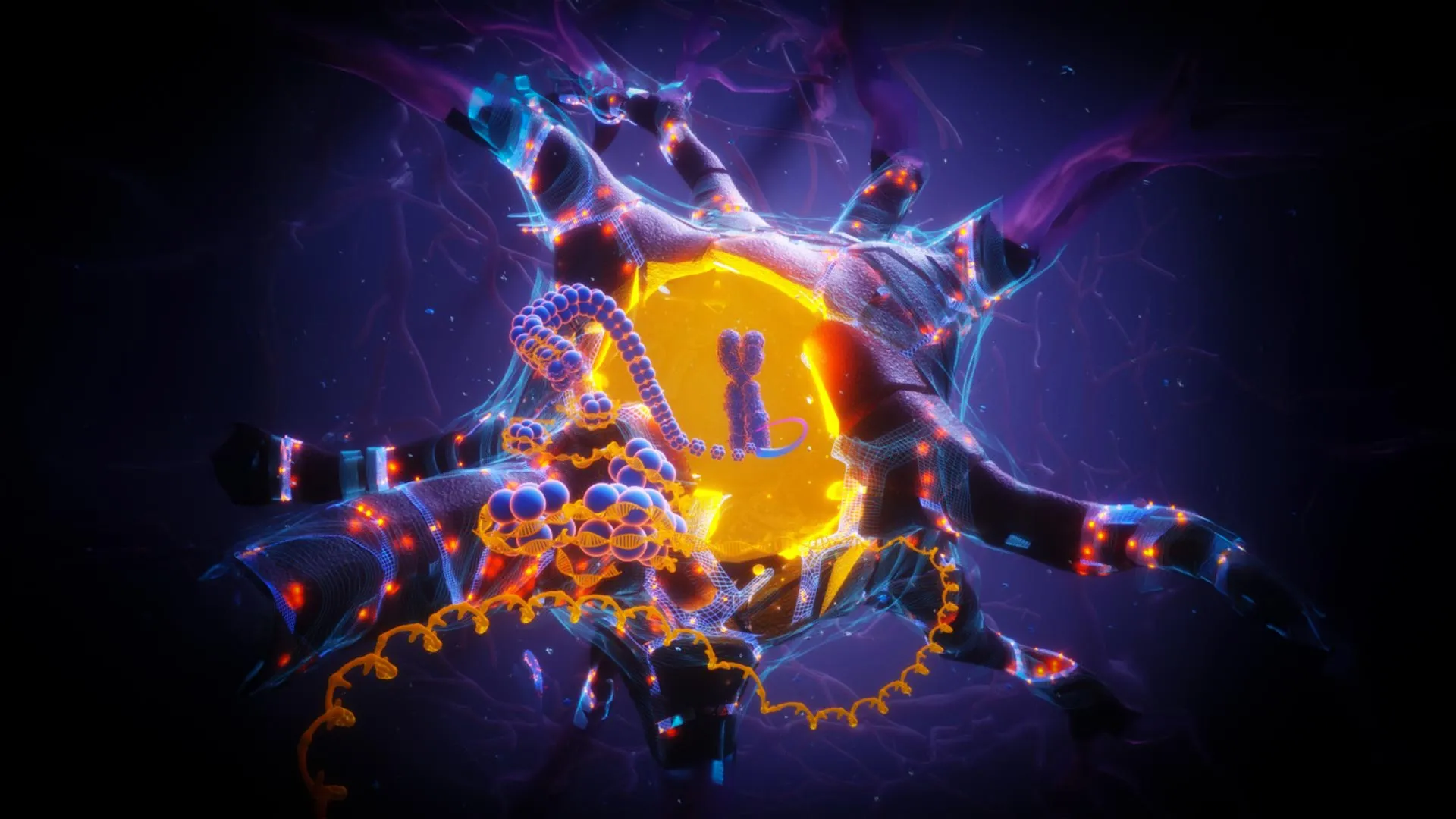
People who carry the APOE2 form of the apolipoprotein E gene tend to live longer and have a lower risk of Alzheimer’s disease. Scientists have known about that advantage for years, but the biological reason behind it has remained unclear.
A new study from the Buck Institute for Research on Aging, published in Aging Cell, suggests that APOE2 helps neurons protect their DNA and avoid senescence. Senescence is a damaged, poorly functioning cellular state that becomes more common with age and is believed to contribute to neurodegeneration.
The results point to a role for APOE that goes beyond its familiar involvement in cholesterol transport. They suggest that different versions of the gene may also influence how well brain cells preserve and repair their genetic material over time.
“We’ve known for years that APOE2 carriers tend to live longer and have a lower risk of Alzheimer’s, but the protective mechanism has been a black box,” says senior author Lisa M. Ellerby, PhD, professor at the Buck Institute. “Our work shows that APOE2 neurons are better at preventing and repairing DNA damage, and they resist the cellular aging program that drives so much of late-life decline. Our findings point to entirely new therapeutic directions.”
Comparing the Three APOE Variants
APOE exists in three common forms, APOE2, APOE3, and APOE4. These versions differ by only two amino acids, yet they are associated with very different effects on brain aging.
APOE4 is the strongest known genetic risk factor for late-onset Alzheimer’s disease (typically after age 65). APOE2, by contrast, has repeatedly been linked in population studies to longer life and a reduced risk of dementia.
To study how the APOE variants influence neuronal aging, the researchers used human induced pluripotent stem cells (iPSCs) that had been genetically engineered so that they differed only at the APOE locus.
The team turned these cells into two types of neurons. One group consisted of inhibitory GABAergic neurons, while the other consisted of excitatory glutamatergic neurons. The researchers then compared how APOE2, APOE3, and APOE4 affected each cell type.
They also studied hippocampal tissue from older mice engineered to carry the human APOE2, APOE3, or APOE4 gene.
APOE2 Neurons Show Less DNA Damage
The researchers found that APOE2 neurons accumulated less damage to their DNA.
Bulk and single-cell RNA sequencing showed that APOE2 GABAergic neurons strongly activated pathways involved in DNA repair and damage response. APOE4 neurons, meanwhile, displayed patterns of gene activity associated with Alzheimer’s disease.
Direct measurements of DNA strand breaks supported those findings. APOE2 neurons had significantly less DNA damage than neurons carrying the other gene variants.
Brain Cells Resist Cellular Senescence
APOE2 neurons also appeared to be more resistant to senescence.
The team exposed excitatory neurons to radiation or the chemotherapy drug doxorubicin, both of which can damage DNA and place cells under severe stress. APOE2 neurons showed lower levels of senescence markers (including p16 and CRYAB) than APOE3 and APOE4 neurons.
They also had smaller nucleoli and better-preserved nuclear architecture, both signs that the cells were maintaining a healthier internal structure.
APOE2 Protein May Transfer Some Protection
The researchers also tested whether APOE2’s protective effect could benefit neurons that carried APOE4.
When they added recombinant APOE2 protein to APOE4 neurons, the cells showed reduced DNA damage signaling after radiation exposure. The result offers an early indication that at least part of APOE2’s protective effect may be transferable rather than being limited to people born with the gene variant.
Similar Signs Appear in Mouse Brains
The mouse experiments produced a similar pattern.
Older APOE2 knock-in mice had smaller nucleoli, higher levels of the nuclear scaffolding protein Lamin A/C, and better-preserved heterochromatin in the hippocampus than mice carrying APOE3 or APOE4.
These characteristics are associated with healthier aging in brain cells and added further support to the findings from the human neuron experiments.
A New View of APOE and Brain Aging
DNA damage and cellular senescence are increasingly recognized as major contributors to aging and age-related diseases, including Alzheimer’s disease.
“Until now, the APOE field has focused largely on lipid handling and amyloid-beta biology,” says Ellerby. “By showing that APOE alleles also tune how neurons defend their genome, this study connects a major longevity gene to two of the most actively studied hallmarks of aging.”
According to Ellerby, the findings raise the possibility that treatments designed to improve DNA repair or remove senescent cells from the brain could reproduce some of APOE2’s natural benefits. Such strategies might eventually help people who carry the higher-risk APOE4 variant.
“What surprised us was how consistent the picture was across two very different neuron types and across human cells and mouse brain tissue,” said co-first author Cristian Gerónimo-Olvera, PhD, a postdoctoral fellow at the Buck Institute. “APOE2 neurons aren’t just less damaged at baseline, they recover faster when stressed.”
Future Treatments Inspired by APOE2
The researchers say they still do not know exactly how APOE2 stabilizes the nuclear envelope and strengthens DNA repair.
Future work will investigate whether APOE2-mimetic compounds or targeted DNA repair treatments can provide similar protection in people with APOE4, the group with the highest genetic risk for Alzheimer’s disease.
Other collaborators include: Stephen M. Scheeler, Carlos Galicia Aguirre, Genesis Vega-Hormazabal, Daniela Garcia, Long Wu, Natalia Murad, Kevin Schneide, Kenneth A. Wilson, Nikola T. Markov, | Jesse Simons, Akos A. Gerencser, Emily Parlan, Eric Verdin, Judith Campisi, Tara E. Tracy, David Furman, Simon Melov, Buck Institute; Sicheng Song and Sean D. Mooney, Department of Biomedical Informatics and Medical Education, University of Washington, Seattle, Washington
This work was supported by the National Institute on Aging (R01AG061879, P01AG066591, T32 AG000266), the Paul F. Glenn Center for Biology of Aging, the Hevolution Foundation (HF-PART-23-1422047), and a CatalystX award from Alex and Bob Griswold and the Valley Foundation Fellowship.
