


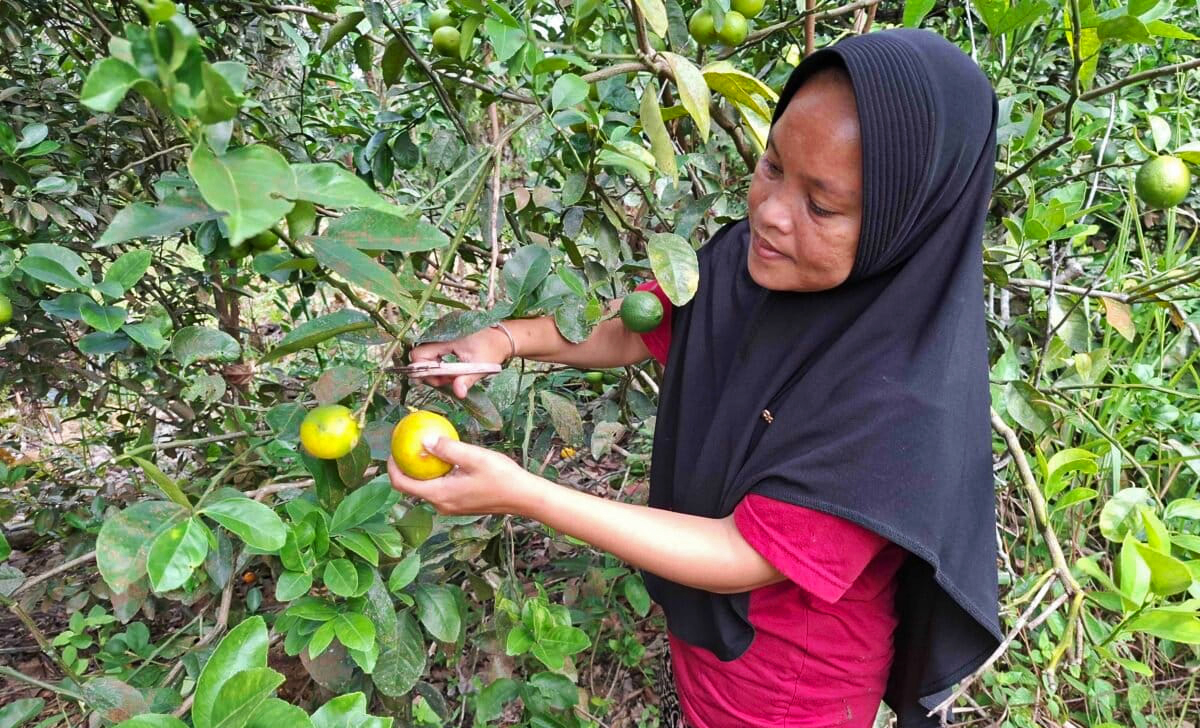
- Tesso Nilo National Park on the Indonesian island of Sumatra is notorious for human-wildlife conflicts, but women farmers living in its buffer zone are working to protect the park.
- Members of the Batang Nilo Women’s Forest Farmer Group, known as Perbani, plant citrus trees, which elephants avoid, around their farms, while also growing fruits that the animals can feed on.
- Perbani also empowers its more than 30 members through monthly gender equality classes, covering skills such as leadership and public speaking, as well as a savings-and-loans scheme.
- In 2024, the forestry ministry granted the women’s group Wanawiyata Widyakarya status, awarded to community organizations that successfully run conservation and forestry-related enterprises and provide training to residents.
LUBUK KEMBANG BUNGA, Indonesia — Tesso Nilo National Park, located on the Indonesian island of Sumatra, often makes headlines due to human-wildlife conflict — a byproduct of illegal encroachment and deforestation by oil palm plantations. However, there is a ray of hope, thanks to female farmers who live in a buffer zone of the national park.
In the village of Lubuk Kembang Bunga, in the buffer zone next to the park, women are leading an initiative to plant fruit trees that both serve a conservation purpose and provide extra income.
To prevent elephants from destroying their fruit plantations, the villagers plant citrus trees, which repel the pachyderms. Elsewhere, they also plant fruits beloved by these large animals, such as jackfruit, its cousin cempedak, and stink beans, known in Indonesian as petai.
Ernita, a 33-year-old farmer, said she can now breathe easy after planting citrus trees on the perimeter of her oil palm farm.
“Before we had the citrus trees, elephants always ate our oil palm fruits,” she told Mongabay Indonesia. “We had to replant the trees four or five times … Praise be to God, since we planted the citrus trees, the elephants haven’t eaten our oil palm fruits.”
Ernita’s farm lies just outside Tesso Nilo, so she can grow various crops, including oil palm. But other parts of Lubuk Kembang Bunga village fall within the park’s borders, where, technically at least, oil palm cultivation isn’t permitted.
Officially, Tesso Nilo National Park, in Riau province, spans 81,793 hectares (202,115 acres) — an area larger than New York City. However, more than three-quarters of its old-growth forest has been lost since 2009, largely to smallholder oil palm farms, according to remote-sensing platform Global Nature Watch (previously known as Global Forest Watch). The remaining forest area is estimated at only around 13,000 hectares (about 32,000 acres), and even that consists only of partial stands of natural forest.
In a radical attempt to regain control of the protected area, last year, a forestry task force began relocating hundreds of farming families living inside the park. However, the efforts sparked protests, occasionally violent, from the residents, as well as concerns about human rights abuses.
Yet even as it shrinks, the lowland national park remains home to the largest population of Sumatran elephants (Elephas maximus sumatranus) in the province of Riau. The loss of habitat has had a detrimental effect on the critically endangered subspecies. In 2007, the forestry ministry estimated there were 2,400-2,800 Sumatran elephants left in the wild. By 2025, there were just 1,100, according to the minister. In Tesso Nilo, wild elephant numbers dropped from 200 in 2004 to 150 in November 2025, according to park authorities.
Without enough food and habitat, the giant animals are forced to venture outside the park, where they sometimes clash with villagers.

Before planting citrus trees, Ernita and other residents used noise-making carbide cannons and firecrackers, the same method deployed by government patrols, to shoo elephants away from their farms. Elsewhere, some residents resort to more violent methods such as poison and electric fences, which have killed scores of animals.
Ernita has been using the more animal-friendly approach for the past three years. She and her husband, Sumardi, have planted a “fence” of about 600 citrus trees around their 1.5-hectare (3.7-acre) oil palm farm. The trees are spaced about 1.5 meters (5 feet) apart, creating an agroforestry plot — a landscape where agriculture and trees combine.
The couple grow five types of citrus: orange, calamansi, lemon, key lime, and kaffir lime. Not only does the tangy smell of the plants drive away elephants, but the fruits can also be consumed at home or sold for extra income.
Win-win solution
The idea was first put forward by the Tesso Nilo National Park Foundation (YTNTN), a community-based organization dedicated to supporting the management of the national park, especially key wildlife like the Sumatran elephant.
Yuliantony, executive director of YTNTN, said the idea was inspired by the presence of citrus trees in some areas in and around the national park. They noticed that elephants never ate the citrus fruits or damaged the groves there.
Long before planting citrus trees, Ernita observed something similar. She noticed that elephants steered clear of her neighbors’ citrus orchards. “Maybe they don’t like the smell and are afraid of the thorns,” she said.
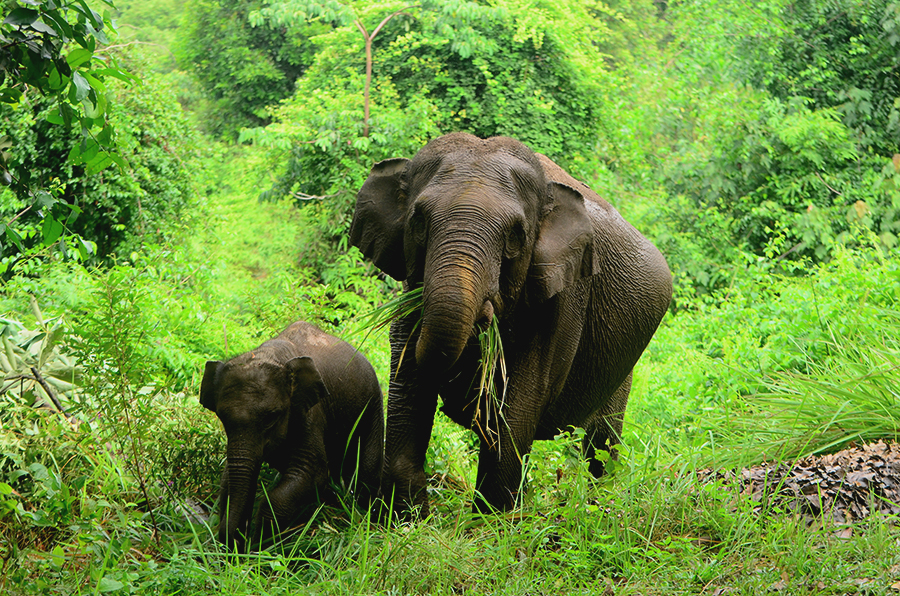
To introduce the wildlife-friendly initiative, YTNTN collaborated with the Batang Nilo Women’s Forest Farmer Group (KTH Perbani), where Ernita is a member. YTNTN also encouraged the women to provide feeding grounds for elephants, advising them to plant jackfruit, cempedak, petai and bananas in forested areas.
Yuliantony called this approach a win-win solution for both the local community and the elephants.
Women are often overlooked in conservation efforts, although they frequently have in-depth knowledge of local ecology and how to manage resources wisely, as they collect water, firewood and other forest products, Yuliantony said.
“That is why it is important to involve women in the conservation and management of natural resources,” he said.
Women’s empowerment
Since it was established around 10 years ago, KTH Perbani, or simply Perbani, has played an important role in protecting Tesso Nilo. A research paper by University of Riau scholars called the buffer zone “a space of ecofeminism.”
The paper lists the range of conservation activities carried out by the women’s group: “conduct participatory forest patrols to prevent illegal logging and fires, initiate the replanting of native forest species, and manage water sources, medicinal plants, and local seedlings as strategies to sustain ecosystems and community health.”
Perbani’s initiatives show that “women are not ‘victims’ of conflicts with elephants who need to be saved but creative problem solvers,” lead author Mita Rosaliza told Mongabay in an email.
“Perbani also demonstrates politics of care, using a different approach to environmental protection,” the sociologist said.
The women’s group also seeks to empower women socially and economically. It offers monthly gender equality classes to its more than 30 members, ranging from leadership skills to public speaking. These classes are credited with helping several members get elected to community and government positions, from neighborhood unit heads to regional lawmakers.

It set up a savings-and-loan scheme, allowing members to borrow money to pay for home repairs, children’s school expenses, and farming costs.
Herlia Santi, director of the Riau Center for Women’s Resource Development (PPSW), an NGO that supports and advises Perbani, said economic empowerment is crucial, pointing out that the savings-and-loan unit also ensures Perbani can continue to operate and fund its activities without relying on external parties.
In addition, Perbani raises seedlings of multiple plants — ranging from native trees such as kulim (Scorodocarpus borneensis) and pulai (Alstonia scholaris) to fruit trees like rambutan and cempedak — not only to use them to rehabilitate forests but also to sell them to other villagers or companies, giving the group a source of income.
Perbani chair Rena Sandriani said the group had sold a total of 18,000 seedlings since 2019.
Rehabilitating Tesso Nilo is not easy, however. Yuliantony said YTNTN had encountered situations in which some people burned the reforested area, claiming they had rights to plant oil palms there.
However, despite the obstacles, Perbani members such as Rena and Ernita said they’re happy to participate in restoring the forest.

Their efforts haven’t gone unnoticed by the government. In 2024, the forestry ministry granted the women’s group Wanawiyata Widyakarya status, awarded to community organizations that successfully run conservation and forestry-related enterprises and provide training to residents.
It was the Tesso Nilo National Park Office that nominated Perbani. “The communities around Tesso Nilo National Park deserve our support,” said Fauzan Kahfi, an extension officer at the office.
Santi of the PPSW said Perbani members play a crucial role in protecting and managing the beleaguered national park.
“If this effort continues and Perbani’s reach expands, there will be a domino effect in the protection and management of the Tesso Nilo National Park area,” she said.
However, as Mita pointed out, in spite of their dedication, Perbani members still face practical, systemic and structural challenges. For example, women do not own land, are marginalized from decision-making processes, and do unpaid conservation work without enjoying health benefits.
“To make conservation truly sustainable, it is not enough to empower local groups; we need big fundamental changes,” she said, listing suggestions such as securing women’s land rights and ensuring gender equality in decision-making processes.
Ensuring their well-being is important, the academic said. “When women care for the forest, they are not only protecting nature; they are protecting the future of their community.”
The long struggle of women farmers to halt a zinc mine in North Sumatra
Indonesian women sustain seaweed traditions in a changing climate
Citation:
Rosaliza, M., Yusuf, Y., Asriwandari, H., Armilus, R., & Dzulqarnain, M. F. (2025). Tesso Nilo buffer zone: A space of ecofeminism, women, ecology, and social resilience. MIMBAR: Jurnal Sosial dan Pembangunan, 41(2), 225-236. doi:10.29313/mimbar.v41i2.8993
Cite this article
Suryadi, Yenni Kwok (2026). How women farmers are helping elephants and forests in a Sumatran national park. Mongabay Conservation news. DOI: https://doi.org/10.66709/news-326257

