


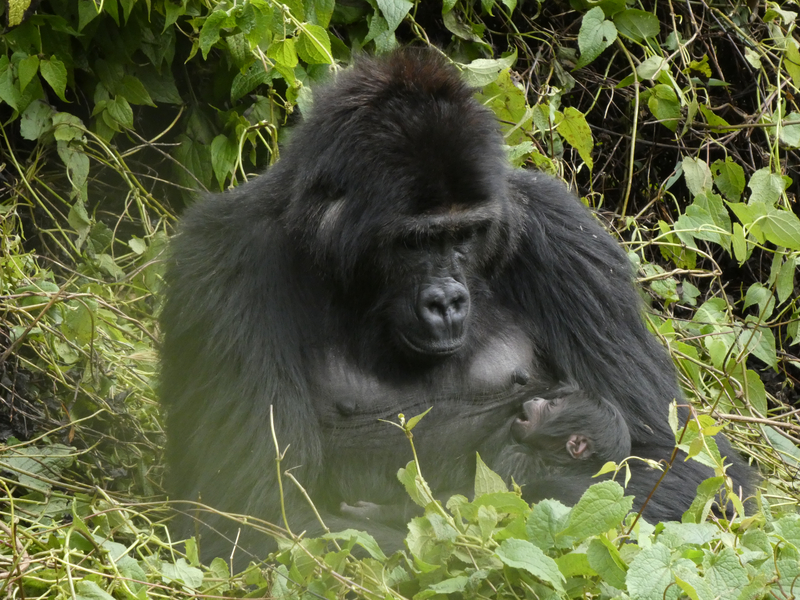
Lulingu, a Grauer’s gorilla (Gorilla beringei), was reintroduced to Virunga National Park, in eastern Democratic Republic of Congo in 2024. In May 2026, Lulingu gave birth to a new baby, bringing hope for the species and excitement for the conservationists working there.
“The baby and the mother are doing perfectly well. It really makes us happy. We are proud of her, it is also a bit of our success. Imagine, we knew her as a baby, we watched her grow, be rehabilitated and now she is a mother,” Jackson Kabuyaya Mbeke, country director of the DRC Gorilla Rehabilitation and Conservation Education Center (GRACE), told Mongabay by phone.
Lulingu arrived at GRACE, a 16-hectare (40-acre) wildlife sanctuary, in 2016 when she was 18 months old. She was rescued from an illegal wildlife trafficking network by the Congolese Wildlife Authority (ICCN) and the NGO Gorilla Doctors. The sanctuary gave her space to socialize and play in a setting close to her natural habitat, under the watchful eyes of adoptive gorilla mothers. Lulingu was later reintroduced into the wild near Mount Tshiaberimu, a remote part of Virunga National Park.
“The purpose of our sanctuary is to take in rescued gorillas, but also to care for them until they can be released into the wild. The fact that Lulingu has had a baby is a sign that she has adapted well to life in the wild,” Kabuyaya Mbeke explained. “By reintroducing them into the wild, we also hope to repopulate forests that have been stripped of their wildlife.”
Grauer’s gorilla, also known as the eastern lowland gorilla, is endemic to the tropical forests of eastern DRC. It is the largest primate on Earth, but its habitat is shrinking under the pressures of armed conflict, deforestation and mining. In 2016, it was reclassified as critically endangered on the IUCN Red List after decades of being classified as endangered. Conservationists estimate that 77% of the population has disappeared since 1994, falling from an estimated 16,900 to 3,800 individuals by 2015. That means every birth is important for the species.
“Thanks to this success, we are now looking at whether we will reintroduce more gorillas into the wild. We are in the preparatory phase,” Kabuyaya Mbeke said.
However, security concerns still exist. Virunga National Park has faced decades of violence since the 1994 genocide in neighboring Rwanda. Conflict has included clashes between DRC armed forces, militias and local self-defense groups known as the Wazalendo. Since early 2025, M23 has seized control of large parts of the park, fueling poaching, deforestation and illegal trafficking.
To build support for the park and its wildlife, conservationists will invite local communities to suggest names for Lulingu’s new baby. “A vote will be held to choose its name, which will be revealed during a ceremony. Everyone will be involved,” Kabuyaya Mbeke said.
Banner image: Lulingu, a Grauer gorilla, holding her new baby. Image courtesy of GRACE Gorillas.
