


With the midterm elections over, the future of Defense Secretary Pete Hegseth hangs in the balance. Rep. Hakeem Jeffries, who is set to be speaker of the house, announced this weekend that he would vote in favor of a resolution to impeach Hegseth. The Defense Secretary is one of the most controversial figures in President Donald Trump’s cabinet, and has purged the Pentagon of many top officials widely perceived as highly effective. He has repeatedly made provocative culture-war comments that have little to do with national security. And most damaging to his reputation, Hegseth has become the face of the war in Iran.
No matter how unpopular the U.S. military operations have been, Hegseth has stood behind the president. He has defended the pledge to eliminate Iran’s nuclear program and to establish a stronger foothold in the region, even as voters, including those in red states, flocked to the polls to express their disapproval of the administration’s foreign policy.
What happens next remains to be seen. Some Republicans privately hope Hegseth will resign, either voluntarily or under pressure, so that Trump can replace him with someone who has a more favorable public presence and clearer strategy for bringing U.S. involvement in the war to an end. Most Democrats are wary about initiating impeachment proceedings against Trump, given that he has only two years left in office and has historically benefited politically when under attack. Hegseth, however, remains a possible target for impeachment. Pursuing him, potentially with some Republican support, would allow Democrats to demonstrate that they are serious about holding the administration accountable.
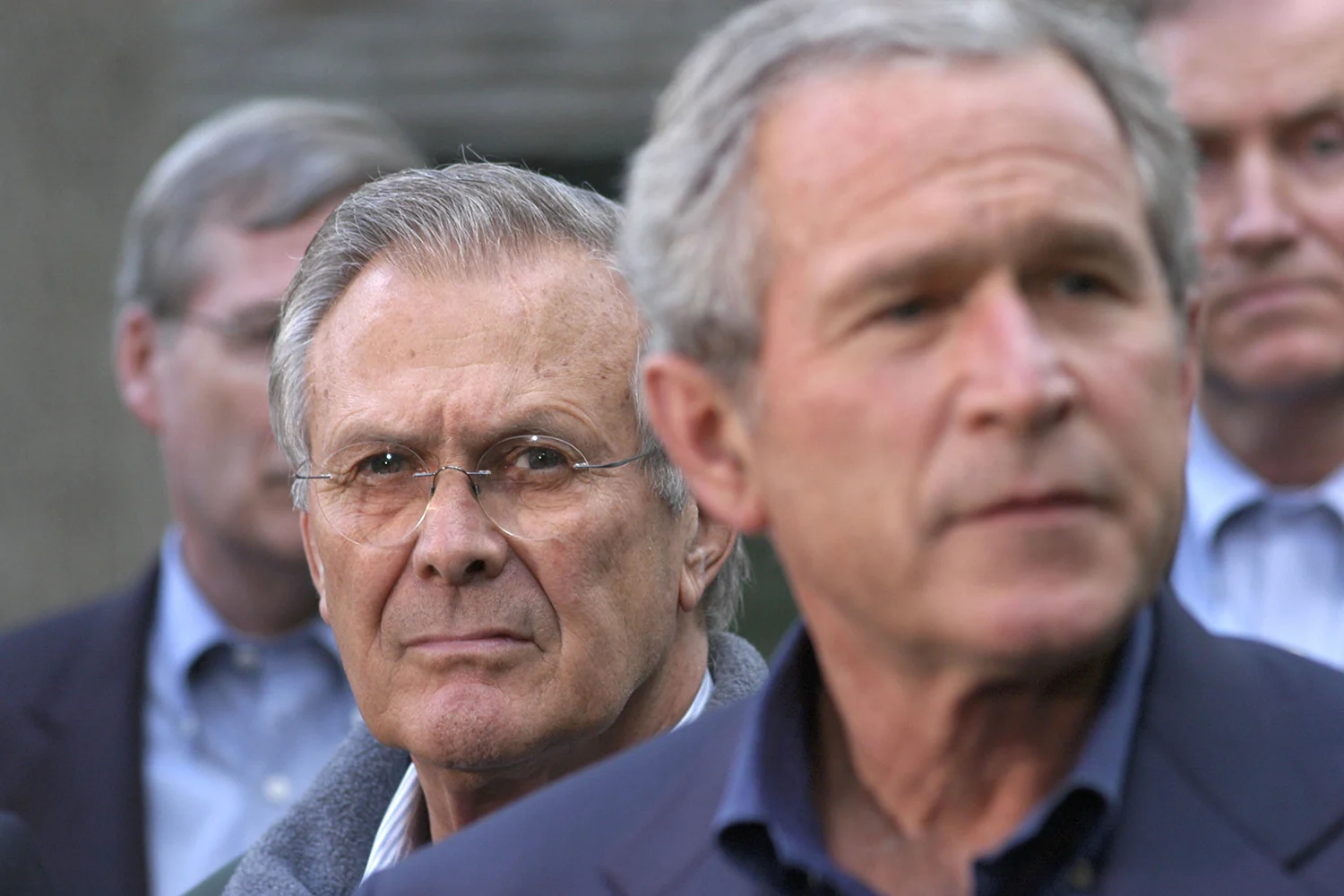
Twenty years ago, Defense Secretary Donald Rumsfeld lost his job after becoming the face of an unpopular war. The question now is whether Hegseth will meet the same fate.
When President George W. Bush announced his nomination of Rumsfeld to be secretary of defense on Dec. 28, 2000, following a highly divisive election recount, most experts considered Rumsfeld one of the most qualified people for the job. A Navy veteran of the 1950s, he had served in the U.S. House of Representatives from 1963 to 1969. He then left legislative politics to become President Richard Nixon’s director of the Office of Economic Opportunity, and later counselor to the president and director of the Cost of Living Council. In 1973, Nixon named him U.S. ambassador to NATO. After Nixon resigned in disgrace over the Watergate scandal in August 1974, President Gerald Ford appointed Rumsfeld as White House chief of staff, and in 1975, Ford nominated him as secretary of defense, a post he held until President Jimmy Carter took office in 1977. Rumsfeld then spent many years working in the private sector while remaining involved in politics as a champion of neoconservatism.
His nomination as was greeted as a sign that the new President Bush would surround himself with a team of seasoned experts. After 9/11, Rumsfeld, who had a close and long-standing relationship with Vice President Dick Cheney, emerged as an important voice within the administration, helping to develop and implement a counterterrorism strategy intended to prevent comparable attacks on U.S. soil. In October and November 2001, the success of the military operations against the Taliban regime in Afghanistan was praised as evidence of his strategic prowess. The same was true in 2003, when the United States went to war with Iraq and Baghdad fell within weeks. On May 1, Bush declared an end to major combat operations beneath a “Mission Accomplished” banner, and in December, U.S. forces captured Iraqi leader Saddam Hussein.
Beneath those successes, however, things were already going wrong for Rumsfeld and for the war. The first major trouble came when looting broke out across Baghdad in April 2003, including at the Iraq Museum and the National Library and Archives. It soon became clear that the Pentagon had done little planning for the aftermath of Hussein’s downfall. “Stuff happens,” Rumsfeld told reporters, brushing off their questions about the looting. Meanwhile, the U.S. military failed to find stockpiles of weapons of mass destruction, which had been the main justification for the war.
By the 2006 midterms, the Iraq War was deeply unpopular. Large numbers of U.S. ground troops were still struggling to establish political stability and contain sectarian violence, and they were suffering heavy casualties. The 2003 decision to disband the Iraqi army proved enormously costly, and in April 2004, a weeknight 60 Minutes broadcast had revealed widespread abuse of detainees of Abu Ghraib prison. Although the story was initially framed as the work of a few rogue soldiers, it soon became clear that the abuses were connected to Pentagon policies authorizing harsh interrogation methods. Rumsfeld privately offered to resign several times, but Bush refused to accept.
There had also been scattered calls from Congress to force the issue. In May 2004, New York Rep. Charles Rangel introduced eight articles of impeachment against Rumsfeld in response to the revelations of Abu Ghraib.
After their tours of duty, many soldiers returned with post-traumatic stress disorder and could not get the support they needed to transition back to civilian life. Democrats made the war a central theme of the 2006 campaign, presenting it as evidence of Republican misrule: Bush’s deeply flawed and unnecessary decision to go to war with Iraq in the first place, made with strong congressional Republican support, compounded by the failure to plan for what would happen once the government collapsed. In September 2006, Republicans were able to block a vote on a nonbinding statement from Senate Democrats expressing a “sense of the Senate” that Bush replace Rumsfeld. “To fight a war on terror,” New York Sen. Charles Schumer said during the floor debate, “you need to be both strong and smart. And with Secretary Rumsfeld in this administration, you do see a great deal of strength but you don’t see enough on the smarts.” Behind the scenes, White House chief of staff Andrew Card lobbied the president, unsuccessfully, to replace Rumsfeld, too.
Rumsfeld himself was an issue. His approval ratings, which had stood at 71 percent in 2003, had fallen to 44 percent in Gallup polling by January 2006. That spring, in what Time called “The Revolt of the Generals,” six retired generals called for Rumsfeld to resign. “When I introduce the Secretary of Defense to my troops, I’m going to be a loyal subordinate,” Army Major General John Batiste told the magazine. “But it was boiling inside me. Every time I looked at him, I was thinking about … that s___ war plan, I was thinking about Abu Ghraib, and I was thinking about the challenges I had every day trying to rebuild the Iraqi military that he disbanded.”
Still, Bush stood by his man. Responding to critical editorials and calls for Rumsfeld’s resignation, Bush told the press on April 18: “Don Rumsfeld is doing a fine job. He’s not only transforming the military, he’s fighting a war on terror. … I hear the voices, and I read the front page, and I know the speculation. But I’m the decider, and I decide what’s best. And what’s best is for Don Rumsfeld to remain as the secretary of defense.” Whenever the issue came up in conversations with the White House, Robert Draper wrote in his 2007 book, Dead Certain, Bush doubled down. “The moment someone would say ‘Fire Donald Rumsfeld,’ Donald Rumsfeld would get a new lease on life,” said a White House aide.
The criticism did not abate. On Sept. 25, 2006, six weeks before the election, Batiste and two other retired generals told the Senate Democratic Policy Committee that Rumsfeld was unable to handle the job. On Saturday, Nov. 6, the newspapers associated with the Military Times Media Group published an editorial titled “Time for Rumsfeld to Go.”
Although Bush had publicly defended Rumsfeld into the final days of the campaign, the outcome made continued support all but impossible. A number of issues drove the election, including corruption, the cost of living, and healthcare, but opposition to the Iraq War was chief among them. Democrats won control of the House and Senate.
The president realized that he needed to change course. According to Rumsfeld, Cheney had given him advanced warning that Bush planned to finally accept his resignation. On Nov. 8, Bush announced that he was nominating Robert Gates as the new secretary of defense. “America is safer and the world is more secure because of the service and the leadership of Donald Rumsfeld,” Bush said. The decision was a blow to Cheney, who counted on Rumsfeld as an ally, and a victory for the foreign policy realists who served under President George H.W. Bush.
The leadership shake-up paved the way for a basic shift in strategy, announced in January 2007: from a U.S. mission focused on fighting insurgents and handing security over to newly constituted Iraqi forces, to a so-called surge of additional troops whose mission was to protect the Iraqi population and win their support against the insurgency.
Many Republicans privately expressed regret that Bush had not made the decision earlier, which might have given the GOP a fighting chance to hold its majorities. As New York Times reporter Adam Nagourney put it, then-Rep. Rahm Emanuel, an Illinois Democrat, “gave private thanks that the president had not robbed the Democrats of a potent issue by firing Rumsfeld before the campaign was engaged.”
The war in Iran is not nearly as large as the Iraq War, and there is no ground war, but Trump’s policies have proven to be extraordinarily unpopular from the start, and as prices rise, the war has only become more controversial. There is little love for Hegseth, even among Republicans. Not only does he embody much of what critics think is wrong with Trump 2.0, but because he is not the president, Republicans feel freer to attack him.
Rumsfeld’s resignation offers a template for today’s Republicans who are angry about what has happened in Trump’s second term, and it could be that Hegseth will now go. But even if he leaves—or if Congress forces him out—it is unlikely to bring a fundamental change in policy. The Trump White House has centralized power in the president himself, so he will remain the source of policy decisions and the focus of attacks. Despite Democratic victories in last week’s midterms, Trump is unlikely to change course. It would take budgetary and investigative pressure from Congress to make that change.
