


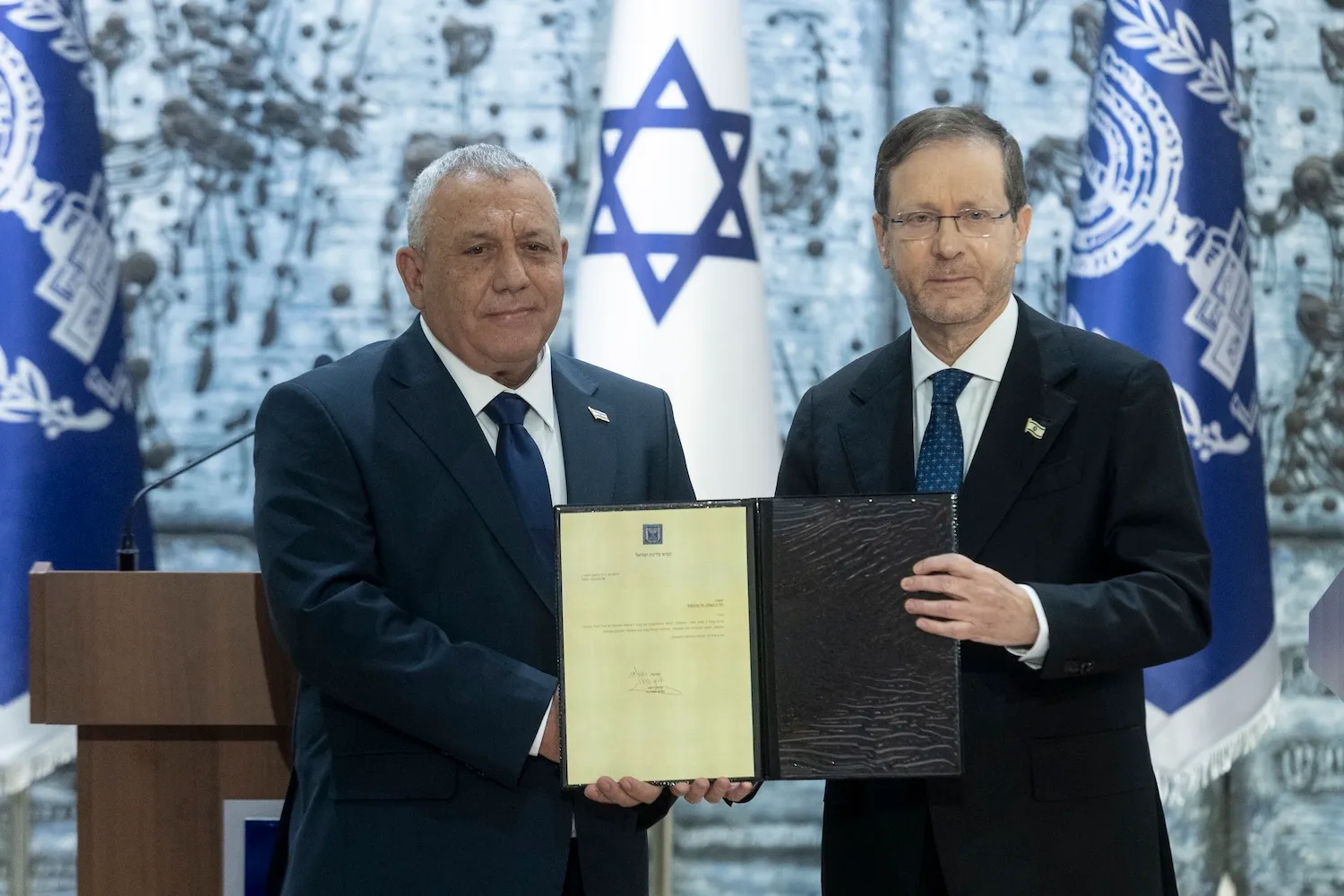
Could Israeli politics get more complicated? Israeli President Issac Herzog tapped Gadi Eisenkot over the weekend to form the next government. You would think that means the opposition parties led by Eisenkot—known in Israel as the “change bloc”—are on the verge of ousting Prime Minister Benjamin Netanyahu and forming a stable, centrist government. But that’s not quite the case, not yet anyway. As the haggling gets underway, let’s take a minute to lay out the facts—and sidestep the vitriol and virtue signaling that tends to dominate social media when it comes to Israel.
Based on the final results of the election held two weeks ago, Netanyahu and his bloc have 53 seats in the 120-seat parliament, while Eisenkot’s change bloc controls 48 seats. The remaining 19 seats belong to two Arab-led parties, the Joint List and Ra’am.
The nod from the president means that Eisenkot gets the first crack at forming a government. The clearest path to a majority would be for him to form a coalition with the Joint List and Ra’am. That would give the anti-Netanyahu forces a commanding 67-seat majority in Israel’s parliament—enough to address some of the most divisive issues in Israeli society, including expanding mandatory military service to include ultra-Orthodox Jews and establishing a state commission of inquiry into the security failures that led to Hamas’s attack on Oct. 7, 2023.
But things are never so straightforward, especially in Israeli politics. Theoretically, a change bloc government with the Joint List and Ra’am is possible, but there are informal barriers to getting there—and political traps once it is established—that would likely make the government unstable.
Since Israel’s founding, only one governing coalition included an Arab-led party, and it didn’t last long. In 2021, parties from across the political spectrum—united mainly by their antipathy for Netanyahu—formed a left-right coalition headed by Naftali Bennett, a onetime Netanyahu protégé. The coalition included Ra’am, which had focused mainly on bread-and-butter issues for Israel’s Arab citizens, who make up 20 percent of the population. In previous elections, the Arab-led parties were considered too fringe politically to be included in coalitions or they themselves ruled out serving in Israeli governments. Bennett’s decision to include Ra’am was groundbreaking.
But the motley coalition held together for just a year. The crisis that precipitated the government’s fall revolved around lawmakers from Ra’am and the left-wing Meretz party who opposed extending a procedural measure that benefitted settlers in the West Bank. This dispute within the coalition prompted the resignation of one of Bennett’s own deputies who assailed anti-Zionists—presumably Arab members—of the coalition holding the government “hostage.” Throughout this period, Netanyahu was able to capitalize on the government’s ideological diversity, adding to its stresses and strains by highlighting the contradictions between its right-wing and anti-Zionist members.
It is not clear why this time would be any different. A change bloc plus Arab parties would have the similar ideological fault lines. Perhaps the exigency of keeping Netanyahu out of the prime minister’s office would be enough to hold everyone together, but it would take significant political skill. All the discussion about a government with the Arab parties may be moot anyway. Eisenkot has laid down four conditions to be in the government—recognizing Israel as a Jewish and democratic state, strict adherence to the values laid out in Israel’s declaration of independence, mandatory national service for all, and recognition of Hamas as a terrorist organization. The first, second, and fourth conditions will be tough for the Joint List to agree to. Ra’am leader Mansour Abbas may have more flexibility, but he recently refused to call Hamas a terrorist organization.
I’m not sure how you square this circle. You can promise Arab parties lots of resources, and their leaders seem motivated to cooperate to prevent Netanyahu from returning to office. That is a good sign for the change bloc, but it does nothing to resolve the hard differences between Zionist and anti-Zionist parties.
The common knee-jerk reaction to this problem among social media posters and some members of the foreign-policy community is to declare Israel racist. Are there racists in Israel? No doubt there are. Right-wing politicians Avigdor Liberman, Bezalel Smotrich, Itamar Ben-Gvir, and others have a history of making racist anti-Arab comments. Netanyahu has repeatedly trafficked in fearmongering around the issue of Arab voters “racing to the ballots” during the elections. But to focus on racism alone is to miss the core tension of the Israeli-Palestinian conflict. Most Israeli Jews support the idea of Israel as a Jewish state, albeit with an Arab minority. It would be uncomfortable for them to have people in government who oppose the country’s founding principles and refuse to condemn Hamas.
At the same time, it should surprise no one that the leaders of Israel’s Arab parties have a different outlook and entirely different concerns. Arab Israelis have their own historical narrative, do not share Israel’s founding myths, and are not part of its collective memory.
One alternative is for Eisenkot to form a minority government without the Arab-led parties and rely on their support from the outside on crucial legislative votes. But minority governments tend to be unstable in Israel and at least one party within the change bloc, Liberman’s Yisrael Beiteinu (Israel Is Our Home), has ruled out such a configuration.
Another alternative would be for Eisenkot to invite the ultra-Orthodox (Haredi) parties to join his coalition. That seems to be more acceptable to mainstream Israelis, but barely. The white-hot anger directed at the Haredi parties among almost everyone in Israel is palpable. That is because most Haredi men do not serve in the military, and Israelis resent supporting an entire community that takes far more than it contributes to society. This would be a difficult coalition for Eisenkot to put together, though the leaders of the Ashkenazi Haredi party, United Torah Judaism, have indicated a willingness to consider it.
The fourth option is for Eisenkot to try and form a broad-based coalition with Netanyahu—what Israelis call a “national unity” government—with the two men rotating as prime ministers. That seems to be where Herzog wants to go. A Netanyahu-Eisenkot linkup would get to a majority in parliament easily and resolve several issues all at once for Israelis. The coalition would not include far-right figures Ben-Gvir and Smotrich, and there would be no need to cater to Haredi parties. The debate over normalizing the Arab-led parties by including them in a governing coalition would be put off for another day. Yet in the Rubik’s cube that is Israeli politics, this option also raises challenges.
For example, who would serve first as prime minister? And how would you guarantee that neither of them will violate the rotation agreement? Netanyahu did just that with the hapless Benny Gantz in 2020, bringing down the government and forcing new elections before Gantz could take over.
Beyond the procedures, Eisenkot would have to make the case to his voters why a deal with Netanyahu is warranted when opponents of Netanyahu hold 67 seats in the 120-member parliament. It is a tough argument to make, especially for Eisenkot, who said during the campaign that he would not agree to a national unity government with the man that he (and many others) hold responsible for failures that led to the Oct. 7 massacre.
Still, a so-called national unity government would probably be the most stable of all the options, freezing out parties on the margins and capturing that center-right part of the electorate where the preponderance of Jewish Israelis now live politically. It would also head off what many Israelis think of as the worst option of all—a political deadlock that leads to another election in the coming months.
Herzog has his job cut out for him if he wants to avoid another election, something that is to Netanyahu’s advantage but not to Israel’s. Wrangling Israel’s political parties is difficult even in the best of circumstances, especially for a president who has limited formal powers. Herzog will rely on the dignity of his office and his powers of persuasion to get an outcome that, regardless of its content, is likely to make a significant number of Israelis unhappy. In the coming weeks, being Israel’s president is going to be among the worst jobs in the world.
