


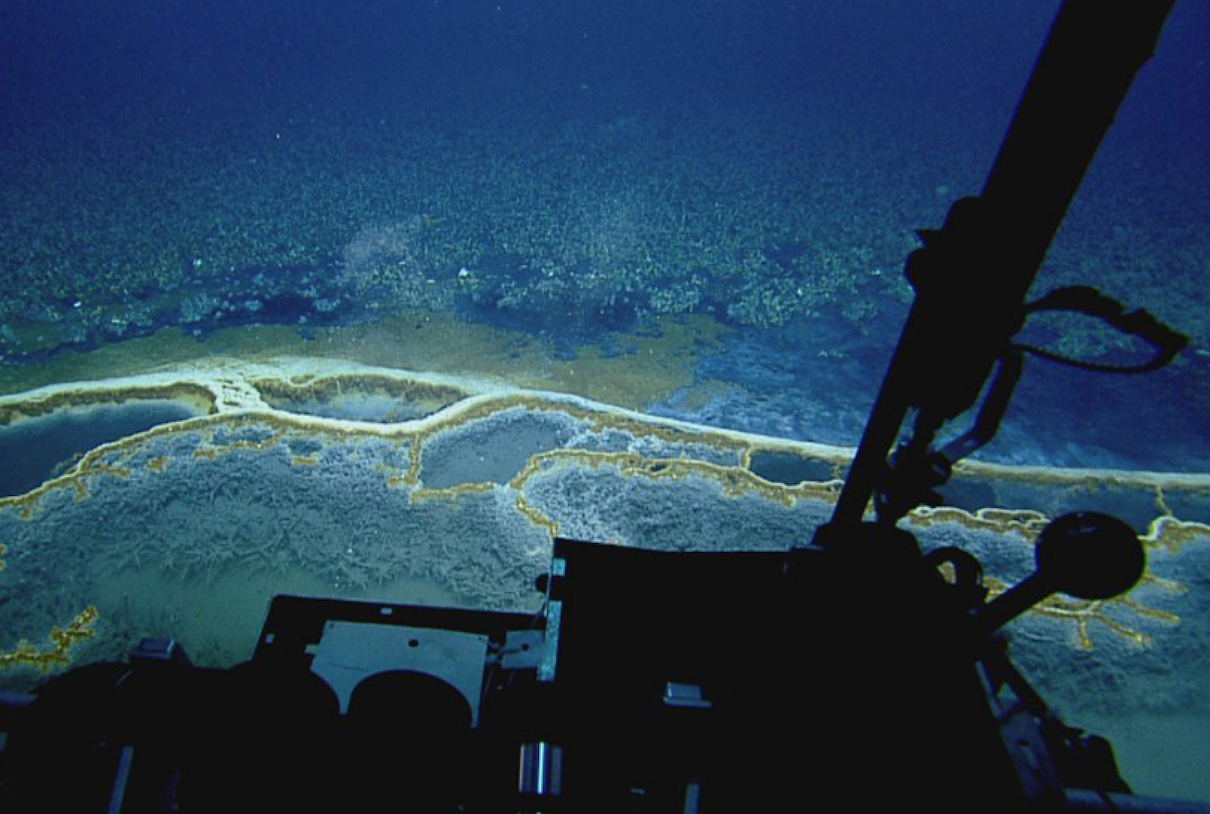
- Deep in the Gulf of Mexico, an ecosystem exists in water so salty and lacking in oxygen that its marine life is unique and virtually unstudied.
- Called the Orca Basin, it’s now the focus of a corporate effort to profit from fighting climate change by dumping tons of organic waste into its depths, a deep-sea biologist explains in a new op-ed.
- “The Orca Basin is not a waste repository waiting for a use. It is a living system that has been developing for thousands of years, hosting organisms we have barely begun to characterize, preserving a chemical and biological record we have barely begun to read,” the author argues.
- This article is a commentary. The views expressed are those of the author, not necessarily of Mongabay.
It’s 3 a.m. and I am standing on the deck of a research vessel, staring into water so dark it looks solid. I feel what I felt standing at the rim of the Grand Canyon, watching the sun set: there are places in this world deserving of our reverence, our protection, and our humility.
The Orca Basin is one of those places.
I have spent years working in the deep Gulf of Mexico, lowering instruments into the dark, pulling up sediment cores that smell of sulfur, watching remotely operated vehicle (ROV) footage of a seafloor that most people will never see, and few even know exists.
Lying roughly 168 miles (270 kilometers) off the Louisiana coast, beneath more than a mile (2.2 km) of water, the Orca Basin is one of the most extraordinary environments on the planet. It is a lake on the seafloor, where the water is so salty and so dense that it resists mixing with the overlying seawater, and has occupied a vast depression on the gulf floor for thousands of years.
Spanning roughly 154 square miles (nearly 400 km2), its salinity runs nearly 10 times that of normal seawater. No oxygen, no multicellular animals venture below its the ghostly boundary, where normal ocean gives way to something ancient and strange. When descending ROV cameras near the surface of the Orca Basin’s salty water, the interface shimmers like heat rising from sunbaked asphalt — a mirage a mile underwater.
Despite this dark first impression, the Orca Basin is far from dead. It teems with microbial organisms that have evolved over millennia to thrive where nothing else can. Its sediments are a biological archive, preserving organic material in near-perfect condition precisely because the elements that would normally destroy it — oxygen, scavengers, and decomposers — are absent.
Scientists have used it to peer back in time, to understand how organic matter is buried and preserved, to study the outer limits of where life can survive. Astrobiologists point to it as an analog for what might exist in the subsurface oceans of Europa or Enceladus, the icy moons of Jupiter and Saturn, which could harbor life. It is, in every meaningful sense, a natural laboratory of irreplaceable scientific value. It’s a Yellowstone of the deep, without the boardwalks and the visitor center.
And now it’s in danger from a company proposing to introduce into it the equivalent of a small convoy of trucks packed with crop waste.
Carbon cache
Carboniferous Inc., an atmospheric carbon removal startup, has received approval from the U.S. Environmental Protection Agency to drop 20 tons of sugarcane bagasse, a compressed agricultural waste, into the Orca Basin. The idea, called the Marine Anoxic Carbon Storage project, or MACS, is that the basin’s anoxic (oxygen-free) conditions will prevent the biomass from decomposing, locking its carbon away permanently, to fight climate change. They plan to monitor the experiment for 14 months, then declare the results.
I want to be charitable here, because the problem of atmospheric carbon is real and urgent, and I understand the pressure to find solutions. But this project is not a solution. It is a poorly designed experiment that risks damaging one of the world’s rarest ecosystems in exchange for scientific answers that we either already have or cannot responsibly collect as proposed.
Start with the science: the Orca Basin’s microbial ecosystem is not simply switched off. These organisms are active, metabolizing, cycling sulfur and carbon, and responding to their environment. What limits them is not the absence of the right conditions, but the absence of high-quality organic carbon, which is precisely what 20 tons of sugarcane bagasse would deliver.

Introducing a large pulse of organic material into a system like this could trigger cascading biological changes that are difficult to predict and impossible to reverse. Microbes could begin producing methane, which might then escape into the water column above. And the very act of lowering heavy, ballasted packages through the basin’s density boundary risks disturbing the layered structure that keeps the system anoxic in the first place. The project’s own permit acknowledges these risks and then largely dismisses them.
The monitoring plan is equally flawed. Fourteen months is not science; it’s a snapshot. Biogeochemical processes in environments like the Orca Basin move slowly. Changes in dissolved carbon, sulfate, methane, or ammonium may take years to become detectable. If the goal is to evaluate carbon stability on timescales relevant to climate change, i.e., scales of centuries to millennia, then a 14-month window tells us almost nothing. It’s like planting a forest and checking back the following spring to declare success.
Then there’s the question of scale. Even if every square inch of the Orca Basin’s floor were blanketed in biomass — an ecological catastrophe in its own right — the total carbon stored would amount to six-tenths of a percent of global annual emissions. So, they would fill this singular, irreplaceable ecosystem to the brim and offset less than a week of human carbon output.
There is no version of dumping in the Orca Basin that scales to a real solution. The Orca Basin is geochemically unique; its conditions cannot be replicated across the broader ocean, a fact acknowledged by one of the permit’s own authors in published research. This is not a pilot for a global solution. It is an experiment in search of a purpose.
I know what it means to watch a unique ecosystem absorb a blow it did not deserve. I have spent years studying the lasting footprint of the Deepwater Horizon disaster on the deep gulf seafloor. Sediment communities are still altered and life is still impacted, years after the headlines moved on.
The deep ocean does not recover on human timescales. When we disturb it, we disturb it for generations.
What troubles me most about the MACS project is not only its scientific weaknesses — and they are significant — but the worldview it reflects. The deep ocean has long been treated as a place where inconvenient things can be put and forgotten. We have dumped munitions there, sewage sludge, and industrial waste. We told ourselves it was too remote to matter, too dark to be worth protecting, too alien to have any real value. We were wrong then, and we are wrong now.

The Orca Basin is not a waste repository waiting for a use. It is a living system that has been developing for thousands of years, hosting organisms we have barely begun to characterize, preserving a chemical and biological record we have barely begun to read. Before we introduce 20 tons of foreign material into it, and before we run a single bale of compressed sugarcane bagasse over the rail of a ship, we should know what lives there. We should have baseline surveys. We should understand the spatial heterogeneity of its microbial communities, the natural flux of its greenhouse gases, the precise structure of its halocline, or salinity gradient.
We have none of that, but the permit was approved anyway.
Having visited many national parks, I’ve seen what it means for a place to be set aside as something worth preserving simply for its own existence. The Orca Basin deserves the same protection. But unlike the landscapes of our cherished national parks, this one is hidden from view. It will never be approached on foot, never photographed from a lookout, never camped in. It exists in permanent darkness, beneath a mile of seawater, where any intervention happens out of sight and without witnesses except the vessel above and the life below.
That invisibility does not make its destruction acceptable. It makes it more urgent that those of us who know the true value of what is there speak up.
The Orca Basin deserves better than this. So does the science of carbon removal, which needs credible, rigorous, and scalable solutions instead of a press release attached to an irreversible experiment in one of the most fragile places on Earth.
If you are a U.S. citizen and share that concern, there are two things worth doing. First, contact your congressional representatives, especially if they are on the House Natural Resources Committee and the Senate Commerce Committee, both of which have jurisdiction over ocean environments, and ask them to demand oversight of how this permit was approved and what safeguards are in place before any deployment proceeds.
And if you live along the Gulf Coast, your delegation has a particular stake in this, so urge them to push for independent baseline science in the Orca Basin, research conducted by scientists with no stake in the outcome, so that we at least know what we are risking, before we risk it.
Craig R. McClain is a deep-sea biologist with extensive research experience in the Gulf of Mexico, including long-term monitoring of deep-sea ecosystems affected by the Deepwater Horizon oil spill.
See related coverage:
Deep sea mining identified as biggest threat to known and unknown deep-sea creatures
Scientists discover 149 new deep-sea species at remote Indian Ocean seamounts
UN regulator delays deep-sea mining rules, but extends criticized exploration contract

