


Reading Time: 8 minutes
Click here to read highlights from the story
- James Gray, Estelle Moncada and their three children have been homeless for the past five years.
- Federal data shows that 561 Wisconsin families with children were homeless in 2025, but because of the way homelessness is counted, the figure could be much higher.
- They sleep in their vehicle at Safe Place Parking hosted by Wise Women Gathering Place in Green Bay.
- Annette Rivera also uses Safe Place Parking and told Wisconsin Watch what it was like to park elsewhere when the safe parking lot was closed.
- Despite the challenges they’ve faced, Gray, Moncada and Rivera maintain hope that their situations will turn around, and they’ll find stable housing.
Like any other family, James Gray and Estelle Moncada love to play with their kids at the park. Their twin girls, Maewahniw and Mataeqsak, are 5 years old and chase each other around, falling down in the grass laughing with their 3-year-old brother, Mahwaew.
But the park isn’t just a place they visit — it’s also their home.
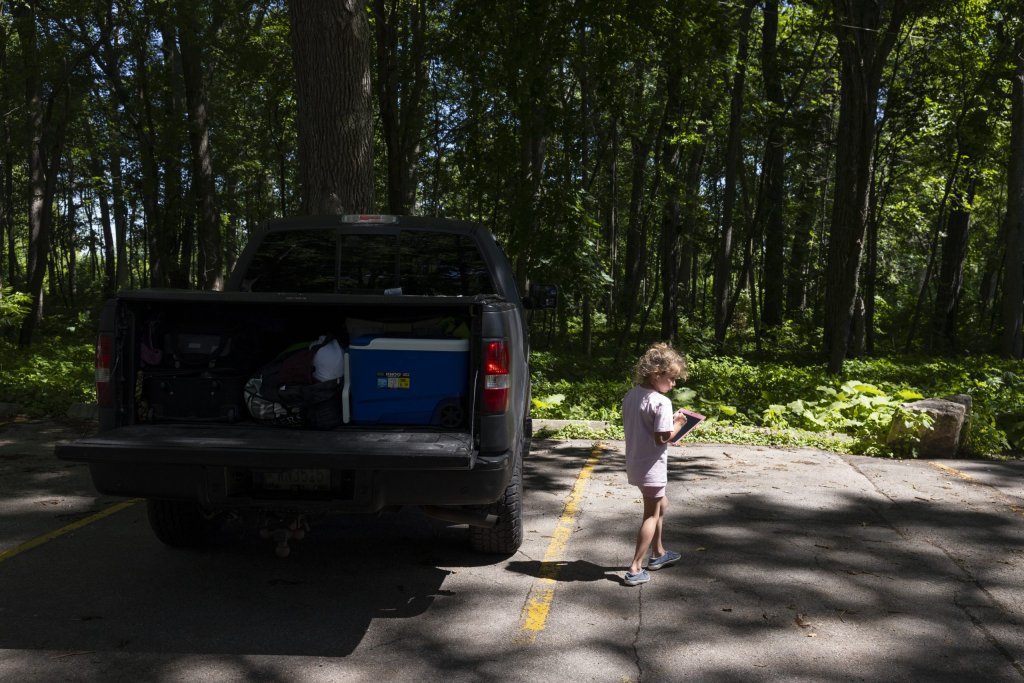
The family spends most days hopping between parks, sleeping on a mattress in their van at night. Their five years of homelessness have taken them to hotels, shelters and parking lots around rural northeast Wisconsin, northern Michigan and finally Green Bay, where they hope to stay while their kids go to Starr Elementary School.
According to data from the U.S. Department of Housing and Urban Development, in 2025 over 5,200 people in Wisconsin experienced homelessness, which has risen 16% over the past five years. Of those, nearly 1,900 were people in families with children – accounting for 561 families.
Because of the way homelessness is counted, that number could actually be much higher. Volunteers have to search for unsheltered people on a single night in January and confirm each person is homeless to add them to the point in time count. The process means it’s often hard to see the “hidden homeless” population living in their vehicles.
The count indirectly ties to the amount of federal funding each region receives for homeless support services — which means there simply aren’t enough resources for homelessness service organizations to provide for the entire homeless population. People like Gray and Moncada have spent years on the waitlist for housing programs meant to help homeless families.
Adding to funding uncertainty, the Trump administration announced major changes to federal homelessness grants and an overhaul of the Head Start early childhood education program for low-income families, where Gray and Moncada sent their twin daughters and enrolled their son this year.
Trying to find housing, work while raising children
The family became homeless during the COVID-19 pandemic, around the time when their twins were born. When the anti-poverty nonprofit Newcap opened a shelter in Shawano, they were one of the first families accepted and stayed there for almost two years. Gray and Moncada said a Newcap employee made false promises about securing them a rental apartment that never came through.
Navigating a system with limited resources while taking care of young children can force families to make hard decisions. They eventually ended up at Abundant Life Mission, a shelter in Menominee, Michigan, near the Wisconsin border, but Gray said he left because he didn’t want the kids to interact with people staying there who struggled with addiction.
That meant going back to living in their car and waiting to be pulled from the waitlist for housing programs. A system called Coordinated Entry prioritizes and matches people with housing resources based on their level of need.
“You feel hopeless, you know what I mean?” Gray said.

Newcap called once a month to ask where the family slept the previous night, part of the process of Coordinated Entry, which the organization led for 10 northeast Wisconsin counties before officials filed for bankruptcy this year. Newcap staff did not contact Gray to tell him the nonprofit closed, even though all of his mail had been going to the Newcap office in Green Bay.
Every weekday for a year, Gray and Moncada drove their daughters to and from the Oneida Nation’s Three Sisters location for Head Start, no matter where they had slept the previous night.
“I think it’s hard for people to understand that I’m over here taking care of three kids, you know what I mean?” he said. “If I had known I’d be taking care of three kids at this age, I would have done some things a little different in my past, too.”
Both Moncada and Gray have to balance the struggles of raising three children without stable housing and securing the employment needed to financially support them. Through the Oneida Nation and Northeast Wisconsin Technical College, Gray earned a traffic control certificate and began working for ANASA Traffic Control Services. But the job required him to drive long distances without reimbursement, knowing his kids needed the car to sleep at night.
“They would never assign me a job in Green Bay,” Gray said. “It was always Sheboygan, Manitowoc, Milwaukee or in Sturgeon Bay, and I’d say, ‘I can’t go to these places, I don’t have gas.’”
So Gray would get marked down for calling in to work, and the next day, he’d be asked to work again in a different city. He was eventually fired in April.
“It’s like, nothing has changed since yesterday. I still have no gas … But I didn’t tell them my situation, that my family needed my car, because I was embarrassed to tell them,” he said.

Searching for a new job was hard since he couldn’t find people to look after the kids so he could go to a job interview. Moncada was working at Burger King at the time.
“I’m worried about them during the day: where they’re going, if they have gas, if they have food. It’s such a struggle, and it’s a lot of stress on him,” Moncada said.
After a few months of searching, Gray recently got a job as a forklift operator in Appleton. The family is trying to work out how they’ll balance Gray commuting to Appleton for third shift while still sending the kids to Starr Elementary School and Green Bay’s Head Start program.
“It’s so hard to have that stability with employment when you don’t have a stable place to live,” Moncada said. “You don’t have gas to go to work the next day because you’re out riding around because you got nowhere to go.”
Safe Place Parking offers ‘peace of mind’
Programs like Safe Place Parking, hosted by Wise Women Gathering Place, provide a potential solution — a reliable place for people living in their cars to park at night without fear of being woken up and asked to leave. Gray and Moncada park there almost every night.
Beverly Scow is the executive director of Wise Women Gathering Place, a nonprofit that provides Native American culturally specific services related to domestic violence and historical trauma. Even though they only account for 1.1% of the U.S. population, Native Americans make up 3.8% of the unsheltered homeless population.
“Part of our resilience is as Native Americans, there was a lot of harm done to our communities, our people, and we survived,” Scow said. “And some of the survival patterns were unhealthy, and some of them were beautiful, right? The culture helped us keep strong and healthy, and so we’ve got a mix of those that have echoed forward.”

The organization originally created Safe Place Parking in response to unhoused people not being able to stay with friends or family during COVID-era social distancing.
“We knew about the hidden homeless who were couch surfing, and most landlord guest policies are up to two weeks,” Scow said. “People would stay under the radar and couch surf between friends and family (for) about two weeks, which totally collided with our understanding of COVID transmission at the time.”
Scow soon realized there was a legitimate need for Safe Place Parking to continue for the many people who live out of their cars. The organization now provides portable toilets, electrical outlets, Wi-Fi, heated blankets in the winter and fans in the summer for up to 46 cars each night.
“There’s a lot of people who are living in their cars and deal with the anxiety of being shooed off a residential street or shooed off a business parking lot, and at Safe Parking, they could have peace of mind to know I belong here, this is my place where I can get a restful night’s sleep,” Scow said.
Last year, Scow said she found out Wise Women’s insurance wouldn’t cover the Safe Place Parking program. The organization had to close the parking lot for four months while searching for an insurance company that would cover the scope of the parking lot for the homeless.
Eventually, Scow found one, but it was five times the price of what Wise Women had been paying. To make things worse, the organization lost two major grants while the parking lot was closed. So the community raised $60,000 in individual donations so the parking lot could reopen in December 2025.
“We saw how important it was to the parkers,” Scow said. “They were so appreciative … and it was such a gap. There’s no one else doing it, so it was important to us to keep it going.”

Annette Rivera can attest to that. She lost her housing in 2024 while Safe Place Parking was temporarily closed. She worked out an arrangement to park at the YMCA at night, but said police came to her car twice in the middle of the night.
“Once you’re in that situation, you don’t sleep 100%,” she said. “You’ve got to sleep with one eye open and one closed, if anything.”
She stopped taking her nighttime medicine so she would be alert. Rivera still wakes up every hour or two at night to adjust her sleeping position in the cramped car.
“It’s uncomfortable,” she said. “You’re not sleeping stretched out. I sleep (in) like a fetus position or an L. Especially at a certain age, it hurts.”
She’s been using Safe Parking for two years now. At 57 years old, she doesn’t meet the age requirement for most subsidized housing for older adults.
Holding out hope
Still, Rivera is grateful for Safe Place Parking and sees her situation as temporary.
“God is good,” she said. “It could be worse.”
Rivera can also relate to Moncada and Gray’s challenges in raising young children while grappling with the daily realities of sleeping in a car. She spends her days watching her three grandchildren while her daughter works as a dental assistant. At Safe Place Parking, Rivera feels for the parents she sees and once spoke to Moncada.

“I was wondering, hoping, praying,” Rivera said. “I told her, I said, ‘I really hope you find a place for the kids.’”
Moncada said she tries to give the kids the best life she can. They play with kites, go swimming, play baseball and forage for mushrooms. Along the way, she tries to teach them about the natural world.
“They’re really, really into bugs,” she said. “So, if we go somewhere, they’re over there lifting up rocks and stuff, trying to find whatever millipedes, centipedes, everything … they’re so fascinated by everything, and curious to learn about so many things.”
Moncada, a member of the Oneida Nation, dreams of one day owning land on the reservation and building a house. She thought about advocating for herself through the General Tribal Council, but she worries about speaking in front of thousands of others who might need help more than her.

“That’s all I want, it’s all I dream about,” Moncada said. “I imagine what it would be like if we did have our house finally, and how that life would be, if our relationship would be better, or how happy our kids would be, what they would be doing, where they would put things, you know?”
She feels hopeful that one day, it’ll happen. In the meantime, she wants to be there for her kids while she and Gray work toward getting their own place and not having to rely on anyone.
“I can imagine us getting there. I have a whole vision of it, and I can almost feel the happiness in me when I think about it,” she said. “That’s a good thing, and I don’t want anything to ever take that away.”

Wisconsin Watch is a nonprofit, nonpartisan newsroom. Subscribe to our newsletters for original stories and our Friday news roundup.
Green Bay’s ‘hidden homeless’ maintain hope while living in their vehicles is a post from Wisconsin Watch, a non-profit investigative news site covering Wisconsin since 2009. Please consider making a contribution to support our journalism.
