


- Pledges to protect the world’s oceans are featured prominently in countries’ action plans to meet the targets set out in the Global Biodiversity Framework — the international agreement to reverse nature loss — according to a new report released by two organizations during the U.N. biodiversity conference (COP17) held Oct. 19-30 in Yerevan, Armenia.
- Yet the report says most pledges related to ocean biodiversity are only “weakly anchored” in policy and accountability measures, raising concerns about how they will be fulfilled.
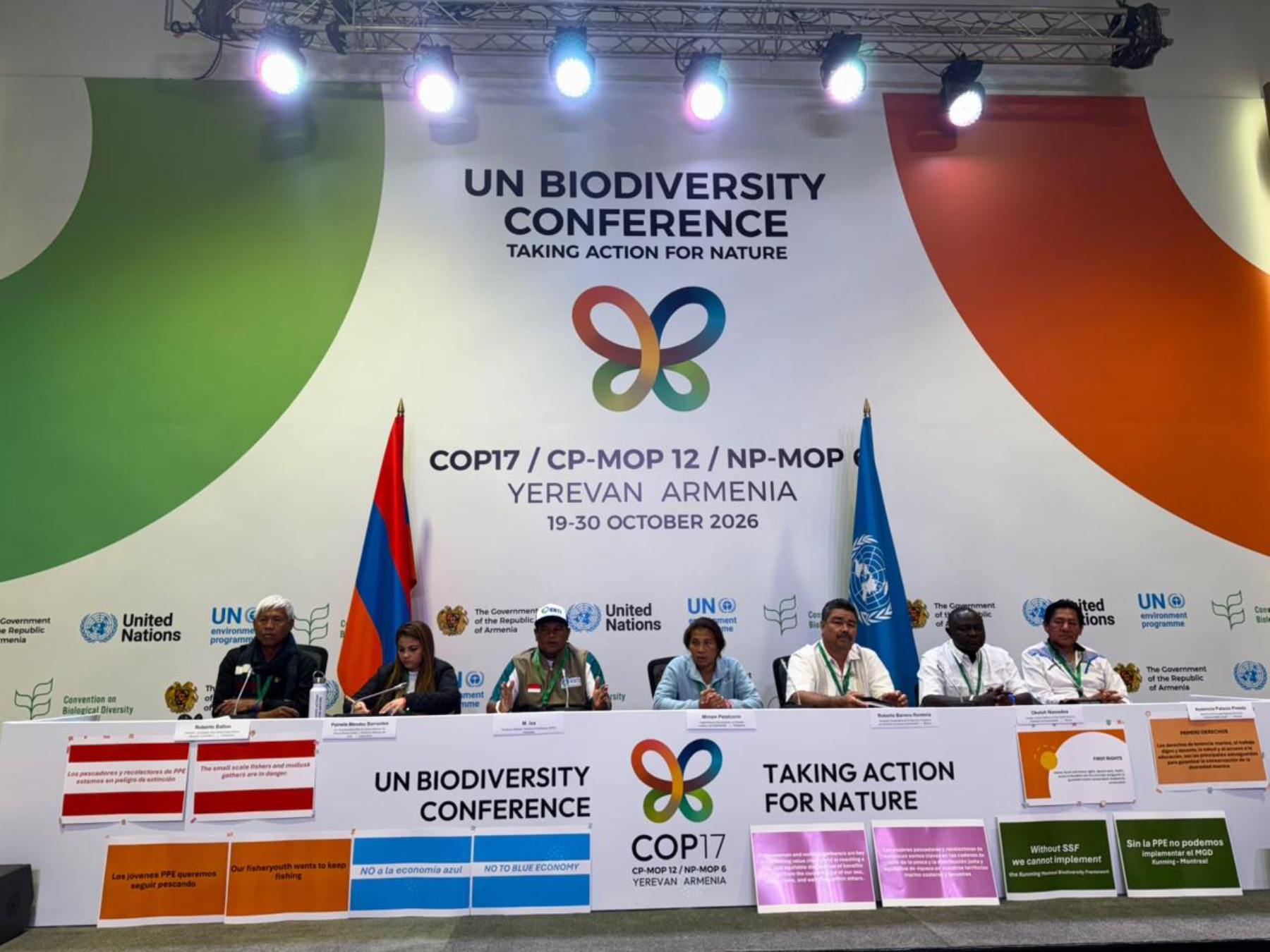
- Speaking during the conference, a group of small-scale fishers underscored the report’s finding that few country commitments addressing the economics of fishing focus on small-scale fishers, and said their role as coastal custodians is often overlooked.
- Instead, the fishers said, governments are focused on creating Blue Economy initiatives, prioritizing sectors such as tourism and shipping and excluding local, small-scale fisheries.
A new report finds that countries around the world have committed to supporting sustainable fishing as a way to counter marine biodiversity loss, but urges them to strengthen accountability measures and do more to support small-scale fishers.
The report, jointly published by the U.K.-based nonprofit the Marine Stewardship Council and the U.S.-based global research organization World Resources Institute (WRI), was released at the U.N. Convention on Biological Diversity summit (COP 17) held Oct. 19-30 in Yerevan, Armenia, and analyzes government pledges made under the Kunming-Montreal Global Biodiversity Framework (GBF). Launched at COP 15 in 2022, the GBF was heralded as a major breakthrough, establishing 23 targets aimed at reversing biodiversity loss by 2030.
Now, at the framework’s halfway point, the new report takes stock of progress toward meeting those targets in relation to ocean biodiversity. It analyzed 812 fisheries-related commitments across the 74 National Biodiversity Strategies and Action Plans (NBSAPs) from coastal and island state countries and the European Union that had met the deadline to submit their plans. NBSAPs are pathways countries are developing in pursuit of the GBF targets. The most cited commitments focused on fisheries management, stronger governance, and science and data collection.
The analysis found that while all national plans included at least one fisheries-related pledge, and 60% contained a measurable metric or deadline, just 27% directly referenced an existing policy, and only 13% included both. So, while fisheries and aquaculture are broadly recognized across NBSAPs, the report says, most biodiversity pledges are only “weakly anchored” in policy and accountability measures, raising concerns about how they will be fulfilled.
Speaking to Mongabay at COP 17, Tom Pickerell, global director of WRI’s Ocean Program, said it was encouraging that all the countries analyzed had made pledges that “recognize that fisheries are part of biodiversity … [and] will contribute to biodiversity targets one way or another.”
However, Pickerell added, “there’s an implementation gap.” Governments, he said, need to strengthen pledges with specific targets and timelines grounded in active policies.
Few commitments for small-scale fisheries
The report also highlights that while market forces strongly influence fishing and biodiversity, just 10% of country commitments address the economics of fishing. Of those, only 5% focus on small-scale fisheries, and another 5% on equity.
“The human and economic dimensions of fisheries, particularly small-scale fisheries, remain under-represented in biodiversity planning,” Pickerell said. “We’re still looking at fish … we’re not really looking at people.”
In an email, Robin Davies, sustainable fisheries lead for the global NGO World Wildlife Fund (WWF), told Mongabay he welcomed the report and its recognition of the importance of small-scale fisheries. “While it is encouraging to learn that governments are recognizing fisheries in their updated NBSAP strategies, this must now translate to tangible commitments,” he said.
Despite their critical importance to global food security and nutrition, Davies said, ocean food systems are not adequately represented in policy conversations and are under-prioritized for investment. “This is especially true for those who depend on this resource the most, such as those in coastal regions, and this is reflected in the report’s finding that only 5% of commitments focus on small-scale fisheries,” he said.

This point was driven home by a delegation of small-scale fishers at the COP, brought together by Blue Ventures, a U.K.-based marine conservation NGO that works with coastal communities in 11 countries to protect ocean biodiversity and improve local livelihoods for fishers.
Speaking at a press conference on Oct. 20, the fishers said current efforts to protect 30% of the planet by 2030 were failing to draw on their knowledge and experience, given that they had successfully managed and protected the earth’s aquatic ecosystems for centuries. Some fishers expressed anger at the failure of governments to stand by pledges and honor existing legislation designed to protect their livelihoods.

Many of the world’s coastal and island nations have adopted the blue economy model, a development framework defined by the World Bank as “the sustainable use of resources for economic growth, improved livelihoods, and job creation while preserving the health of ocean ecosystems.” But a growing number of small-scale fishers and coastal community members say that, in practice, the model has harmed local people and the environment.
Speaking through an interpreter, Costa Rican fisher Pamela Méndez, who as the national coordinator of the regional Marine Responsible Fishing Area and Marine Territories of Life Network represents 23 small-scale fishing communities, said they felt invisible and ignored. Méndez said governments in the region are prioritizing tourism activities such as surfing and sports fishing over small-scale fishing, and the focus on the blue economy means fishers have fewer opportunities to work.
Costa Rica, she said, had in some cases generated economic development agreements with businesses and other organizations while failing to inform or involve fishing communities.

Ausencio Palacio, who previously served as Panama’s vice minister for Indigenous affairs, is a member of the Ngäbe Buglé, the country’s largest Indigenous group, with responsibility for its marine and coastal conservation issues. He said fishers wanted to be able to follow their traditional ways of conserving coastal areas, but that the Panamanian government was not listening to them.
Palacio said he was particularly worried about plans by the government to grant additional environmental protection to areas within Indigenous communities’ traditional lobster fishing territories, which threatens to shut them out of some long-term fishing grounds.
Roberto “Ka Dodoy” Ballon, a fisher and prominent environmentalist from Zamboanga Sibugay, Philippines, also criticized how governments are pursuing blue economy goals. “We are not included in the planning and the process,” he said. “The blue economy is about shipping and eco-tourism, but where do small-scale fishers fit in?”
“We are calling for the support from our government and the community around the globe to protect our rights, to be heard and to be part of the decisions,” Ballon said.

Banner image: During a press conference on Oct. 20, 2026, a delegation of small-scale fishers at COP 17 said they felt invisible and ignored as governments pushed ahead with efforts to protect ocean biodiversity that they say sidelined their traditional skills and knowledge. Image by Mark Hillsdon.
Sour on the ‘blue economy,’ small-scale fishers seek ‘blue justice’ instead
Feedback: Use this form to send a message to the editor of this post. If you want to post a public comment, you can do that at the bottom of the page.

