


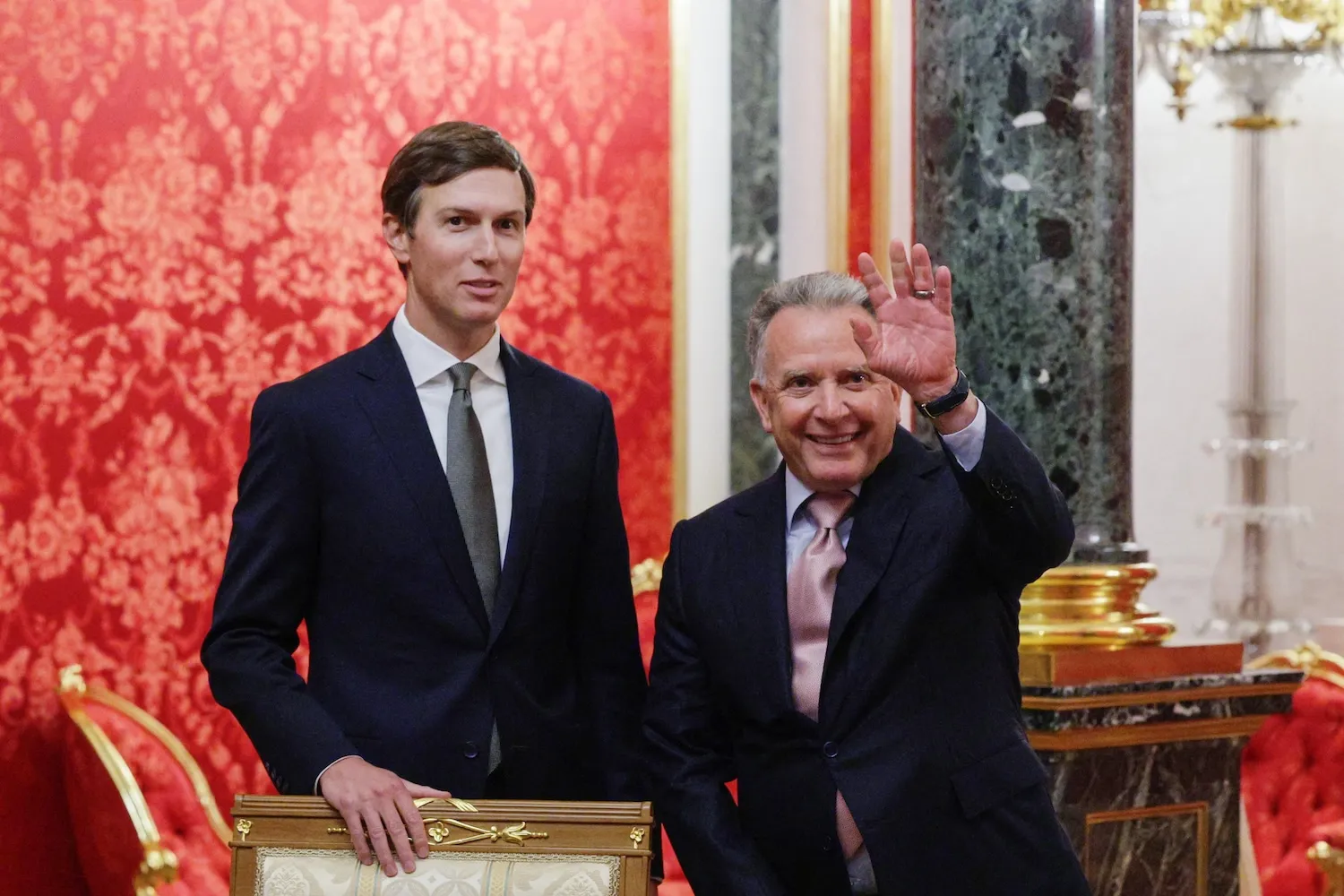
Jared Kushner and Steve Witkoff are unofficial presidential envoys, personally selected by U.S. President Donald Trump to handle critical negotiations over Ukraine, Gaza, and Iran. While it’s safe to say neither was selected after a long and extensive search (Kushner is Trump’s son-in-law and Witkoff is a longtime friend and golfing buddy), let’s be charitable and assume that they have been genuinely trying to reach agreements that would advance U.S. interests. The question is: Why have they accomplished so little?
Look at the record: The supposed peace deal over Gaza is a sham, as Israel continues to bomb Gaza with impunity, expand its territorial control there, and limit relief aid while tolerating (if not actively helping) Israeli settlers’ violent campaign against Palestinians in the West Bank. Genuine peace may not have been their real objective, however, as Kushner and Witkoff are both ardent Israel supporters who were even less likely to put serious pressure on Israel than former U.S. President Joe Biden (which is saying something). In this view, the Gaza agreement was a Potemkin peace deal whose main goal was to free Israeli hostages held by Hamas and get the conflict off the front pages while tying Israel’s hands as little as possible. If so, then one might concede that they accomplished their objective. But if the goal was peace, they failed.
Similarly, their efforts to negotiate an agreement with Iran before the war never went anywhere, in part because these two amateur diplomats apparently didn’t understand some critical technical details regarding Iran’s nuclear program but also because Trump and Israeli Prime Minister Benjamin Netanyahu decided to launch a war while talks were underway. As with Gaza, the negotiations may have been something of a sham from the start, intended not to reach a lasting agreement but to allow time to prepare for another round of war.
Russia’s war in Ukraine is still raging, too—a direct refutation of Trump’s campaign boast that he could end it in 24 hours. Witkoff and Kushner have met with Russian officials on multiple occasions and offered increasingly generous inducements, even as the administration keeps pressuring Kyiv to cut a deal. The result has been not peace but more war, including expanding attacks on civilian targets in Ukraine and Russia alike.
If judged by whether their efforts have led to peace, in short, Kushner and Witkoff are 0 for 3. To be fair, handling all three of these conflicts at once would tax the abilities of an Otto von Bismarck or a Henry Kissinger, and trying to conduct complex and difficult diplomacy on behalf of an erratic president who is more interested in appearances than achievements would be a challenge for any negotiator. But these handicaps don’t fully explain their repeated failures.
One can think of several reasons why their efforts have been unsuccessful, but a big part of the problem is their overarching worldview. Kushner and Witkoff and Trump are all real estate developers who are preoccupied with making money. That’s the only thing that really matters to them, which is why Trump seems more interested in monetizing the presidency than he is in actually governing and why Kushner may have pocketed billions of dollars in secret payments from the United Arab Emirates and Saudi Arabia (an accusation he denies). If you assume that everyone else is also on the make, then the way to get to yes is to offer your counterparts a sweet deal that will make them richer. In this world, everyone has their price, and the trick is to figure out what that price is and then convince them you can meet it.
This one-dimensional perspective was already evident in Trump’s first term. It lay behind Kushner’s belief that the key to Middle East peace was to ignore the Palestinian desire for statehood or political rights and focus instead on promoting business deals among Israel, some wealthy Gulf states, and (eventually) Saudi Arabia. That same instinct underlay Trump’s belief that he could get North Korean leader Kim Jong Un to give up his arsenal of nuclear weapons by offering an alluring vision of ritzy resorts and luxury condos along North Korean beaches, an idea later recycled as a potential blueprint for Gaza. And it is obviously central to recent attempts to persuade the Kremlin to end its war in Ukraine by buying some Russian diesel fuel, letting Russian companies help develop gas fields in Alaska, talking up lucrative future business deals, and ending Moscow’s economic isolation from the West.
The obvious flaw in this worldview is its failure to recognize that the top priority for smart political leaders isn’t money or wealth—it’s national security. Security is more important because without it, one’s wealth is vulnerable: Having all the money in the world is useless if someone stronger can take it from you. Look at what happened to Kuwait in 1990, when Iraqi leader Saddam Hussein decided to invade the wealthy emirate, simultaneously eliminating one of his main creditors and gaining control of resources that would have increased Iraq’s GDP by roughly 40 percent. And his gambit would have worked had a coalition of outside powers not ridden to Kuwait’s rescue.
Wealth is far from irrelevant, of course, and greed can be a powerful motivator, too. I don’t doubt that Russian President Vladimir Putin would be happy to pocket all those blandishments that Kushner and Witkoff keep dangling as part of an eventual peace deal in Ukraine. But if all he cared about were money, he wouldn’t have invaded Ukraine in the first place, and he wouldn’t have continued to wage war there at considerable economic and human cost. Unless and until the security concerns (whether exaggerated or not) that drove his decision to invade are met, offering him a bunch of economic goodies isn’t going to end the war.
The same is true for Kyiv, of course: If money were all that mattered, the smart move would be to accept the loss of Crimea and the Donbas and hold out for a big aid package to rebuild Ukraine’s shattered economy. But Ukrainians don’t want to surrender lands they regard as rightly theirs, even for a price. Equally important, they don’t want to live in fear of future Russian threats. Thus, a future peace arrangement would have to meet both sides’ security concerns as well as their economic desires.
Nations also care about preserving their identity and cultural autonomy, and those living under a foreign yoke often want to govern themselves. As a result, these groups will sometimes make enormous sacrifices to try to establish their own state. Palestinians won’t abandon their national identity or desire for political rights in exchange for a lucrative economic package (even assuming one were genuinely on offer), and neither will any number of other aspiring national movements. That same sense of national pride also helps explain why bombing other countries to topple a regime or get it to surrender rarely works, even when it is coupled with the prospect of future economic benefits. On the contrary, such actions tend to rally the population behind leaders who might otherwise lack broad support and make them even less willing to compromise.
International politics, in short, is not like real estate development because relations among states take place in an arena where there is no central authority and where some states have the ability and the will to use violence to get what they want. In such a world, states have powerful incentives to guarantee their own security first and then worry about how to become more prosperous. A solid grasp of how business works and experience negotiating complicated deals can be an asset in diplomacy (as former Secretaries of State George Shultz and James Baker demonstrated)—but only if you understand the critical differences between these two realms. Regrettably, Kushner and Witkoff (and Trump) show no sign of having understood the distinction or of having learned very much from their experiences to date. But they (or their families) are making some serious bank while these conflicts rage on, which may have been the real goal all along.
