


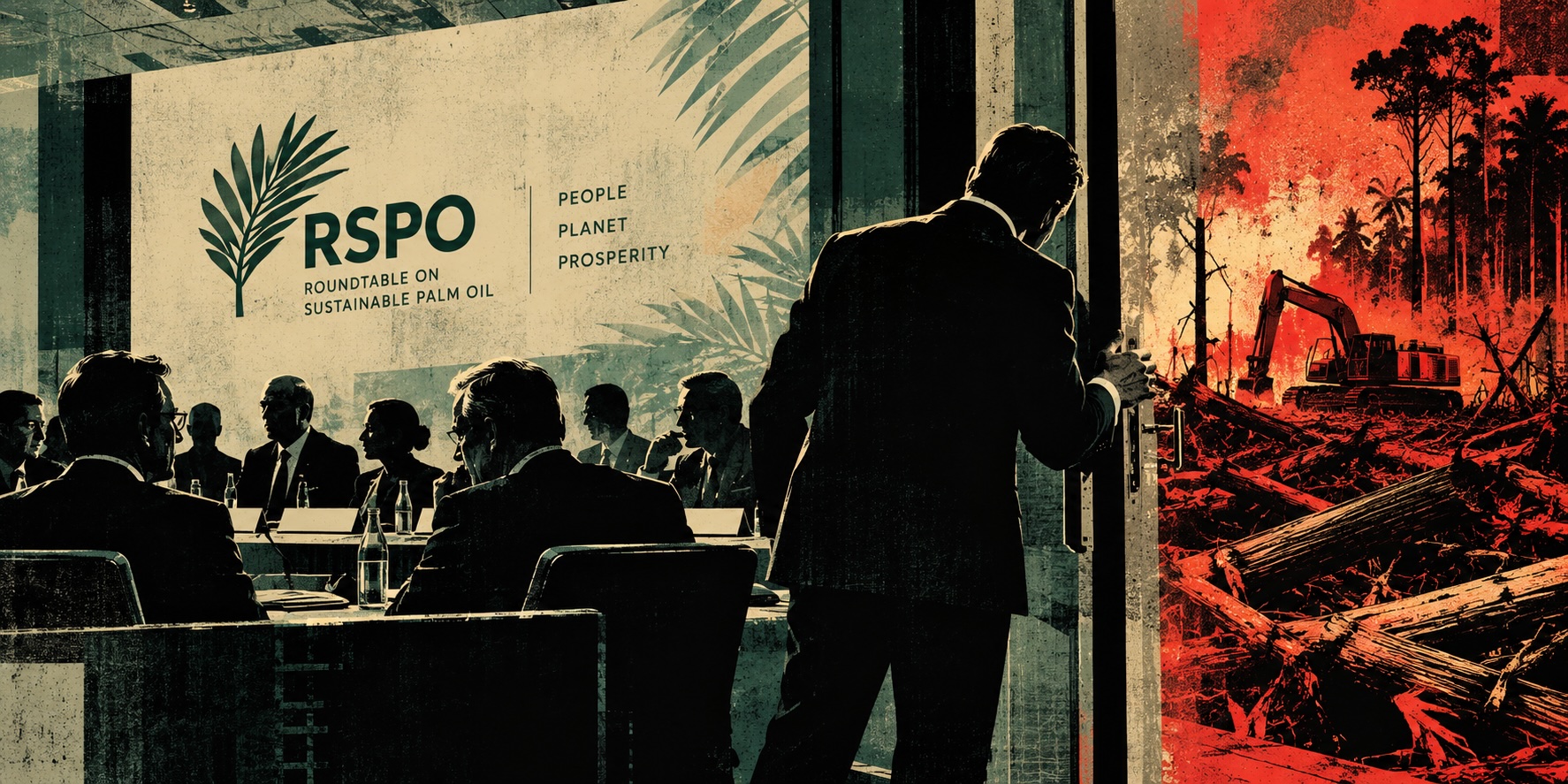
- A new report and unearthed court records raise questions over the palm oil industry body RSPO’s ability to police its members, writes The Gecko Project’s Tom Johnson.
- The report, by Rainforest Action Network, builds on work by The Gecko Project, published in 2023, investigating Singapore-listed, Indonesian-owned First Resources, a palm oil producer alleged to be clearing rainforest through a network of secret companies in Indonesia.
- In December 2025, the RSPO Complaints Panel issued its final ruling on a long-running case against First Resources.
- “If this is a system on which commodity traders moving billions of dollars of palm oil into Europe rely, what did the RSPO-appointed investigators actually look at?” asks Johnson in this commentary piece.
The Roundtable on Sustainable Palm Oil (RSPO) — as the name suggests — sets itself up as the arbiter of what is sustainable in the palm oil industry.
For that to work, it has to do two things. First, it has to make sensible rules about what is and isn’t sustainable. Second, it has to enforce those rules, to ensure that companies whose actions fall outside them do not get to market their products as sustainable. If it does not police the rules, the rules don’t really mean all that much.
Evidence from a new investigation — and newly unearthed court records — shows that it has failed on that second task.
In December 2025, the RSPO Complaints Panel issued its final ruling on a case that had dragged on for more than four years. In a succession of NGO reports dating back to 2017, allegations had piled up connecting Singapore-listed, Indonesian-owned First Resources, an RSPO member and major palm oil producer, to a string of other groups that were still clearing rainforests.
First Resources had first committed to “zero deforestation” in 2015 and was able to access markets closed to unsustainable palm oil through its RSPO membership. But through its apparent control of so-called “shadow companies,” the theory went, the Fangiono family that owned First Resources was simultaneously able to keep expanding into rainforests.
A complaint alleging that the Fangionos controlled two other groups — Ciliandry Angki Abadi and FAP Agri — was first taken up by the RSPO in 2021.
In November 2023, The Gecko Project — together with media partners in Europe, the U.S. and Indonesia — published an investigation based on interviews with more than a dozen former employees of both First Resources and the shadow companies. Several had worked for a group of companies known as New Borneo Agri — since rebranded Kalimantan Agro Sejahtera, or KAS — that had collectively cleared more rainforest to plant oil palms than any other group in Southeast Asia, over the past half-decade.
These employees regarded First Resources, FAP Agri and KAS not as separate groups but as different divisions of a single corporation. They had good reason to see it this way: some said they were recruited by First Resources, then sent to work at FAP Agri or KAS; others said they were moved freely between them by their superiors. They claimed that annual “kick-off” and budget meetings for the groups were all held together, our investigation found.
Whether they worked for First Resources, KAS or FAP Agri, the employees said they reported to the same regional heads. They said their work was ultimately overseen by Cik Sigih and Ciliandra Fangiono, the brothers whose family holds a majority stake in First Resources, and who serve as deputy CEO and CEO respectively. Some said they had seen the brothers make site visits to KAS plantations.
In response to the allegations, First Resources said that KAS was “not a subsidiary, an associated company, nor a related party.” Its board later restated that position in a statement to the Singapore Stock Exchange adding that it “had not purchased any palm oil products from, nor entered into any other transactions” with KAS.
In January 2024, KAS was added to the RSPO complaint. But in 2025 the RSPO Complaints Panel concluded, based on an “independent investigation” it had commissioned, that “there appears to be insufficient evidence to establish a link to uphold the allegation” that First Resources controlled KAS. The RSPO noted in its decision that KAS is majority-owned by a company in the British Virgin Islands whose shareholders are protected by secrecy laws. As such, its owners remained hidden.

Case closed, palm oil flows
The new investigation that casts further light on this comes from the Rainforest Action Network (RAN).
In early 2026, RAN followed palm oil leaving KAS plantations in East Kalimantan, Indonesian Borneo, to see where it would end up. Trucks and barges from different plantations repeatedly converged on a single point, according to RAN’s fieldwork and interviews with staff on the ground: a bulking facility and jetty on the Mahakam River. That facility is operated by First Resources and even appears in one of its RSPO audits. From there, RAN found, the palm oil was shipped downstream to refineries in a “fleet” of barges owned by the Fangionos.
Once you get across the logistical and technical challenge of tracking barges and trucks across Borneo, the picture appears simple — and brazen. In RAN’s view, it shows First Resources and the shadow groups “operate as a coordinated economic enterprise with integrated supply chains.”
If you’re still skeptical, then consider the evidence that emerged in a 2023 court case.
In that case, a truck driver was convicted of attempting to embezzle from a tanker carrying palm oil from a KAS mill. Where was the palm oil being delivered? To the same First Resources facility identified by RAN. According to the court testimony of multiple employees from both KAS and First Resources subsidiaries, palm oil was routinely trucked from the shadow company to that facility over several months in 2023.

‘In the interests of righteousness’
After our investigation was published in November 2023, several consumer goods firms in Europe and the U.S. dropped First Resources as a supplier. Many more withheld their judgment, stating that they would await the outcome of the RSPO case that — by that stage — had been dragging on for more than two years. That included the palm oil trading giants through which most palm oil is channeled.
The ruling has now been made and some of them have treated it as an exoneration of First Resources. All the traders that told us they were awaiting the outcome of that decision — those who responded to our most recent enquiries — said they had kept First Resources in their supply chains.
First Resources itself has declined to fully engage with the evidence unearthed by the new investigation or the court records, insisting instead in response to RAN that “similar allegations” were already “investigated and adjudicated by the RSPO through its formal complaints system, culminating in a final decision that closed the case.” Its position remains that the allegations are false.
The decision by First Resources’ customers to await that judgment and to accept the ruling, means that despite their commitments to sustainability, they remain in business with a corporation that still stands accused of widespread deforestation.
The shadow companies have cleared more than 9,000 hectares (22,200 acres) of rainforest since 2021. Deforestation continued through 2026, after the RSPO dismissed the appeal against its ruling, according to data published by Nusantara Atlas and analyzed by The Gecko Project. This is within a landscape with “incredible biodiversity”, home to orangutans, gibbons, sun bears and helmeted hornbills.
It remains to be seen whether those customers will be satisfied by First Resources’ argument that these issues have now been adjudicated, or more compelled by RAN’s evidence — and the court records — to stop doing business with the group.
This is, no doubt, a headache for the consumer goods firms that just want to agree to a set of rules and have everyone abide by them. That returns us to the point at the top of this article: The system is only as strong as the way it polices its boundaries. Did the handling of the complaint really amount to a “thorough investigation and comprehensive assessment”, as one commodity trader described it to us; one that First Resources beseeched RAN to heed, “In the interest of righteousness”?
If this is a system on which commodity traders moving billions of dollars of palm oil into Europe rely, what did the RSPO-appointed investigators actually look at?

Our own investigation relied not only on the testimony of more than a dozen former employees who independently corroborated the same picture, it also unearthed documentary evidence.
This showed that the sole director of the British Virgin Islands company that owns KAS was, as of October 2023, a member of the Fangiono family. He was also employed by First Resources. In 2019, a woman was granted authority to act as the legal representative of the KAS shareholders. She was also employed as a legal officer for First Resources. We now know that KAS was routinely shipping palm oil to a First Resources facility during and after the complaint.
In other words, there is compelling documentary evidence pointing to First Resources’ control of KAS and to the integration of the two companies’ supply chains.
It is possible that the RSPO-appointed investigator arrived at the correct conclusion based on the question they were required to answer, the limits of the evidence they were asked to consider, the threshold of proof they were required to reach or all three. If so, there was a fundamental flaw in the parameters of the investigation. That in turn leads to the conclusion that the complaints process as a whole was not fit for purpose.
It resulted in a decision that First Resources is now using to dismiss new evidence that it is connected to some of the most destructive palm oil companies in Indonesia. First Resources was effectively cleared — in its interpretation, at least — and within months, RAN found palm oil flowing from the shadow companies to its facility.
If there is an innocent explanation for all this evidence — why a First Resources lawyer was appointed to represent KAS shareholders; why former employees independently regarded the companies as one group; why the Fangiono brothers visited KAS plantations; why a family member was director of the BVI company that owns KAS; why KAS palm oil was routinely delivered to a First Resources facility; why Fangiono barges moved it downriver — I for one would be interested to hear it.
But First Resources has, beyond its denials, offered no proper explanation publicly. And for the RSPO, it’s “insufficient evidence”.
Tom Johnson is director of The Gecko Project, an investigative journalism initiative established to shine a light on the corruption driving land grabs and the destruction of tropical rainforests.
Investigations into Singapore palm oil firm find family ties to Borneo deforesters
Cite this article
Tom Johnson (2026). The RSPO closed the case on First Resources. Indonesian forests kept falling for palm oil (commentary). Mongabay Conservation news. DOI: https://doi.org/10.66709/news-334809

