


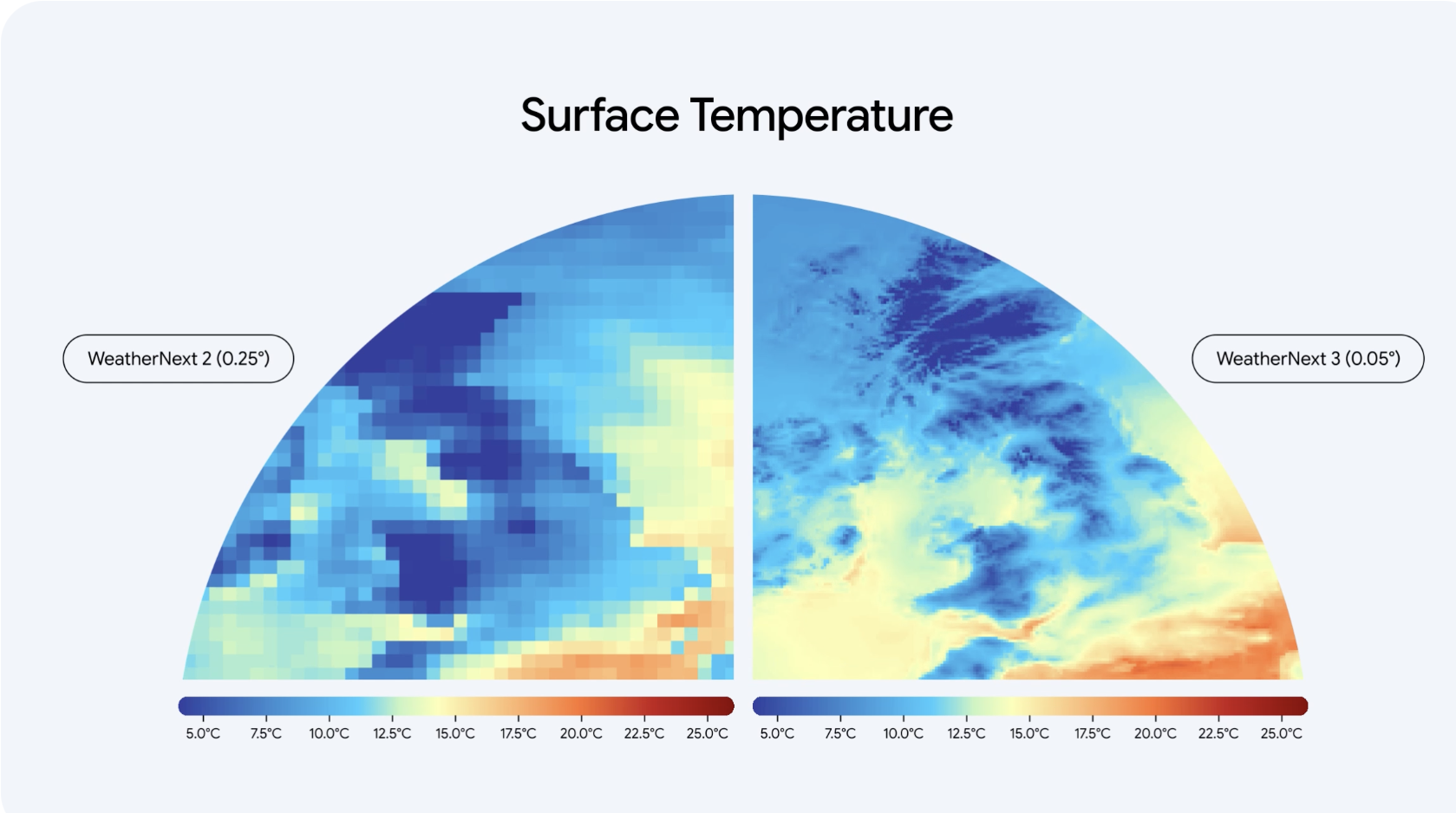
Google’s newest AI weather forecasting model predicts wind speed at 100 metres above the ground, roughly the height of a modern wind turbine. It also forecasts cloud cover and how much sunlight reaches the surface, and it updates every hour. Energy traders, grid operators and wind and solar developers already pay other companies for that data. The introduction of WeatherNext 3 now puts Google in their market.
Google DeepMind and Google Research released the model on September 3. It produces a global forecast every hour at up to five-kilometre resolution for surface variables such as temperature and moisture. The previous version, WeatherNext 2, worked on a 25-kilometre grid and refreshed every six hours. Google says the new energy variables are meant to help grid operators and developers predict how much power their wind and solar assets will generate, then match that against demand.
The consumer side of the launch has had most of the attention. WeatherNext 3 now powers weather results in Google Search, the Gemini app, Google Maps and the Google Maps Platform Weather API. Behind it sits an enterprise layer that matters more commercially. The same forecast data can be queried in BigQuery and Earth Engine or downloaded in bulk from Google Cloud Storage, with no model setup required by the customer.
Why the energy sector is buying AI weather forecasting
Grid operators are running a system that has become harder to predict at both ends. On the generation side, renewables now account for most new capacity. S&P Global Market Intelligence’s US Grid Outlook 2026 projects solar and energy storage as the primary sources of new capacity this year, at 51.2GW and 25.7GW respectively out of more than 90GW of planned additions.
Solar and wind generate according to the weather rather than demand, so each gigawatt added makes a short-term forecast more accurate.
On the consumption side, the new load is coming from AI. S&P Global identifies the spread of data centres across North America as a primary driver of the recent surge in electricity demand, forcing utilities to revise their load forecasts upward. Deloitte’s 2026 Power and Utilities Industry Outlook projects peak demand growing by roughly 26% by 2035, with data centre demand alone potentially reaching 176GW, five times its 2024 level.
The cost of getting a forecast wrong is straightforward. If an operator underestimates how much wind power will arrive, it has to buy replacement electricity at short notice, usually from gas plants kept on expensive standby. If it overestimates, wind and solar farms end up being paid to switch off because the grid cannot absorb what they are producing. Both outcomes are expensive, and both are forecasting failures.
The market Google is entering
Selling weather forecasts to the energy sector is an established business. Vaisala, Solcast, DNV’s WindGEMINI and IBM’s HyperWatch all compete in it. So does Jua, a Swiss firm that claims its EPT-2 model beats Microsoft Aurora and DeepMind’s earlier GraphCast on accuracy while updating 24 times a day, against what it describes as a typical four updates a day among competitors.
Google’s advantage is reach. The same forecast appears as a table in BigQuery, a layer in Earth Engine, an API in Google Maps Platform and the default answer in Google Search. No specialist vendor has that spread, and the hourly refresh closes the update-frequency gap those vendors have used to differentiate themselves.
The incumbents have one technical argument left. Jua’s published position is that physics-based models such as ECMWF’s HRES still outperform purely data-driven AI models during record-breaking extreme weather, because physics models encode rules about how energy and mass move through the atmosphere, while AI models learn patterns from past data.
Jua sells a physics-constrained product, so the claim serves its own interests. It also describes the conditions grid operators worry about most, when a storm falls outside anything the model has seen in training.
What is new, and what is being oversold
WeatherNext 3 system architecture showing satellite mosaic and analysis inputs producing gridded forecasts, station data and cyclone tracks. Photo from Google’s blogThe architectural claim behind WeatherNext 3 is that it learns from real observations instead of from simulations. Most AI weather models, WeatherNext 2 included, are trained on output from numerical weather prediction models, which are supercomputer-driven physics simulations that carry a six-hour data lag. That lag can introduce bias in fast-changing variables such as rain and surface temperature. WeatherNext 3 ingests live geostationary satellite imagery and trains directly on readings from individual weather stations.
The shift is real, though narrower than much of the coverage has suggested. Google’s own system diagram shows the model taking in one-hour satellite mosaics alongside traditional historical analysis. DeepMind senior research scientist Ilan Price told Bloomberg the gain comes from not waiting for the next analysis and using the most recent information available instead.
Reporting puts the remaining data lag at three to four hours, down from about seven. Dependence on numerical weather prediction has been reduced, not removed.
The accuracy figures need similar care. Google reports improvements of up to 60% against NASA’s IMERG satellite product, 30% against MRMS radar and 10% against rain gauge readings at early lead times, measured using a standard scoring method for probability forecasts. Those are three separate baselines, and the percentages do not add together. The widely repeated claim of 50% better precipitation forecasting applies specifically to forecasts a day or more ahead. Every figure carries an “up to” qualifier, which makes each one a best case rather than a typical result.
Google published no independent third-party validation alongside the launch. It points instead to live evaluations by Brightband, whose leaderboard it cites in claiming WeatherNext 3 is the most accurate global weather model to date. A utility considering a switch away from a paid specialist will care more about performance in its own service territory, on its own assets, than about a global leaderboard position.
Google’s own stake in the problem
Google is selling forecasting tools into a grid problem its own industry helped create. The data centre build-out driving the load growth utilities are struggling to serve is led by the hyperscalers, Google among them, and Google has signed multi-gigawatt renewable procurement agreements to supply its own facilities.
Accurate prediction of wind and solar output is directly useful to a company matching large volumes of clean energy against a load that is both growing and variable. That is commercial logic, and it goes some way to explaining why the energy variables shipped in this release.
Google has not published pricing for enterprise access to WeatherNext 3, or said whether the BigQuery and Earth Engine data carries standard Cloud query charges or a separate licence. Utilities weighing a move away from a paid specialist will want that figure before they weigh any accuracy claim.
2025, more than 65,000 employees in its Corporate and Investment Bank were actively using the platform, while more than 90% of its engineers were using AI coding assistants.
The bank also said AI-based transaction screening allowed it to review more than twice the previous transaction volume while reducing manual operator checks by half.
Bank of America is using a generative AI-enabled system called EricaAssist with more than 18,000 customer service employees. The tool summarises why a customer is calling, retrieves relevant information, and recommends possible next steps while keeping the employee responsible for the interaction.
Bank of America said in July 2026 that EricaAssist can deliver contextual guidance in under three seconds and has reduced average call times by nearly one minute. The bank plans to extend the system to additional servicing scenarios and business lines later in 2026.
(Photo by Google)
See also: MIT AI forecasts extreme weather without historical data

Want to learn more about AI and big data from industry leaders? Check out AI & Big Data Expo taking place in Amsterdam, California, and London. The comprehensive event is part of TechEx and is co-located with other leading technology events, click here for more information.
AI News is powered by TechForge Media. Explore other upcoming enterprise technology events and webinars here.
