

Close Menu
NCIJ Network NCIJ Network
    What's Hot

    AI reveals a massive algae boom across the world’s oceans

    August 5, 2026

    Malaysia implements total e-waste import ban to curb toxic trade

    August 5, 2026

    Shell’s JV chooses ECOnnect’s jettyless import solution for Caribbean LNG project

    August 5, 2026
    Facebook X (Twitter) Instagram
    Trending
    • AI reveals a massive algae boom across the world’s oceans
    • Malaysia implements total e-waste import ban to curb toxic trade
    • Shell’s JV chooses ECOnnect’s jettyless import solution for Caribbean LNG project
    • Democracy is at stake when foolish humans bet on machines being intelligent | Rafael Behr
    • AI before AI: The legacy of Norbert Wiener’s cybernetics (3/3)
    • Russian ballistic missile strike on Kyiv kills at least 17
    • Burnham considering public inquiry into UK activities of Jeffrey Epstein | UK news
    • A New Device Eases One of the Most Annoying Parts of Routine Physicals
    • About
      • Our Team
      • Editorial Policy
      • Editorial Independence
      • International Support
    • Trust & Standards
      • AI Usage Policy
      • Conflict of Interest Policy
      • Corrections Policy
      • Ethics Policy
      • Fact-Checking Policy
      • Source Protection
    • Get Involved
      • Guide for Sources
      • Support Independent Journalism
    • Legal
      • Cookie Policy
      • Privacy Policy
      • Terms of Use
    Facebook X (Twitter) Instagram
    NCIJ Network NCIJ Network
    Wednesday, August 5
    • Home
    • World
    • Ai
    • Business
    • Politics
    • Health
    • Crypto
    • Science
    • Technology
    • Cybersecurity
    • Defense & Security
    • Economy
    • Energy
    • Europe
    • More
      • Fact Check
      • Investigations
      • Opinion & Analysis
      • Environment
    NCIJ Network NCIJ Network
    Home»Science

    Giant waves are sweeping Mars’ atmosphere into space

    NCIJ NETWNCIJ NETWORKBy NCIJ NETWNCIJ NETWORKAugust 5, 2026 Science No Comments4 Mins Read
    Share
    Facebook Twitter LinkedIn Pinterest Email

    The Sun continuously sends a fast stream of charged particles through space, a phenomenon known as the solar wind. Earth is largely protected from this flow by its global magnetic field, but Mars has no comparable shield. This leaves the planet’s upper atmosphere exposed, allowing the solar wind to knock atmospheric particles away and carry them into space.

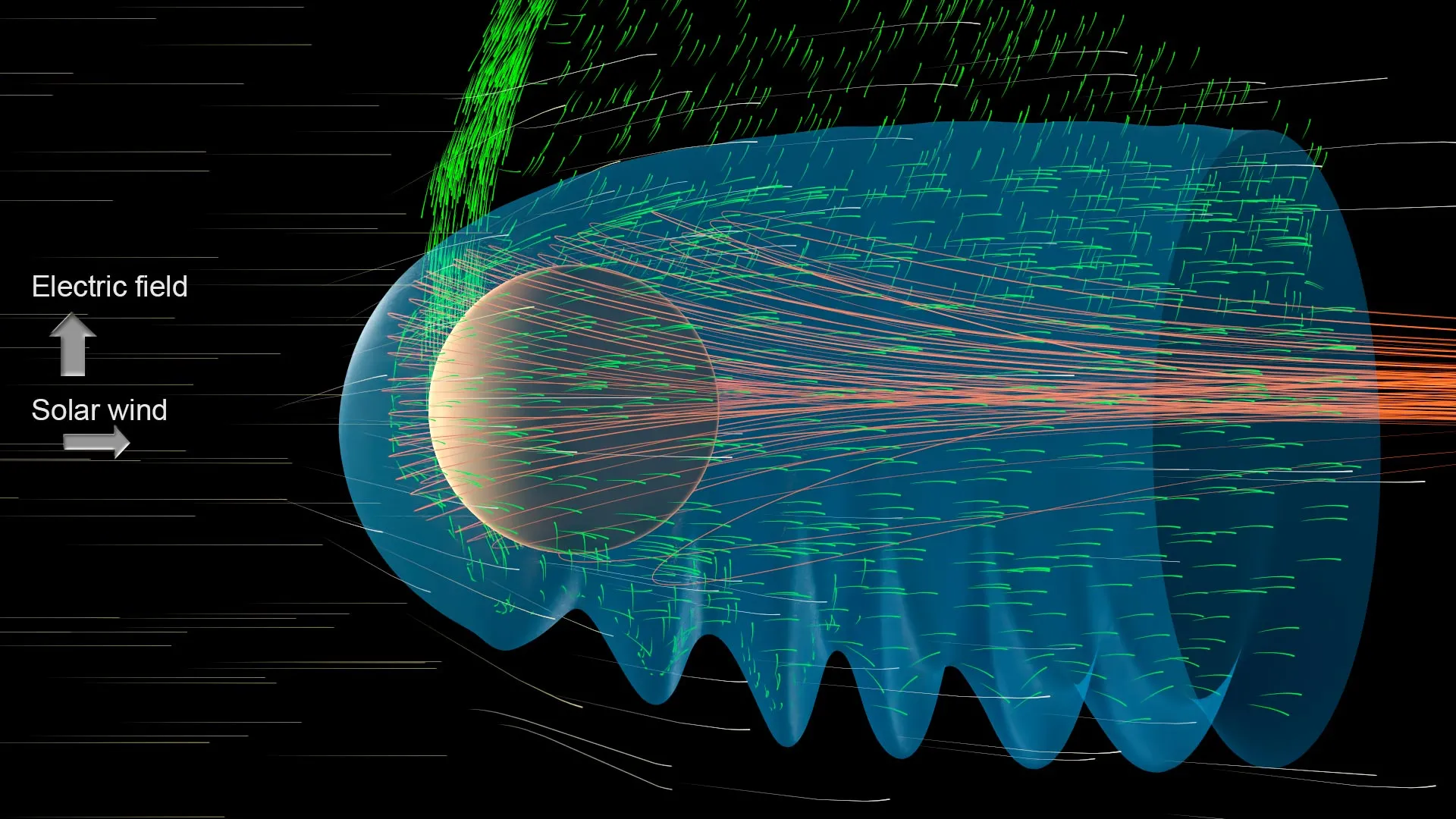
    A new study led by Boston University and published in Science Advances suggests that this atmospheric loss can resemble wind moving across water. On Earth, wind passing over a body of water can create rolling waves and swirling vortices. At Mars, the solar wind appears to produce a similar effect by “stirring” the outer boundary of the upper atmosphere.

    This interaction generates enormous boundary waves called Kelvin-Helmholtz waves.

    First author Chi Zhang, a research scientist at BU’s Center for Space Physics, a collaboration between BU’s College of Arts & Sciences and College of Engineering, worked with colleagues to analyze data from the MAVEN and Tianwen-1 missions. Tianwen-1 measured the incoming solar wind before it reached Mars, while MAVEN tracked atmospheric ions escaping near the planet.

    By combining the two sets of observations, the researchers could directly compare changing solar wind conditions with the movement of Martian atmospheric particles into space.

    Two Spacecraft Reveal Atmospheric Escape

    Large clouds of plasma in the upper atmosphere can produce what researchers call the “bulk escape” of atmospheric ions. Scientists had previously proposed several possible explanations for how these clouds formed, but their origin remained uncertain because direct evidence was limited.

    One major obstacle was that a single spacecraft could not observe the undisturbed solar wind upstream of Mars while also measuring atmospheric ions escaping closer to the planet.

    In an earlier study published in Nature Communications, Zhang and his colleagues showed that simultaneous measurements from MAVEN and Tianwen-1 could connect changes in the incoming solar wind with conditions around Mars. The new Science Advances study builds on that work and identifies Kelvin-Helmholtz waves as an important mechanism behind atmospheric ion loss.

    The researchers found clear evidence that these waves generate the large plasma clouds associated with atmospheric escape. They also discovered that the process is not distributed evenly around Mars.

    “Instead, it is mainly observed on one side of the planet, depending on the direction of the solar wind electric field,” said Zhang.

    The findings provide a direct connection between Kelvin-Helmholtz waves and increased atmospheric ion escape from Mars.

    Measuring the Waves That Drain Mars

    “Future research will focus on identifying the conditions that favor the formation and growth of Kelvin-Helmholtz waves and determining how much they contribute to atmospheric escape from Mars,” Zhang noted.

    Answering those questions will require additional spacecraft measurements and advanced computer simulations. MAVEN is now moving toward the closeout stage of its mission, but researchers expect future missions to continue its work.

    “Its rich scientific legacy will be complemented by NASA’s ESCAPADE mission, which has already launched and will provide an important new opportunity to investigate solar-wind-driven atmospheric loss at Mars,” said Zhang.

    “We want to know when these waves are most likely to form, how they evolve, and how strongly they can drive atmospheric escape,” said Chuanfei Dong, a BU Center for Space Physics faculty member and a College of Arts & Sciences assistant professor of astronomy. “This process could also occur on other planets that lack a strong magnetic field, including some exoplanets.”

    A Clue to Mars’ Lost Habitability

    Understanding atmospheric escape could help explain the dramatic transformation Mars experienced over its history.

    “Mars is thought to have once been potentially habitable, with a thicker atmosphere and surface liquid water. Understanding how it became the cold, dry planet we see today is important for understanding how planetary environments evolve over time,” said Zhang.

    Atmosphere giant Mars Space Sweeping waves
    NCIJ NETWNCIJ NETWORK
    • Website

    Keep Reading

    AI reveals a massive algae boom across the world’s oceans

    NASA Provides Updates on Moon Base Cargo Landers, Tech Demonstrations

    A common sugar may help cancer cells break free and spread

    Scientists just 3D printed one of the hardest metals on Earth

    DNA on the Shroud of Turin reveals centuries of hidden history

    August 2026 Satellite Puzzler – NASA Science

    Add A Comment
    Leave A Reply Cancel Reply

    Editors Picks

    AI reveals a massive algae boom across the world’s oceans

    August 5, 2026

    Malaysia implements total e-waste import ban to curb toxic trade

    August 5, 2026

    Shell’s JV chooses ECOnnect’s jettyless import solution for Caribbean LNG project

    August 5, 2026

    Democracy is at stake when foolish humans bet on machines being intelligent | Rafael Behr

    August 5, 2026
    Latest Posts

    Oil prices hit $100 for the first time since May

    July 23, 2026

    Pew Survey: China May Be Liked More, but It Is Celebrating a Race It Never Ran

    July 23, 2026

    Yinson Production and PTSC’s FSO heads off to Southeast Asian oil project

    July 23, 2026

    Subscribe to News

    Get the latest sports news from NewsSite about world, sports and politics.

    NCIJ Network is an independent digital news platform delivering trusted investigative journalism, European and global news, in-depth analysis, and fact-based reporting with accuracy, transparency, and integrity.

    Facebook X (Twitter) Instagram Pinterest YouTube

    AI reveals a massive algae boom across the world’s oceans

    August 5, 2026

    Malaysia implements total e-waste import ban to curb toxic trade

    August 5, 2026

    Shell’s JV chooses ECOnnect’s jettyless import solution for Caribbean LNG project

    August 5, 2026

    Subscribe to Updates

    Get the latest creative news from FooBar about art, design and business.

    Type above and press Enter to search. Press Esc to cancel.