


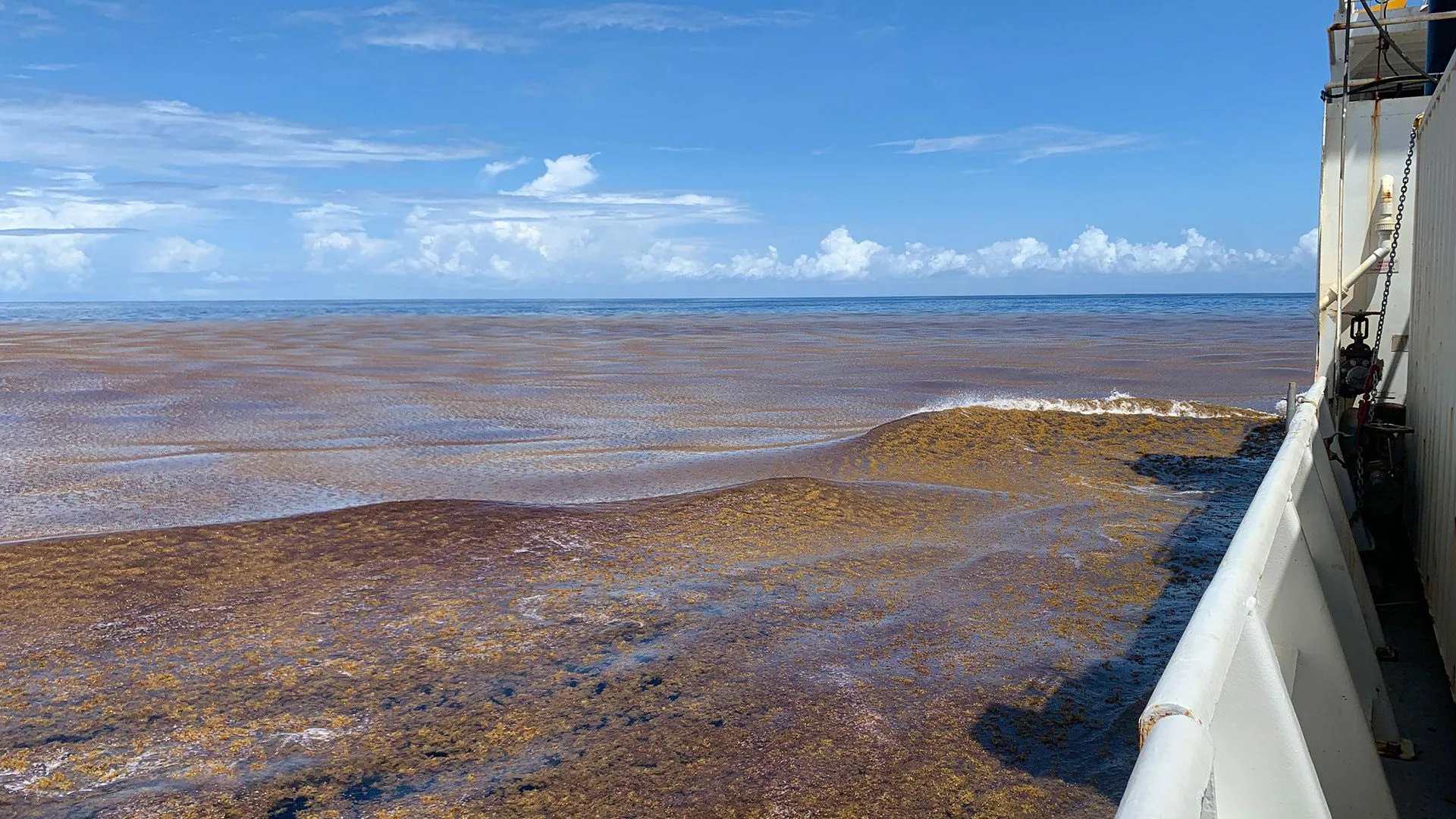
Artificial intelligence has helped scientists produce the first comprehensive global assessment of floating algae, revealing that blooms are spreading across much of the world’s ocean.
Researchers say the expansion is likely being influenced by changes in ocean temperatures, currents, and nutrient levels. The shift could bring major consequences for marine ecosystems, tourism, public health, and coastal economies.
The study was led by scientists at the University of South Florida and the National Oceanic and Atmospheric Administration. It also highlights how artificial intelligence can be used to process enormous volumes of satellite data that would be difficult to examine manually.
AI Reveals a Global Algae Shift
“While regional studies have been published, our paper gives the first global picture of floating algae, including macroalgal mats and microalgal scum,” said Chuanmin Hu, professor of oceanography at the USF College of Marine Science and senior author of the paper published in Nature Communications. “Our results show that the global ocean now favors the growth of floating macroalgae.”
Macroalgae such as seaweed can have both beneficial and harmful effects, according to Hu. In the open ocean, floating algae can form important habitats and nursery grounds for marine species, potentially supporting fisheries.
Problems arise when large quantities reach the coast. As the algae decay, they can damage marine environments, threaten human and animal health, discourage tourism, and create financial losses for coastal communities.
Floating Blooms Expand Worldwide
The researchers found that both microalgal scum and macroalgal mats increased globally between 2003 and 2022.
Microalgae floating at the ocean surface grew at a modest but statistically significant rate of one percent per year. Macroalgae expanded much faster in some regions. In the tropical Atlantic and western Pacific, blooms increased by 13.4 percent annually, with the sharpest rise in biomass beginning after 2008.
The cumulative area covered by the microalgal blooms reached 43.8 million square kilometers (16.9 million square miles), marking a clear departure from historical patterns.
Major Blooms Emerged After 2008
The researchers identified a major turning point for macroalgae blooms around 2010.
The first large bloom of the green seaweed Ulva appeared in the Yellow Sea in 2008. A major sargassum bloom developed in the tropical Atlantic in 2011, followed by another in the East China Sea in 2012.
“Before 2008, there were no major blooms of macroalgae reported except for sargassum in the Sargasso Sea,” Hu said. “On a global scale, we appear to be witnessing a regime shift from a macroalgae-poor ocean to a macroalgae-rich ocean.”
1.2 Million Satellite Images Analyzed
Hu and his colleagues used artificial intelligence to examine 1.2 million satellite images covering the global ocean. Their analysis included 13 geographic zones and five categories of algae.
The team trained a deep learning model to recognize subtle visual signals associated with algae floating at the surface. These algae features often extend across many pixels, yet they usually account for less than one percent of an individual pixel.
Lin Qi, an oceanographer at the NOAA Center for Satellite Applications and Research and first author of the study, modified a computer model previously created by the same research group. The upgraded system allowed the researchers to analyze two decades of global satellite observations.
Training the model required several months and involved millions of image features.
High Performance Computing Made the Study Possible
The researchers credited USF’s Research Computing facility with providing the processing power needed for the project.
Its high-performance computing systems allowed several sets of satellite images to be processed at the same time. Despite that capability, analyzing all 1.2 million images still required several months.
“This work is impossible without the high-performance computing facility or the long-term collaborations between NOAA and USF,” Qi said.
Warming and Nutrient Runoff May Fuel Growth
The study linked the spread of floating algae to a combination of human activity and natural climate variation.
Nutrient runoff entering the ocean may be encouraging algae growth in some locations, while warming waters and other climate-related changes may be contributing elsewhere. The researchers noted that the causes are likely to vary from one region to another.
Looking forward, Qi said, “We are going to explore more satellite data and look for better understanding of the expansions.”
