


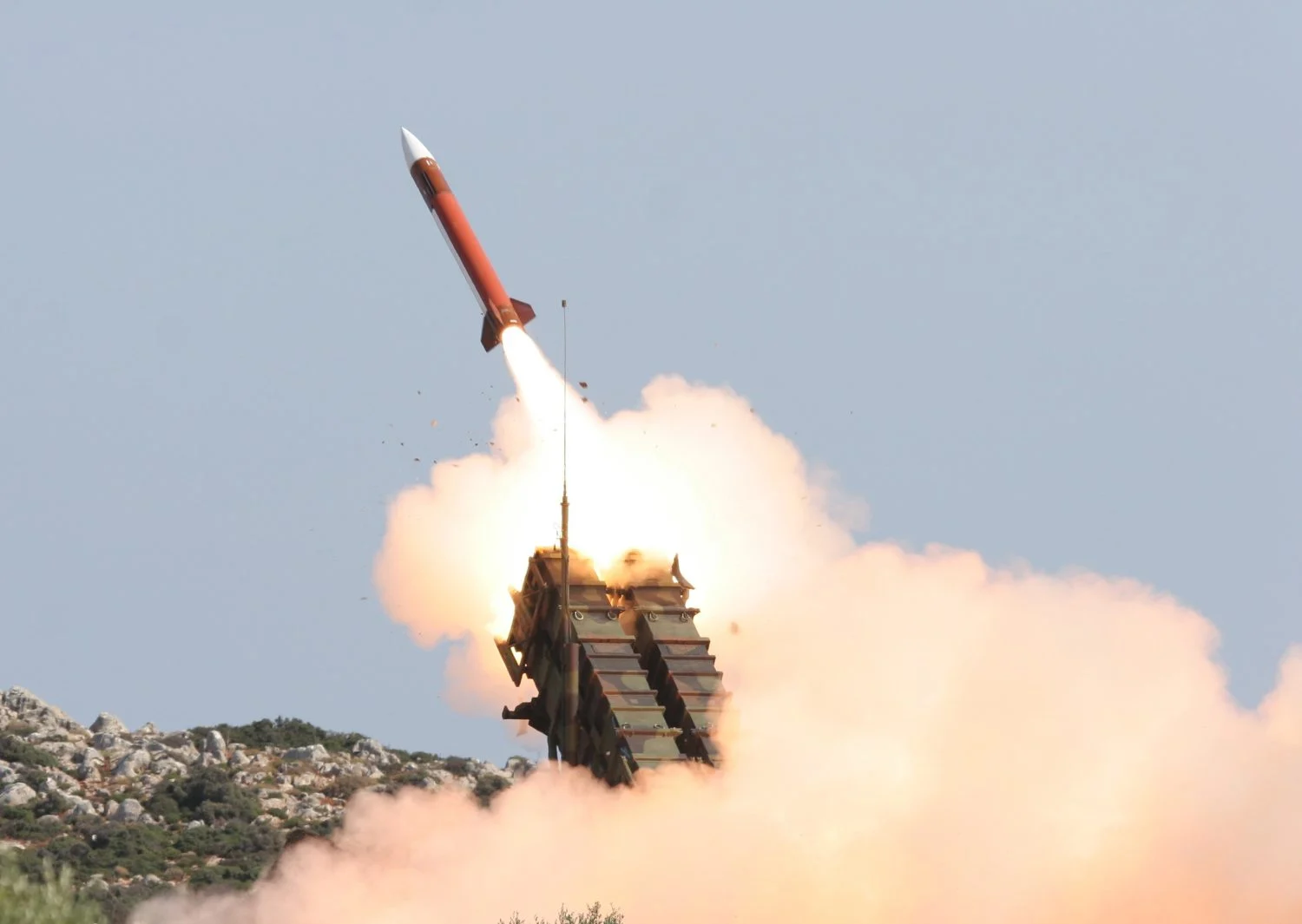
Whether or not it’s prudent for the United States to continue its war with Iran, a new constraint is becoming public knowledge: the depletion of crucial U.S. munitions. According to the Center for Strategic and International Studies (CSIS), the United States has used up as much as half of certain key defensive and offensive missiles in this year’s conflict with Iran. The running down of these munitions diminishes the White House’s ability to project power and emboldens its adversaries.
On the latest episode of FP Live, I spoke with Tom Karako, the director of CSIS’s Missile Defense Project, to understand the extent to which the United States has expended its inventory of missiles, and what that means for its foreign policy. Watch the full discussion on the video box atop this page, or try the FP Live podcast on Apple, Spotify, or YouTube. What follows here is an excerpted transcript of our discussion.
Ravi Agrawal: So we’re going to discuss several different types of munitions. Some of this is going to get wonky, but I just want to start with the one that seems to be the most well-known: the Patriot missile interceptors. Just very briefly, can you explain how they work in layman’s terms and why they seem to be so popular?
Tom Karako: They’re popular because people want to be defended against missiles, and missiles have become weapons of choice globally. In fact, there are 18 nations that count themselves members of the “Patriot family” and operate one or another kind of Patriot missile. So you’re alluding to essentially two different kinds: Patriot Advanced Capability-2 (PAC-2) and -3 (PAC-3). PAC-2 is a “blast frag”; it explodes. PAC-3 is “hit to kill”; it collides with the target. All of that is possible because sophisticated radars detect a threat, track the threat, develop a fire-control solution, and tell the missile where to fire. It’s a very sophisticated system, and that’s why the demand for it is out the door and around the block.
RA: And what is your understanding of how many of these the United States had before the war, which began in February, and how many it has now?
TK: The Pentagon—correctly—does not release exact numbers of inventory necessarily, or the numbers that have been used. That’s for good reason. Having said that, according to some public statements in the budget requests, you can guess there were probably about 2,500 or so before the war. Some of my colleagues have estimated on the basis of open-source information that probably over half of that, perhaps as many as 1,200 or more, have been expended. Those are probably for the United States; there’s also a number of Patriot operators in the Middle East—Saudi Arabia, United Arab Emirates, and others—that, according to news reports, have also been expending a lot of their interceptors defending against these Iranian missiles.
RA: How much does each one cost? How long does it take to replace them?
TK: It takes about $4 million per round. There are different kinds, and how much it costs in any given year is going to depend upon how many the government is buying in a given lot—if you want to buy one of something or a hundred of something, the price per unit is going to vary; that applies to missiles as it does to many other commodities. In terms of the production rate, that’s a little bit complicated to answer. In round numbers, it probably takes about 36 months from a flat start to delivery. Having said that, the defense industry is ramping up its production rates. Rather than just a flat number per year, they’ve gone from about 350 to 650 a year, as of last year. We’re probably going to get to 1,000 a year, up to probably at least 2,000 a year, by the end of the decade.
RA: And just sticking with Patriots for a minute before we broaden this out to other types of munitions, what does this mean? So, this dwindling of these interceptors in the United States, how does that impact U.S. interests, not just in the Middle East, but more broadly in Europe, in the Indo-Pacific, for example?
TK: It’s important to note some of the things that Pentagon officials have said, which is that we do have, in many respects, a lot of munitions left of various kinds, but not necessarily of this particular kind. And second, we actually have a decent amount left for this particular conflict. You’ve seen, at press conferences and the like, the chairman or the secretary correctly note that we probably do have enough for this conflict. But how does it affect our interests and our care-abouts everywhere, not just in the Middle East? That’s where it begins to get concerning.
The United States has been talking about the need to pivot to the Pacific for over 10 years. Unfortunately, we’ve reportedly been pulling a lot of kit and munitions out of the Pacific for this particular conflict, which leaves shortages. So far, we’re just talking about Patriots. But that leaves us with some shortages on both offensive and defensive missiles that adversely affect our ability to sustain conventional deterrence, or a strategy of denial, or a blunting strategy, which is to say, the ability to thwart an aggressor’s efforts—say, China—in the Pacific. That’s bad news for our overall deterrence and defense goals, and it’s potentially provocative in that it could tempt an aggressor to do something, knowing that we have fewer long-range conventional strike missiles and fewer air missile defenses to thwart them.
RA: This is very useful. As I promised, I want to broaden this out beyond just Patriots. What are the other munitions that strike you as important in terms of how their use in the Iran war is now changing the White House’s options globally?
TK: Top of the list is probably our longest-range cruise missile: our Tomahawk. That is the cruise missile with a very large conventional payload and a very long range. And that’s pretty useful for places where there’s a lot of water, or, more significantly, where you don’t want to fly a manned aircraft over the target because of enemy air defenses. So that gives you what’s called “standoff capability.” Tomahawks are the sort of things that U.S. presidents tend to reach for early and often. Over the past several decades, whether it’s strikes in Syria or Yemen or what have you, we tend to reach for Tomahawks a lot because they are highly capable.
Staying on the strike side, or the offensive side, there are things like the Armement Air-Sol Modulaire (AASM) missile; the Army Tactical Missile System (ATACM); the Precision Strike Missiles (PrSM), which are ground-launched; and the AGM-158 Joint Air-to-Surface Standoff Missiles (JASSM), which are air-launched. Those have all been reportedly used in significant numbers in this conflict.
On the defensive side, other concerns are about the Terminal High Altitude Area Defense (THAAD) inventory. Going back to last summer, during the 12-day war—we published a report last fall about this—probably a very significant number of our overall THAAD inventory was expended. Flash forward to Operation Epic Fury, and one can surmise that probably a significant number of those were used again. Finally, the interceptors on ships, which are called Standard Missile 3, for killing ballistic missiles in space, and Standard Missile 6 for air defense purposes—those come to mind as the most salient.
RA: And I’m assuming the costs and the build times on these other defensive and offensive munitions are similar to what you were describing for the Patriots, right?
TK: You’re probably looking at two to three years, all things being equal, for getting these things off from contract to delivery. Again, everybody’s trying to ramp up the production rate and to go faster, so it’s going to vary based on the units and the producer. In terms of cost, it’s also going to vary, but from the lower-end Standard Missile 6 to the higher-end THAAD, you’re looking at under $1 million to a number of millions of dollars.
RA: When you put all of this together, what does this mean now for the United States’ ability to deter China from, for example, attacking Taiwan? What does it mean in terms of how much the United States can give Ukraine? What is your sense of how much all of this has hurt the United States so far?
TK: To be blunt, quite a lot; quite significantly. When you dig into the overall inventory of your offensive and defensive files—and again, the United States has responsibilities globally, in Europe, the Middle East, and Indo-Pacific—you’re going to either “peanut butter spread” your munitions, or you’re just going to not have them in some places. Sometimes when we see these news reports about missiles getting through, it may just be the case in some of those that we don’t have the defensive systems in place to be able to intercept.
In terms of Ukraine, unfortunately, one’s druthers aside, it would be a much harder choice to funnel more to Ukraine or to other places than it was a couple months ago. That’s not to say it’s not a good idea; that’s not to say we don’t want to. I would very much like to give more Patriots to Ukraine so they can defend themselves against the salvos that are coming in—there are a lot of them, and a lot of people are dying. But this is the hole that we’re in, and we keep digging. The hole keeps getting deeper. This is why it’s so important to begin to replenish and to get things on track so that we can get back to where we were in January, number one, and number two actually get out of the hole and begin to produce much greater rates. This has been the Pentagon’s plan for about a year and a half now. We need to begin implementing that plan. We’re not quite there yet. And I’m cautiously optimistic, but the bottom line is for the near term; possibly the medium term. There’s no way you can look at this and not see it as a setback.
RA: It’s increasingly clear to me from this conversation and others that the United States is not in a good place in terms of its ability to deter adversaries and also its ability to be a difference-maker in ongoing conflicts, given how much of its key munitions have been used up in the war in Iran so far.
How much of this problem right now is because the United States didn’t have enough to begin with, or that it just used up too much in the last six months? Is it one or the other, or a bit of both?
TK: I’ve heard a number of folks say the first: “You can’t blame the administration or the Pentagon for expending all these things because we didn’t have enough to begin with.” It is a little bit of a head-scratcher because that’s kind of like telling a drunk who comes into a bar, “You’re already drunk. Instead of cutting you off, here’s a bottle of bourbon because it doesn’t really matter. You’re already intoxicated.” What it really comes down to is when you’re in a hole, the beginning of wisdom is to recognize that you’re in a hole and to stop digging.
So yes, the plans for ramping up have been there. The Pentagon started to look into this even before Operation Epic Fury. So I don’t think it’s one or the other. It is definitely both. We didn’t have enough to begin with, and we began to recognize that, and we began to revise upward our objective inventory numbers.
RA: Wow. The question then is, what would it take to dramatically increase production at this point? If the U.S. adopted an industrial base on a war footing, would that solve this problem?
TK: You hear this a lot. You hear, in fact, Pentagon officials saying we’re on a wartime footing. But unfortunately, that sense is not universally shared. I have every confidence that the Pentagon is seized of the urgency of the problem. So this is not about not understanding or not appreciating it. You’ll know that we’re on a wartime footing when Congress begins to appropriate money for the war footing that you’re on. The Pentagon can come up with the plans all day long, but until Congress appropriates the money and puts it on contract, you’re going to have challenges.
[Follow the FP Live podcast for the full conversation, and to automatically download it—it’s free!]
