


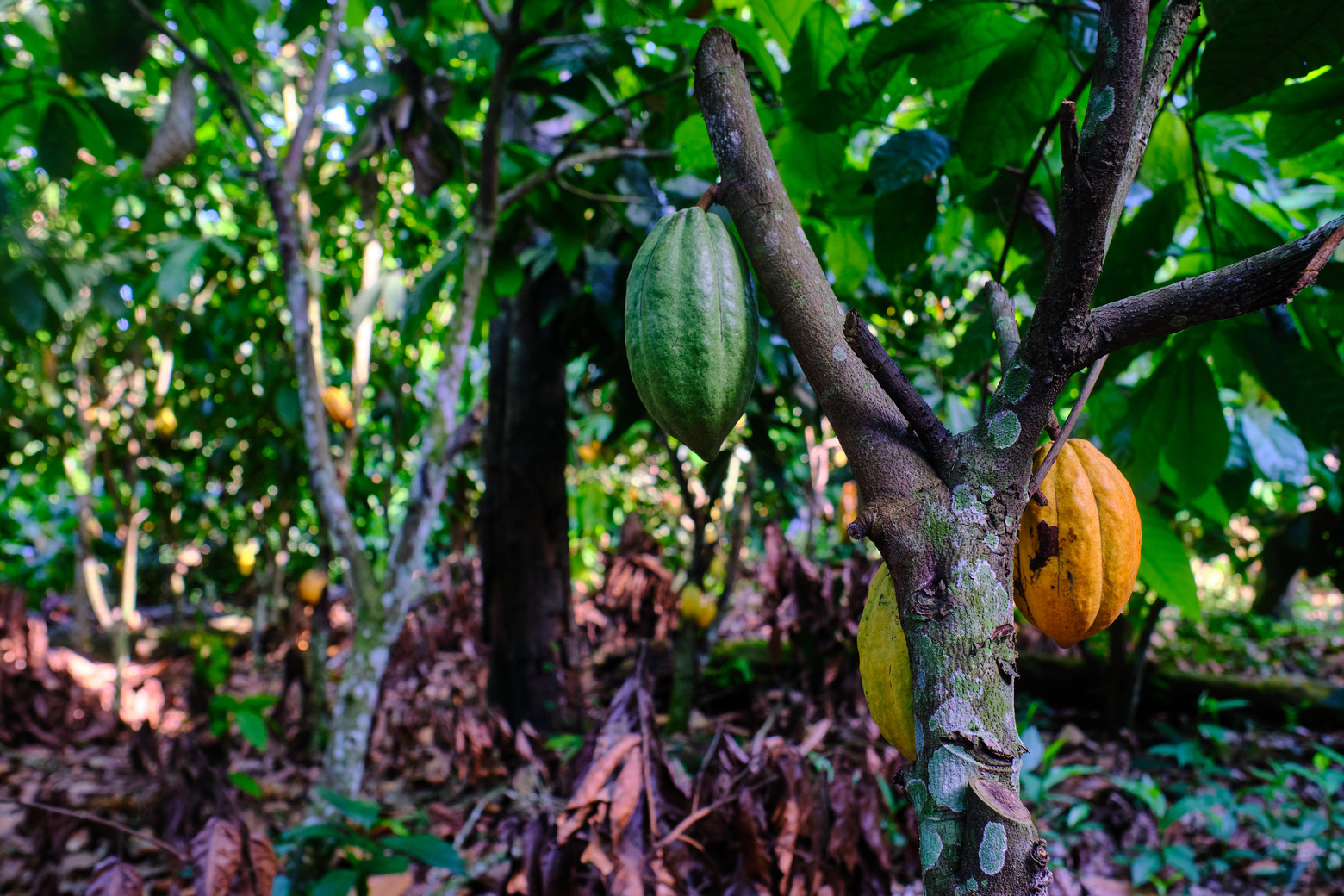
On this week’s episode of the Mongabay Newscast, we speak with features writer Ashoka Mukpo, who traveled to southeastern Liberia to investigate what satellite images indicated was a spike in deforestation over a relatively concentrated period. Along with video production coordinator Juan Maza, Mukpo documented illegal cacao plantations in the rainforests in the county of Grand Gedeh. In this interview, he explains how and why these plantations are appearing now in Liberia.
“What we saw … probably the best metaphor for it is that there’s a kind of gold rush happening in this part of Liberia, except it’s not gold that people are after, it’s cocoa,” Mukpo says.
“And this makes sense, given the context that in the last few years there was a huge price spike for cocoa, and this had to do with a lot of factors, including climate change and a poor harvest in Côte d’Ivoire. And so that’s pushing this huge number of migrant workers from Côte d’Ivoire into Grand Gedeh.”
At the end of the year, the European Union Deforestation Regulation (EUDR) is set to take effect. The EU legislation would ban the importation of certain commodities produced via deforestation, and one of those commodities is cocoa. And much of the cocoa being grown in Liberia right now would potentially fall under this ban, Mukpo says. Furthermore, setting up the tracking infrastructure to ensure commodities meet EUDR standards is expensive. While nations like Côte d’Ivoire have already invested in this, Liberia has not. That leaves a lot of farmers who are betting on this commodity vulnerable.
“A lot of farmers are gonna suffer just from lack of clarity. And I could see a scenario where suppliers choose to just not buy from Liberia because if there’s no way for them to know where these beans are coming from, they could get in a lot of trouble if they do buy, and I think that’s the real concern,” Mukpo says.
The deforestation happening in Liberia due to cocoa challenges the narrative of a clear villain, he says; it’s more the result of a system where farmers struggling to make a living feel they have no choice, while the European Union is trying to make good on a promise that its own demand for tropical forest commodities doesn’t contribute to deforestation.
“I think this is much more just a reflection of a system and a reflection of a mind state,” Mukpo says. “On one hand, these farmers in Gran Gedeh want better lives, and you have to sympathize with them for that. And then on the other hand, and this is what the policymakers in the EU that I spoke to had to say, is that they understand that frustration and that impulse, but they feel like their market has some responsibility to not participate in deforestation. And I find both of those perspectives compelling and understandable, and the problem is that they’re not really compatible.”
Cacao cultivation experts Mukpo spoke with say the method of farming used, which cuts down and/or burns patches of forest to make way to plant cacao saplings, isn’t necessary at all. Agroforestry, when provided with the upfront investment, could produce comparable yields without the deforestation.
“There are novel ways of cultivating cocoa as part of agroforestry schemes that the cocoa is incredibly productive, and you don’t have to destroy the forest to grow it,” Mukpo says. “But it takes a little bit more money, it takes a little bit more patience, it takes a little bit more investment.”
Mike DiGirolamo is the host & producer for the Mongabay Newscast based in Sydney. Find him on LinkedIn and Bluesky.
Banner image: A young cacao tree in Grand Gedeh, Liberia. Image by Ashoka Mukpo/Mongabay.
Notice: Transcripts are machine and human generated and lightly edited for accuracy. They may contain errors.
Ashoka Mukpo: I guess I feel like deforestation and forest destruction stories often have, like, what you might think of as a clear villain. Illegal logging, you have companies with ties to politicians, and you can really point at someone and say, “You know, this is the person who’s at fault, and we need to throw them in jail, or we need to put some sanctions on them.” But this, I think, is much more just a reflection of a system and a reflection of a mind state. And so that, I would say, wasn’t so much a surprise, but it was a challenge to really be able to hold all these competing points of view, where on one hand these farmers in Grand Gedeh want better lives, and you have to sympathize with them for that. And then on the other hand, and this is what the policymakers in the EU that I spoke to had to say, is that they understand that frustration and that impulse, but they feel like their market has some responsibility to not participate in deforestation. And I find both of those perspectives compelling and understandable, and the problem is that they’re not really compatible.
Mike DiGirolamo: Welcome to the Mongabay Newscast. I’m your host, Mike DiGirolamo, bringing you weekly conversations with experts, authors, scientists, and activists working on the front lines of conservation, shining a light on some of the most pressing issues facing our planet, and holding people in power to account. This podcast is edited on Gadigal land. Today on the newscast, we speak with Mongabay features writer Ashoka Mukpo. After seeing deforestation alerts on the Global Forest Watch platform in southeastern Liberia, Mukpo was alarmed by the scale of the vanishing rainforest. So he traveled to the country with a camera crew to meet with a local journalist, who took him into the forest in the county of Grand Gedeh. What they saw there were vast tracts of rainforest that had been cut and/or burned and replanted with cocoa plantations. Many of these are illegal. In this interview, Mukpo explains how and why so many new cocoa plantations are appearing in the nation. Previously, much of Africa’s cocoa production was concentrated in Côte d’Ivoire, but for a variety of reasons, including surging cocoa prices driven by climate change, new production is now occurring in Liberia. But the backdrop to this story is that later this year, the European Union deforestation regulation is slated to take effect. This bill would ban certain commodities from being imported into the European Union that are produced through deforestation, legal or otherwise. And while nations like Côte d’Ivoire have been preparing for this, Liberia has not, and much of these new plantations would not be able to sell to the European Union after this bill passes. Mukpo goes in depth explaining his conversations with local farmers who created these plantations, cocoa distributors, local conservationists trying to protect the forest, and the federal Liberian authorities trying to enforce the forest protection law. These are illuminating discussions, but perhaps the most interesting part of the story that Mukpo mentions is that farming cocoa in this sort of slash-and-burn technique isn’t necessary at all. And while there isn’t a cookie-cutter answer to the problems outlined in this episode, it’s clear that agroforestry could mitigate much of this deforestation.
Mike: Hi, Ashoka. Welcome back to the Mongabay Newscast. It’s good to speak with you again.
Ashoka: Hey, Mike, it’s great to be here.
Mike: So we’re gonna talk about your investigation, but before we get into the details of it, can you just explain what prompted you to head to Liberia exactly?
Ashoka: Well, I’ve actually worked in Liberia quite a bit in the past. It’s, uh, one of the first countries that I really kind of learned how to report. So I have quite a few contacts and connections and just people that I stay in touch with there. And one of them, in a conversation just getting an update because it’s such a forested country and there are so many kind of nexuses of development and environmental issues, and so many of the things that we report on, I was asking what was up, and they clued me into the possibility or what they said was a circumstance of a lot of deforestation that was happening in the southeast, which is an area that I’ve been to before and it’s very remote, very hard to get to, and quite densely forested.
Mike: And, and so, you went there and you met up with a local journalist, and he took you into the forest, and this area is called, uh, Grand Gedeh. What did you find there?
Ashoka: So yeah, Grand Gedeh is a county. Uh, it’s about the size of Lebanon, and it’s in southeastern Liberia. And I think basically the best way to look at this is that there was once a period in West African history where there was a forest called the Upper Guinean Rainforest, and this forest was huge. It stretched all the way from parts of Sierra Leone, really almost all the way to Nigeria. And it was, it was like classic huge rainforest, a lot of resources, a lot of wildlife. And over the course of time, it’s been heavily deforested for cocoa, for settlements, for infrastructure, you know, what, what we might call development. And for a lot of historical reasons, actually, Grand Gedeh and the counties nearby it have sort of escaped a lot of this particular form of development that causes deforestation. So if you look at it on a map of satellites, what you really see is this sort of huge belt of missing forest and then a thick kind of blotch of green that’s in this part of Liberia. And so James Giahwoye is an environmental journalist who I’ve known and admired in Liberia for a very long time. He’s very brave and very good, and I’ve worked with him a few times on some stories. And he essentially, when I called him, told me that there was a huge amount of cocoa being cultivated in this part of Grand Gedeh. And so before we went there, really what kind of um, pulled me into this story is, you know, between the source that I spoke to and then James, I decided to take a look at the satellite map of deforestation on Global Forest Watch’s dashboard. And this is like a kind of website that you can pull up that will give you information on where deforestation might be occurring and, you know, it’s kind of satellite alerts. And the amount of alerts that I saw in Grand Gedeh was so broad that it almost felt unbelievable. I had a very hard time really believing what I was seeing because it just seemed so crazy and it was… there were whole sections of this county that looked like they’d experienced some form of deforestation just in the last six or seven months, and that is when really I, I’d say that this story grabbed my attention as something that mattered.
Mike: Right. Yeah, so, so you, you actually went to look at some of these spots and, what did you find?
Ashoka: Well, yeah. We traveled to Liberia and it was kind of a crew, me, um, Juan Maza, and a freelance videographer. We met up with James and we went to Grand Gedeh. And what we saw, I guess the, probably the best metaphor for it is that there’s a kind of gold rush happening in this part of Liberia, except it’s not gold that people are after, it’s cocoa. And this makes sense given the context that in the last few years there was a huge price spike for cocoa. Uh, and this had to do with a lot of factors, including climate change and a poor harvest in Côte d’Ivoire. And so that’s pushing this huge number of migrant workers from Côte d’Ivoire into Grand Gedeh, where they’re basically making these partnership deals with Liberians to build cocoa plantations. And for them, you know, it’s kind of a ticket to a better life. For the rainforest, it’s not great news.
Mike: What did it, what did it look like when you happened upon a cocoa plantation? What was it that, like, told you this is a, this is a cocoa plantation?
Ashoka: Well, they’re all over the place in Grand Gedeh, but I think the one that really was kind of, um, dramatic for us was inside this proposed national park called Kwah. So the Wild Chimpanzee Foundation has been financing and supporting eco-guards to, um, kind of patrol the forest. It’s this, you know, kind of thick maze of rainforest where chimpanzees live and forest elephants, pygmy hippos. It’s like a big hotspot for endangered species and, general kind of important ecology, for lack of a better phrase. And they wanted to show us some parts of the northern part of the park where there was this issue of encroachment happening. And so, they hooked us up with a guy named George Bowie, who’s one of the eco-guards who actually comes from a community in that area. And George brought us really deep into this part of Kwah where these cocoa farms are being cultivated. And, to get there, it was like long, long hikes down very muddy trails and, particularly Kwan, who’s a video producer, is hauling all of his equipment and, you know, it was, um, it was kind of a laborious effort. But then, when we finally got to one of these farms, it was kind of this like, like rush of cognition for me of, you know, just how irreversible some of this loss kind of looks because the method of cocoa farming that’s being used in Grand Gedeh that’s been brought from Côte d’Ivoire is very destructive. So, in one of the ones we went to, you really went from this kind of like thick, soupy, dense rainforest where you’re… There’s a cool—it’s very cool actually in the rainforests even though it’s, it’s humid. It’s kind of like there’s—it’s shaded and there’s a climate inside there. And then suddenly we walked out into a cocoa farm, and all the trees were dead or dying, and it was just like the temperature jumped twenty degrees Fahrenheit instantaneously, and there are all these trees that are laying on the ground.
There are others that are burned and about to fall down. And it really looked almost, I, I’d say, apocalyptic, except for there were these small saplings, these kind of cocoa saplings, in the midst of all these dead trees. And, you know, on its own, one of these isn’t a big deal, but when you pull back and you see how many of these plantations are being cut in the forest in Grand Gedeh, you start to realize that it’s a major ecological change that’s happening.
Mike: I don’t know if it was exactly this one where you saw this, but you witnessed a, a minor being arrested, I believe. I think he was, like, just a couple months shy of his 18th birthday. And he was, he was working on this farm. And so I just was curious about what you saw and, and how was it that someone like him had, had ended up in that situation?
Ashoka: Sure. Yeah, I mean, that’s, that was kind of an emotional moment for us as a crew and, for me, reporting the story. The issue of young children working on cocoa farms is a very old one in West Africa. There’s been campaigning and reporting and kind of, um, warnings about this for a very long time. So I-I would say that part isn’t surprising so much. But what’s happening right now is that, whether they’re, they’re minors or, or they’re older, historically, a big part of the labor pool that made up the Côte d’Ivoirean cocoa industry, which is now the biggest cocoa industry on Earth, was laborers from Burkina Faso. So, a lot of the workers who built Côte d’Ivoire’s cocoa industry came from Burkina Faso. But there’s so few forests there that now there’s this huge appeal of Liberia, and the legalities around where you’re supposed to build a plantation are not always clear to these workers. So their Liberian hosts, who invite them and say, “Go build a cocoa plantation here,” maybe they don’t know, or more likely they don’t care, that they’re sending them to a place that’s illegal. And in our case, we were with some forest rangers from the Liberian government agency whose job is to enforce the law. And we were on this sort of patrol inside a forest where cocoa is illegal. And at one point, the woman who I was shadowing, um, who was kind of the chief forester in this region, she got very quiet and sort of said, “Shh. You know, everybody be quiet.” Kind of crept through this little pathway in the forest, and when we got out, immediately there were a couple of kids, I mean, you know, kids eighteen, nineteen, younger, who saw us and just bolted into the forest. And one of them, I think he maybe had just been sleeping or he was cooking, and he didn’t quite make it out, and so the rangers were able to grab him and detain him. And it was an emotional moment. You know, I—when we saw his ID and realized he was under eighteen, you know, you realize that this is someone who, who should be in school, you know, could be in school under different circumstances. And he was so scared. I mean, he started crying at one point, and he was apologizing. I think the presence of that many forest rangers and journalists was really, really intimidating for him, and it sort of just spoke to how vulnerable some of these workers are. I mean, they, they’re, they’re there intentionally because there’s opportunity, but ultimately, it’s not their country. And so, for this kid, I think that that was a pretty overwhelming and frightening experience.
Mike: You also sat down and talked with, um, I think you talked with the chief who was running operations in that area of the Forest Development Authority. What did she sort of, like, tell you? What was her perspective on the situation?
Ashoka: Yeah, sure. So her name is Yayi Nyagor, and I thought that she was a very interesting character. Um, you know, like in any country, anywhere in the world, but definitely in West Africa, anyone who’s tasked with forest law, e-enforcing forest law, is gonna be subjected to a lot of political pressures. And I could really tell that Yayi was balancing a lot. You know, there’s a lot of money in cocoa, and there’s a lot of local officials who are clearly connected to it. But I think she really felt some sort of responsibility for doing as much as she could to not let it completely just destroy the entire forest in the county. You know, she’s someone who has a background of some intentional, she cares, obviously, about biodiversity and the ecology, even if kind of her job is to make sure that there’s a functioning system for everything from forestry to community control of, of landscapes. But I felt that Yayi was trying her best to do what she could to keep the destruction from happening too fast. And you could tell that it really weighed on her that there was only so much that the government could do.
Mike: And it, it also appears that there’s a bit of government corruption that also plays a role in this. Can you explain more about that?
Ashoka: Well, you know, I always think that it’s, like, a bit oversimplistic to just call something corruption. I mean, certainly in, in a country like Liberia, it’s no secret that there are struggles with corruption. I, I tend to look at these issues more as, like, the presence of competing interests. So even when we talk about the government in a place that’s as remote as Grand Gedeh, you have county leadership, right? And then you have the national government in Monrovia, and then you have the Forestry Development Authority in Grand Gedeh, and then you have maybe Liberian immigration officials in Grand Gedeh. And each of these groups, even though they’re, like, in the same ecosystem, they all have different interests.
And what I saw was, at least once, you know, with this young man who’d been arrested by forestry officials, he was inexplicably let go at an immigration checkpoint. And when I asked Yayi later what happened, she basically very coyly said, “Well, you know, I think that these immigration officials knew that they were farming cocoa in this area where it was illegal,” and said that they sort of didn’t care. So her implication was that maybe money was involved in it. But there’s also, even outside of that, there’s been a lot of reporting and even investigations into, um, the, you know, the participation of local officials and, and, and powerful people in this area in cocoa cultivation. And it makes sense. You know, it’s a big business opportunity, and I think people think that it’s gonna make them rich.
Mike: We’ll talk a little bit more about… Actually, we’re gonna talk about that right now because you met with members of the Konabo Community Forest to get their perspective on this, and what did they tell you?
Ashoka: Well, I thought it was important. You know, the, the migrant workers are really the ones who are doing the work, but they wouldn’t be able to do that work unless Liberians were asking them to come. And often, actually, people like the folks we met in Konabo, in the Kono- Konabo Community Forest, will go to Côte d’Ivoire and invite workers to come in. There’s actually a bit of a competition for who can get them to come because it’s kind of, you know, depending on how you look at it, it could be a good arrangement. You know, it’s people who have… And, and this is sort of what people said in, in Konabo, is that when you go to them and say, “Well, why are you destroying all this forest?” What you get back is kind of, “Well, we’re, you know, we’re struggling with poverty here, and the arrangement that the workers are offering is a very good one for us. You know, they will come in and do all the labor, and for some period of two or three years, they’ll sustain themselves until the cocoa becomes productive. And by the way, they’ll also give us a kind of appreciation fee,” they called it, “for setting the farm up in the first place.” And so then there’s this kind of tentative agreement that they’ll sort of split the profits. And hearing that from people, it, it made it really sort of clear that anything like conservation is gonna have a hard time competing with something that attractive for people who really have customary ownership of these forests. The problem is that their agreements with these workers are not written down, so it’s up in the air what’s going to happen once money starts entering the picture. You know, I, I think a lot of the Liberians, frankly, seemed a bit naive to me about their ability to keep an eye on what was being sold, where it was being sold. And so there’s actually a lot of concern in the Liberian government in Monrovia about the potential for conflict or disagreements, and also, in some cases, it’ll probably go just fine. But the bottom line is that these partnerships between people like the ones we met in Konabo and the migrant workers are very informal, and it’s a very chaotic situation. And so it’s, it’s really unclear how this is gonna play out in the next few years.
Mike: So you talked to both farmers, and then you also talked to distributors, and the distributors more or less told you that this, this opportunity had transformed their lives. So can you talk, can you talk about how they feel about the situation?
Ashoka: I mean, I think every– it’s, it’s very similar to what you hear from the community members who are leasing out their land. You know, they see money coming in, and the distributors, in particular, for the older farms, they’ve started to actually move cocoa that’s being produced. And I wanna make it clear that not all of this is illegal. You know, some of it has… I mean, there’s, like, tentative kind of illegalities in some cases and then explicit illegalities in other cases. But a lot of this is kind of above-board trade. And so for them, it’s just, it’s, it’s great. Suddenly, there’s this huge new industry that’s bringing in money, and they’re catching thirty percent off the top, whatever comes from Grand Gedeh and gets sent to Monrovia. So I, I think for them, this is feeling like the way that anybody would feel, really, if they suddenly have a small business that’s earning significant amounts of income. It’s, it’s like it’s a huge blessing. I would say that there’s also, to go along with that, a serious naiveté about their position in the global economy and how commodity prices work. So, you know, cocoa might be hugely stratospheric in terms of its price one year, and then things change, which is actually what has happened since 2024, and then suddenly it’s much lower. And so I could see them struggling with that part a little bit too. But the big thing for these distributors is, I think, that they don’t understand what’s coming at them with the EU’s deforestation regulation, and that really felt like that was kind of the backdrop to this whole story.
Mike: Hello, listeners, and thank you for tuning in. As I always like to mention, Mongabay is a nonprofit news organization. We rely on funding from listeners like you. So if you’d like to support the podcast, go to patreon.com/mongabay to become a monthly sponsor of the show. If you wanna watch the video investigation from Juan Maza and Ashoka Mukpo, you can find a link in the show notes. If you’d rather read it, there is also a link in the show notes as well. Yeah, let’s put a pin in that ’cause I wanna talk about that more in depth later. But before we get to that, I wanna talk about… ‘Cause you spent a lot of time, or some time, with George Bowie, I think you said his name was, the young conservationist. And what, what did he tell you about his perspective on things happening? ‘Cause it seemed like he didn’t have– Like, he understood the economics of the situation and the plight that people are facing, but it seemed like he didn’t have, at the end of the day, a ton of sympathy. So what, what was going on there?
Ashoka: I was surprised by that, actually, a little bit. I mean, George was just such a kind of, like, likable, affable, chipper kid, really, you know? I, I felt my age being around him, watching him move through the forest. Like, at one point, when we were walking towards the camp with all our equipment and we got very tired, and we’d been walking for two hours, and we were like, “How long is it gonna take?” And he said, “Well, are you gonna move at a ranger’s pace or not?” And s- we were like, “Well, what’s a ranger’s pace?” He said, “Ranger’s pace, half an hour. You guys, I don’t know.” And it took us, obviously, two hours to get to the camp. So he’s just a, you know- … kind of a funny, upbeat, cheerful guy. And then, and George is kind of, I think, in this sort of middle position that a lot of people who work for conservation groups in places like Liberia do find themselves in, where he was from the communities, some of the communities that are, at least one of them, that has been sending people into the forest to build these farms, and on the other hand, conservation is his livelihood. And I don’t think it’s just about his job. After spending years inside this forest and really having this kind of education about the fragility of the ecosystem and seeing the wildlife up close, he’s developed a real sense of affection for the park and for its importance, and, um, you know, I think he feels some sense of responsibility to take care of it. So from his point of view, I guess maybe you might say, well, he has a job, so it’s a little bit easier for him to have this point of view than it might be for someone who doesn’t have employment with a conservation organization. But I think he feels like there are other places that you can plant cocoa, so, okay, I understand that we’re struggling to have a better life, but this is just not the way to do it. And so he really didn’t seem conflicted. You know, I think George really felt like this has to stop. And so he’s doing everything he can, but it’s hard.
Mike: I th– The reason why I ask about this is because I think it’s really interesting that him being a younger person had more of this sort of, like, long-term mindset, where he seemed to s- he seemed to understand the inherent value of everything and the need to keep it going for the long term. ‘Cause this is something I see in a lot of people around our age and younger. Are you sort of, like, connecting the dots on that in your reporting? Are you seeing kind of a commonality there?
Ashoka: I think it depends on your position and what it is that you’re trying to accomplish. You know, some of these people in Konabo who were involved in the land deals were not that much older than him, maybe five, 10 years max, right? You know, they’re not too far advanced than him. I, I think that there’s a lot of things going on with someone like George. First of all, there’s just who he is. I think he’s somebody who gets excited about the world, and he’s in this incredibly spectacular place, so I think there’s part of it is personality. And then I think also part of it is education. You know, George has been on the front lines of this, caring for this incredible space, and so he’s privileged enough to see chimpanzees regularly.He’s privileged enough to connect with this protected forest in this really visceral way and also understand how easy it is for the natural systems in places like this to be disrupted. So that, that i- isn’t really always present for everybody. Like, I’m saying this because I heard s- people said things to me, like at one point, you know, when I was saying, “Well, are, are you not worried about what could happen with the forest?” to one of the distributors. He said, “We left a little bit of it standing. There’s, like, 10% that’s still there.” And that’s something that I think you could feel was a conservation priority if you don’t understand how ecosystems work, that just one patch of forest somewhere isn’t gonna sustain wildlife. It’s not gonna sustain a biodiverse ecosystem. And George- Right … on the other hand, understands that, and so I think that’s part of where his responsibility comes from.
Mike: So getting back to the cocoa and, and its sort of—we’re gonna talk about the trade implications here, but first of all, where is all of this cocoa ending up?
Ashoka: Yeah, that’s a good question. I mean, statistically, it’s, it’s hard to trace individual beans in the Liberian supply chain because it all gets mixed up at these kind of distribution points, and that’s part of the problem. But from a volume perspective, the largest market for cocoa is the European Union. So statistically, I’ve heard anywhere from, like, 50 to 65% of Liberia’s cocoa production ends up in the EU. And it’s hard to tell which beans come from where because even the suppliers that buy in Monrovia mix it up. They can make it into this kind of paste of cocoa that’s sold then to various buyers, and it’s, like, mixed up, and they call it, like, a West African blend. But I think it’s fair to say that the majority of it goes to the EU.
Mike: So we’re, we’re coming up on, uh, the end of a sort of a two-year delay on what’s referred to as the European Union Deforestation Regulation. And for, for folks who aren’t aware, it’s, it’s a piece of legislation that’s sort of meant to crack down on certain commodities that are, that are produced through deforestation, and the EU is, is, is banning the importation of those products. So, Ashoka, how is that, how is that potentially gonna affect trade in Liberia? Because you spoke to people in the European Union who, who work on this legislation, so explain what they had to say about it.
Ashoka: Well, I just think it’s people living in two totally separate worlds, and that is really, was sort of dramatic for me when you go to Strasbourg and we met with Delara Burkhardt, who’s one of the MPs, MEPs, who’s been trying to get this thing through the finish line, and seeing how sophisticated her understanding is of the various political nuances and her kind of drive to really get the regulation through and implemented versus going to Grand Gedeh and saying, “Do you know what the EUDR is?” And just hearing people say, “Oh, I-I’ve never heard of that before.” And kind of me being in the middle and understanding, well, you might not have heard of it, but it’s gonna be a big deal for you if it goes through. And there’s a lot of kind of, um, you know, fuzzy edges to the EUDR, I would say, in terms of whose responsibility it is for flagging problems and what happens when problems do get flagged. But the bottom line is that really all of the cocoa cultivation that I saw happening in co- in, in Grand Gedeh is not permissible under the bounds of the EUDR. The EUDR sets a cutoff date for deforestation, and it doesn’t have to be illegal deforestation. It’s any deforestation that happened after 2020 makes a commodity inadmissible to the European Union. And if companies don’t follow those rules, they can get really heavily fined by member states. And so I think this is a huge problem for Liberia and for its farmers, and they’ve actually just started to wake up to it. And I think there was this sort of confusion about these delays for two years and thinking, “Does this mean it’s not actually gonna come into force? Is this just a paper tiger?” And from everything that I can see, that’s not the case. It seems very likely that this year, at the end of the year, the EUDR will come into force, and it’s going to, I think, really upend commodity production in places like Liberia and elsewhere in ways that I’m not really sure everybody’s prepared for, and they certainly didn’t seem prepared for it in Grand Gedeh.
Mike: Yeah, I was thinking about that, ’cause you do outline in the piece that there are some neighboring countries that have been preparing for this, and they’ve spent a lot of effort on putting in the processes and the infrastructure in place so they can prove and track their traceability. So can you explain to the audience the kind of the, the difference in, like, what a place like, uh, Cô- Côte d’Ivoire has done versus Liberia?
Ashoka: Well, I mean, first, you know, I, I’d say that the people who are supportive of the EUDR, this is the point that they make, is they say, “You know, this is a l- really laborious process to comply with the EUDR, but it’s also a big opportunity.” You know, it, it sort of fosters sustainability. It means farmers know, you know, how to access an important market, and suppliers can really have a full understanding of their supply chain. That said, these, the … particularly for cocoa, it is a hard process to set up a tracing system because really these farms are in incredibly remote areas, and somebody has to go to all of these farms manually with a GPS locator and punch their coordinates in and say, “Well, this farm was started in this year, and this is why it’s permissible.” And then, through this really intricate and layered system of recording which cocoa comes from where and how it enters supply chains, buyers can kind of be- see themselves as in compliance depending on who and where they buy from. But the money that it takes to set something this complicated up, and really just the kind of human labor of someone getting on a motorcycle or getting in a car and going to this really remote part of Côte d’Ivoire or Ghana, uh, y- you know, it was something that took years to set up. And there are gonna be problems with these traceability systems inevitably, but Côte d’Ivoire—cocoa is so important to them—they’ve really put a lot of time into trying to put something in place, and Liberia has just been too slow to the party. They… And for a lot of reasons that I think are important to note, which is partially it’s very expensive. It’s not easy to set these up, and it costs a lot of money. Now, for Côte d’Ivoire, cocoa is 60% of its economy or something like that. It’s, it’s a huge amount of its exports are cocoa. Liberian cocoa at this point is a very minuscule amount of its exported commodity value. So do they have an incentive to spend $10, $20 million setting up a system like this For a country like that, it might, might answer be no, and in that case, a lot of farmers are gonna suffer just from lack of clarity. And I could see a scenario where suppliers choose to just not buy from Liberia because if there’s no way for them to know where these beans are coming from, they could get in a lot of trouble if they do buy, and I think that’s the real concern. And it’s, um, you know, it’s, it’s kind of one of those, uh, subjects of environmental policymaking where things come at a cost, right?
Mike: What surprised you the most about this story, I- I- if, if anything?
Ashoka: I don’t know if this is a way of, you know, a surprise, but I, I guess I feel like deforestation and forest destruction stories often have, like, what you might think of as a clear villain. Illegal logging, you have companies with ties to politicians, and you can really point at someone and say, “You know, this is the person who’s at fault, and we need to throw them in jail, or we need to put some sanctions on them.” But this, I think, is much more just a reflection of a system and a reflection of a mind state. And so that, I would say, wasn’t so much a surprise, but it was a, a challenge to really be able to hold all these competing points of view, where on one hand these farmers in Grand Gedeh want better lives, and you have to sympathize with them for that. And then, on the other hand, and this is what the policymakers in the EU that I spoke to had to say, is that they understand that frustration and that impulse, but they feel like their market has some responsibility to not participate in deforestation. And I find both of those perspectives compelling and understandable, and the problem is that they’re not really compatible. And so that was the… I think what drew me to this story is that there was a lot of gray area to sift through.
Mike: Yeah. Inev- inevitably, I think that when we see a story like this, we always tr- try to… A lot of us want, like, okay, what’s the solution, so to speak. And I kinda struggle with this, Ashoka, where I will be seeing a story like the one you’ve just described here, and it feels indicative of kind of, like, the whole meta-crisis that we’re experiencing globally, where it feels like profit-driven, c- consumer-based economies essentially are, are causing the destruction of the natural world. And so inevitably, we need to find ways to support people and give them lives. And I’m just kinda curious if you have any personal opinions on that, if you have any, like, thoughts about maybe, perhaps, is this a wake-up call for governments to get together and find a better way to support people and give them the things that they need?
Ashoka: Well, in this case, I think what I’d say particularly, not to evade that question, but to make it narrow to this particular instance, which is that there are better ways to farm cocoa than what’s happening in Grand Gedeh. And that’s something that experts in cocoa cultivation in Liberia were really throwing their hands up in, is that the, the way that is sort of the most efficient that’s coming from Côte d’Ivoire involves a massive amount of deforestation. But there are novel ways of cultivating cocoa as part of agroforestry schemes that the cocoa is incredibly productive, and you don’t have to destroy the forest to grow it, but it takes a little bit more money, it takes a little bit more patience, it takes a little bit more investment. And so I think if there is a frustration for me or, or some opinion, it’s, it’s that you, you have to ask, well, whose responsibility is it, and who has the capacity to really go in and kind of, like, make that happen? That you go to a place like Grand Gedeh and you say, “Hey, everybody, stop. Cocoa’s a big thing. This could be great for a lot of you, but let’s do this in a way that’s managed well.” And so, you know, that’s kind of… I, I don’t feel like, again, there’s someone who’s a clear solution there in terms of, like, who you can put the bag on for that. But the frustrating thing is that it is possible, and this is what cocoa experts told me, is that it just doesn’t have to be this way, that the world can enjoy a lot of these commodities in much more sustain- particularly, like, uh, in much more sustainable ways. So the, the core thing for me is just the same wall that we’re hitting across so many different subjects of our life with each other, which is cooperation.
How do we understand ourselves as part of a shared experience here as humans and as life forms on this Earth? And is there a way for us to see things like this and work together? And I can understand the critique of the EUDR, that it’s very punitive without a lot of solution-making for people like the folks in Grand Gedeh. And so maybe that’s, that’s something I mi- I might say, is that there, you know, uh, uh, for the EU, which does have so much power here, I think that the response to the EUDR in Grand Gedeh might be, “Okay, so what do you want us to do?” And that, that, I think, is a good question.
Mike: Before I, before I sign off here, is there anything else you wanted to mention or say about this story?
Ashoka: Yeah. I mean, I think I just… This sounds so sort of trite, but I think it’s kind of important to acknowledge that I, we put a lot of energy and time into this story, and I’m, I’m very proud of the reporting that we’re producing. And a lot of it wouldn’t be possible if civil society organizations and local journalists hadn’t looked into this and flagged it for us. So, at Mongabay, I, I just feel like we’re always in debt to these various kind of folks from these societies we cover and, you know, often our staff are embedded in them, who we wouldn’t know what was happening in the world if it wasn’t for their labor. So I think I just wanna kinda give an acknowledgment of the work that we built on top of.
Mike: Well said, Ashoka Mukpo. Thank you so much for joining me today. It’s been a pleasure speaking with you again.
Ashoka: Yeah, it’s been a pleasure, Mike. It’s always nice to talk to you.
Mike: As always, if you’re enjoying the Mongabay Newscast or any of our podcast content and you wanna help us out, please do spread the word about the work we’re doing and tell a friend and leave a review. Word of mouth is one of the best ways to help expand our reach. You can also support us by becoming a monthly sponsor via our Patreon page at patreon.com/mongabay. Mongabay is a nonprofit news outlet, so pledging a dollar per month makes a very big difference, and it helps us offset production costs. So if you’re a fan of our audio reports from Nature’s Frontline, go to patreon.com/mongabay to learn more and support the Mongabay Newscast. You can also read our news and inspiration from Nature’s Frontline at mongabay.com or follow us on social media. Find Mongabay on LinkedIn at Mongabay News and on Instagram, Threads, Bluesky, Mastodon, Facebook, and TikTok, where our handle is @Mongabay, or on YouTube at Mongabay TV. Thank you, as always, for listening.
