


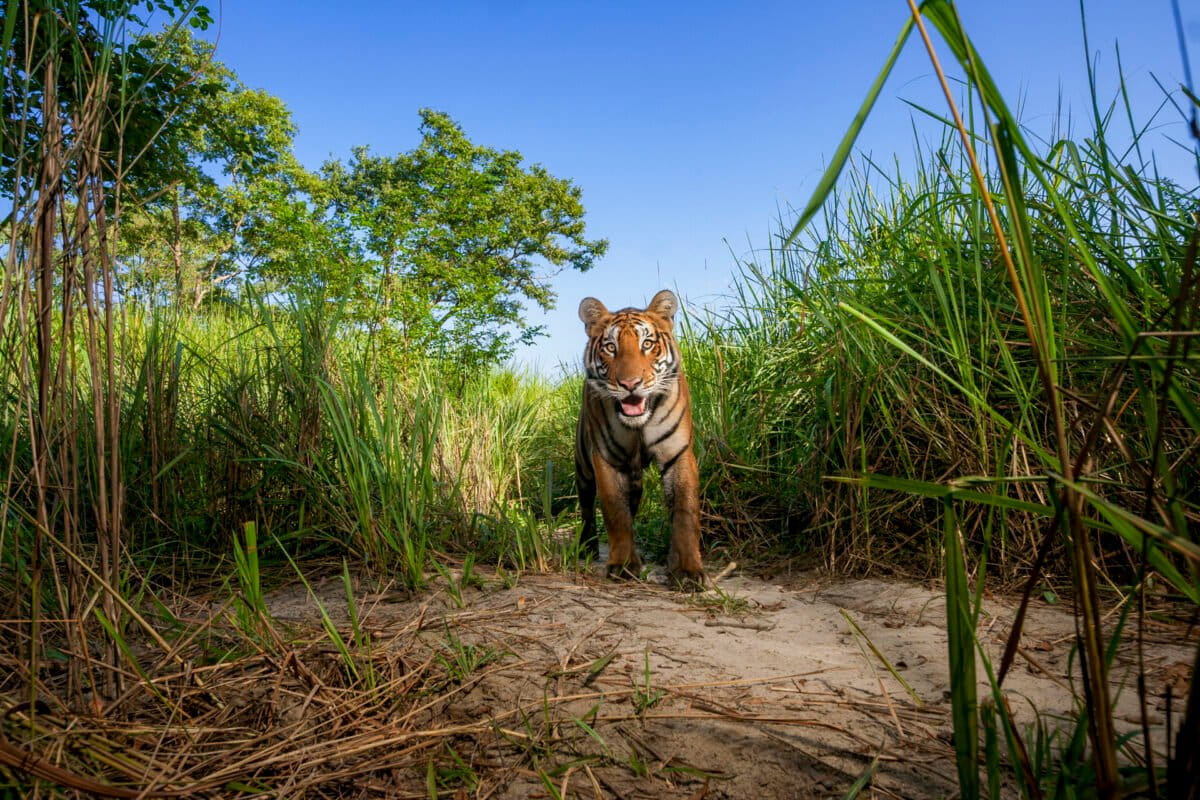
- India has made progress in conserving its Bengal tigers, but now it must accommodate growing numbers as they disperse from protected habitats into human-dominated areas — even as poaching is on the rise and destruction of forested land continues.
- Protected forest corridors are crucial to restoring lost or tenuous connectivity between key habitats, enabling genetic exchange between tiger populations that otherwise risk isolation and inbreeding.
- India has built more mitigation structures than any other country in Asia, including the world’s 10 largest wildlife underpasses and overpasses.
- But even as the country is reconnecting habitat, it’s also rapidly expanding road infrastructure, and even protected forests remain under threat.
RAJAJI TIGER RESERVE, India — It is early morning in late May in the hardwood sal forests of Rajaji Tiger Reserve in north India, and the heat is rising. By afternoon it will reach 39° Celsius (102° Fahrenheit).
I am squatting on the forest floor under National Highway 72, a steady rumble of traffic above, looking at the footprints of a wild elephant in a patch of moist mud that has thus far survived this scorching summer.
This is the Teen Pani (Three Waters) underpass, just 400-odd meters (about 1,300 feet) in length, but good enough to allow everything from mice to elephants to pass safely beneath the highway.
And it’s also good enough for T8, a Bengal tiger (Panthera tigris tigris) that occasionally walks through the area on his nocturnal perambulations, safe from the speeding vehicles above. T8 was one of five tigers relocated to Rajaji from Corbett Tiger Reserve in May 2025, and now roams extensively, and elusively, across this often human-dominated landscape.
The expressway above me dates back just to 2021, and it doesn’t have sound barriers, hence the noise. But it replaced the narrower, heavily trafficked old road running from Delhi to the holy Hindu town of Haridwar and on to Dehradun, the capital of the mountain state of Uttarakhand.
Now, if you walk just a short distance, a few meters off to either side of this strip, the traffic noise recedes and the forest swallows you slowly, as if absorbing you into its bloodstream, the enveloping silence highlighted only by the drilling of an unseen woodpecker, and by the insistent calls of a coppersmith barbet (Psilopogon haemacephalus) and a brain fever bird — the hawk cuckoo (Hierococcyx varius).
This jungle has survived, and even been revived, in a country of 1.4 billion people — in an economy that has grown at 6-7% per year over the last decade. As it strives to graduate to new-generation infrastructure, India is now building large highways at precisely the time that wild tigers have rebounded to the point that the existing network of protected habitats is no longer sufficient. The big cats must disperse to find new territory.
Roads fragment habitat. For some species, they’re barriers, with traffic tantamount to a fence slicing across their habitat. For others, as in the case of big cats and elephants, they can become routes for them to use. In both cases, roadways often prove deadly.
India’s National Tiger Conservation Authority has identified four critical tiger landscapes where corridors play a key role and need protection. These corridors allow tigers room to roam, to hunt, to find water — linking key populations by allowing them to disperse and spread their genes.
Even as pressures on India’s remaining forests persist, these corridors are the hope, allowing lifesaving movement, guarding against extinction risks caused by environmental and human-made factors.
India has built more mitigation structures — overpasses and underpasses — in terms of total length, than any other country in Asia, according to Bilal Habib, a scientist at the Wildlife Institute of India (WII), a government-run research center. Since 2017, India has created the world’s 10 largest wildlife underpasses and overpasses. And overall, Habib tells me when I meet with him at the WII offices, “I don’t think anywhere in the world, any developing country has spent as much money as we have on mitigation, exclusively for wildlife conservation.”

Born to roam
Tigers are wired to roam and establish their own territories. A male tiger’s home range can be up to 200 square kilometers (77 square miles), depending on the amount of prey available, the type of habitat and the density of tiger residents. They mark out their territories and guard them, sometimes fighting other males. Females have smaller home ranges, but they, too, are territorial.
Here in Rajaji Tiger Reserve, which is also a national park, it’s not easy for the cats to move. There’s a deep canal, highways, a railway, towns (some of which were once just villages), and associated disturbance slicing through and disrupting these forests at the western end of the Terai Arc landscape. This 51,000-km² (19,700-mi²) string of protected areas runs along the foothills of the Himalayas and their outer range, the Siwalik Hills, and east into Nepal. This landscape is tenuously connected by 19 corridors that tigers use; experts say that 10 of them “need attention.”
It’s often even slender jungle corridors like Teen Pani — snaking under and over highways, through fields, and around and between towns and villages — that connect larger patches of ecologically intact, viable habitat for wildlife populations.
These pathways have become imperative for wild tigers here and across India. The cat’s numbers have more than doubled since 1972, from an admittedly rough estimate of 1,827 to an estimated 3,682 as of the 2022 census, a figure that by now may well have been exceeded.
The Terai Arc is considered a tiger conservation success. Today, this landscape, with Corbett Tiger Reserve at its heart, supports around 560 tigers, more than triple those found here 20 years ago. It was here in Corbett Tiger Reserve that former Indian prime minister Indira Gandhi’s Project Tiger was launched in 1973, which is credited with saving India’s tigers.
India has become the species’ last true stronghold, accounting for about 75% of all the wild tigers left on Earth. Of the six subspecies, its Bengals have the best chance of long-term survival.

Elsewhere they’re struggling. The South China tiger exists only in captivity. No more than 750 Amur tigers (Panthera tigris altaica) remain in the Russian Far East, according to a 2021/2022 census, and fewer than 150 Malayan tigers are left. In mainland Southeast Asia, the Indochinese subspecies has vanished from Laos, Cambodia and Vietnam; Thailand’s Western Forest Complex is their only bright spot, with a population brought back from the brink by determined protection.
India, on the other hand, has dramatically increased its numbers, and its tiger reserves have grown from nine in 1973 to 58 today. They now cover some 84,500 km² (more than 32,600 mi²), an area the size of Austria.
But tiger density is uneven. Some reserves are overflowing, while a few may not have any tigers at all. The big cats roam across landscapes: Experts estimate that around 35% of India’s wild tigers live outside its protected area network.
There has to be some place for those tigers to go. It’s a wide-ranging and territorial species. Young cats disperse to find their own home when they leave their mothers. It’s a biological imperative: Without safe pathways between habitats, gene flow to isolated populations is cut off, and tigers risk inbreeding and infighting. Yet the likelihood of conflict with people — or being killed by poachers — rises dramatically as the big cats venture into human-dominated landscapes.
Together, these threats compromise prospects for their long-term survival.
Road and rail infrastructure is not the only issue wildlife corridors face. With proliferating human populations, many tiger reserves are increasingly surrounded by urban sprawl. Many corridors have degraded into poor, fragmented habitat, ecologically compromised and depleted, with forest land merging into human-dominated landscapes and invaded by the domestic animals they bring, including cattle and free-ranging domestic dogs.

Compromised corridors, rising conflict
Chandrapur district in the western state of Maharashtra is a hotspot of conflict. It’s been called “an industrial and mining powerhouse,” but it’s also home to Tadoba Tiger Reserve. Tiger numbers rose there from 30-40 in 2006 to 220-300 today. The district is home to about 2.5 million people.
Both people and tigers suffer in close contact. Between 2021 and May 2025, 150 people in the area were killed by tigers. On the evening of May 26, 2026, a female tiger was struck and killed by a freight train in Chandrapur — one of at least 19 tigers killed on that route in just three years.
Tiger poaching is a relentless threat across India and has been rising in Maharashtra and Madhya Pradesh. Tigers have also been killed by illegal electric fences put up to stop other species like deer and wild boar from raiding crops.
Meanwhile, tigers continue to lose habitat even in protected areas, many of which are under threat from mines and infrastructure.
These projects gain approval at the highest levels. The National Board for Wildlife, an appointed panel tasked with review of projects in critical wildlife habitats, recently cleared a mining project within the so-called eco-sensitive zone surrounding Phen Wildlife Sanctuary in the central state of Madhya Pradesh. It’s adjacent to the storied Kanha Tiger Reserve, where George Schaller, eminence grise of wildlife biologists, studied tigers in 1963-1965, later publishing the classic work The Deer and the Tiger.
Earlier this year, Prakriti Srivastava and Prerna Bindra documented how the National Board for Wildlife has essentially become a rubber-stamp body for development in protected areas, Eco-Sensitive Zones and wildlife corridors. Over the past 12 years, it has approved 97% of the project proposals brought before it. Srivastava is a former principal chief conservator of forests in the southern state of Kerala, and Bindra is a researcher, author and former member of the board’s Standing Committee.

In one case, in Odisha state, officials redrew maps of forest areas used by elephants and, occasionally, tigers, to make land available for bauxite mining. in Maharashtra’s Gadchiroli district, an approved mining project will divert about 9.4 km² (3.6 mi²) of forest from a tiger corridor.
The Ken-Betwa project, a controversial river-linking scheme that’s been widely protested by both residents and wildlife conservationists, would submerge some 57 km² (22 mi²) of forest in Panna Tiger Reserve, displacing wildlife and squeezing animals into a shrunken habitat. The project has gone through several layers of statutory approvals, and groundwork has started, but local people — some 2,000 families stand to be displaced — are still protesting it, demanding better compensation for moving out of the area. Police intervened on July 19, breaking up a protest at the site.
These ongoing pressures make functional dispersal corridors even more critical. But corridors should not become surgical fixes for compromised core habitats, experts say.
India needs to consolidate habitat and incentivize local populations to coexist with wildlife, for example by seeing tiger tourism as an opportunity, says Ullas Karanth, one of the world’s top tiger experts and a former director with the U.S.-based Wildlife Conservation Society and emeritus director of the Bengaluru-based Centre for Wildlife Studies.
Karanth says there’s still plenty of space for tigers. He estimates there are around 400,000 km² (roughly 155,000 mi²) of potential tiger habitat where the big cats once roamed — almost the size of the U.S. state of California. But only a small fraction of that land currently supports breeding populations of tigers.
Successfully reconnecting available habitat requires landscape-level conservation planning. While gigantic structures — that have charismatic animals going over or under them to safely cross roadways — are impressive, Karanth says, animals will only use them if there’s motivation to cross, which requires healthy habitat on the other side. “To me the context is first to secure the core habitat,” he tells me. “India could, in fact, accommodate up to 10,000-20,000 tigers if habitats are adequately protected.

Civil engineering meets wildlife ecology
Historically, wildlife scientists and transportation agencies have had opposing agendas: Conservationists have long noted that a civil-engineering approach to roads and other infrastructure is fundamentally incompatible with ecology. For big projects, environmental impact assessments (EIAs) are often seen as an onerous burden, not as an important part of the process.
There is a common belief that animals restrict themselves to wildlife corridors. That’s not how it works on the ground, says wildlife biologist Ravi Chellam. “Elegantly and clearly demarcating narrow wildlife habitats on a map and calling them corridors is not the solution,” he says. “Animals don’t limit their movements to corridors. They use a matrix of habitats available in the landscape.”
It is here that conservation organizations can and do make a difference, says Amrita Neelakantan, conservation scientist with the Coexistence Consortium, an India-based group that addresses human-wildlife conflict. It often seems as if there’s a barrier between government agencies and conservation NGOs, but these organizations often act as bridges between government departments, she tells me.
Coordination is often needed between government agencies tasked with very different mandates, looking at landscapes in very different ways, says Prachi Thatte, a conservation scientist with the Coalition for Wildlife Corridors (CWC), a group of Indian NGOs working on connectivity conservation. “We need to think of shared space management in terms of conflict that happens while tigers move through spaces shared by people,” Thatte tells me.
The Central Indian Tiger Landscape
The vast jungles of central India were the setting for Rudyard Kipling’s The Jungle Book; today, only patchy forests remain, with critical corridors connecting viable habitats and absorbing wandering tigers.
These jungles hold about 40% of India’s estimated 3,682 wild tigers. But habitat is quickly disappearing. A new study of connectivity in six key tiger reserves — Panna, Pench, Bandhavgarh, Sanjay-Dhubri, Achanakmar, and Indravati — found that between 2005 and 2015, forest cover shrank by about 5%, while agriculture and settlements expanded.
One critical area is the transboundary Kanha-Pench corridor, which straddles the border between the states of Madhya Pradesh and Maharashtra. The most recent census found that Kanha Tiger Reserve was home to 105 tigers, while Pench held 77. There’s ample evidence of tigers using and even breeding in the lush Balaghat forest corridor that connects them.


Wild places, human faces
Tigers regularly make the news nowadays for showing up in places where they haven’t been seen in recent memory, sometimes having roamed exceedingly long distances from where they were born. In 2023, a tiger was detected at an elevation of some 2,100 m (about 7,000 ft) in Binsar Wildlife Sanctuary in the Indian Himalayas.
In fact, these big cats are just recolonizing their historical range. At the turn of the 20th century, about 100,000 tigers roamed across India — a guesstimate by the naturalist E.P. Gee. But humans have long since occupied and transformed many of the spaces the cats previously roamed.
Take the dramatic change in the human population surrounding the Bandhavgarh and Sanjay Dubri tiger reserves, which are connected by a slender corridor. In 1901, there were around 9 people per square kilometer there, or about 23 per square mile; today, there are about 223 people/km², or 578 people/mi².
Tigers can move huge distances. In January 2024, a tiger made its way some 125 km (77 mi) from Sariska Tiger Reserve in Rajasthan to agricultural fields on the outskirts of India’s National Capital Region, a sprawling urban agglomeration around Delhi of some 60 million people. The tiger mauled two people, but officials decided to leave it alone because its radio collar indicated that it was heading back to Sariska.
But other tigers have walked out of Sariska since and will keep doing so.
Amid the challenges, WII’s Habib says he sees the development of roads as a conservation opportunity. While new road infrastructure is inevitable, he says it’s possible to build it better with the needs of wildlife in mind.
While road upgrade projects often run into opposition because they involve cutting down trees, some of these efforts offer larger long-term benefits.
“It’s about restoring the landscape, restoring ecological connectivity. We are giving land back to the ecosystem,” Habib tells me.
Indian states have also begun cooperating with each other — which has not always been the case in the past — as wide-ranging tigers and elephants increasingly move across state boundaries.

Asia’s longest wildlife underpass
Just days after visiting Teen Pani, I walked under what’s being billed as Asia’s longest wildlife underpass: a 12-km (7.5-mi) structure beneath the newly opened Delhi-Dehradun Expressway, NH-72. Leopards, elephants, deer and antelope are among the species recorded using it since it opened in April 2026.
So far, the reigning male tiger, T8, hasn’t come through. But back in 2023, as the expressway was being built, another tiger crossed over on a ramble that took it hundreds of kilometers through four states.
There’s a huge amount of forest on the other side of this underpass, which has the potential to host more than 150 tigers, Habib says, adding that “the new underpass is the key.” “We have leopards and elephants already using it. As soon as there are more tigers, they will disperse using this underpass.”
More tigers are soon to be translocated from Corbett Tiger Reserve to the western half of Rajaji. If they breed, the cubs will grow up and wander in search of their own territories. And one night they might cautiously use this underpass to venture across state lines and into the jungles beyond. Because that’s what tigers do.

And that’s where a new set of challenges will begin. People will have to get used to coexisting with tigers in areas where they may have been absent for a generation, or far longer.
In this there is hazard, experts say, but there is also tremendous potential for restoring what’s left of India’s wild lands to what they once were.
Banner image: Tigers are territorial and must strike out to find their own territory when they leave their mothers at 18 months-two years of age, adult cats require large home ranges, making safe pathways between protected areas critical for their survival. Image © Steve Winter/Big Cat Voices.
Nirmal Ghosh is an author and independent writer based in Asia, a trustee of the Corbett Foundation, and a member of the board of the Global Initiative Against Transnational Organized Crime.
By protecting tigers ‘we save so much more,’ says Debbie Banks
The long and winding road to safe highways: Inside the global movement to reconnect habitat
Above an Australian highway, a bridge reconnects wilderness for quolls, koalas and other animals
Citations:
Wikramanayake, E., Manandhar, A., Bajimaya, S., Nepal, S., Thapa, T., & Thapa, K. (2010). The Terai Arc Landscape: A tiger conservation success story in a human-dominated landscape. In R. Tilson & P. J. Nyhus (Eds.), Tigers of the World (2nd ed., pp. 163-173). Boston, MA: William Andrew Publishing. doi:10.1016/B978-0-8155-1570-8.00010-4
Jeong, D., Hyun, J. Y., Marchenkova, T., Matiukhina, D., Cho, S., Lee, J., … Lee, H. (2024). Genetic insights and conservation strategies for Amur tigers in Southwest Primorye Russia. Scientific Reports, 14(1). doi:10.1038/s41598-024-79970-3
Ahsan, A., Shanu, S., & Roy, A. (2026). Modeling tiger dispersal in the central Indian landscape using a prey-predator game theory approach coupled with network analysis and remote sensing-GIS. Journal for Nature Conservation, 91, 127224. doi:10.1016/j.jnc.2026.127224
FEEDBACK: Use this form to send a message to the author or editor of this post. If you’d like to post a public comment, you can do so at the bottom of the page.
