


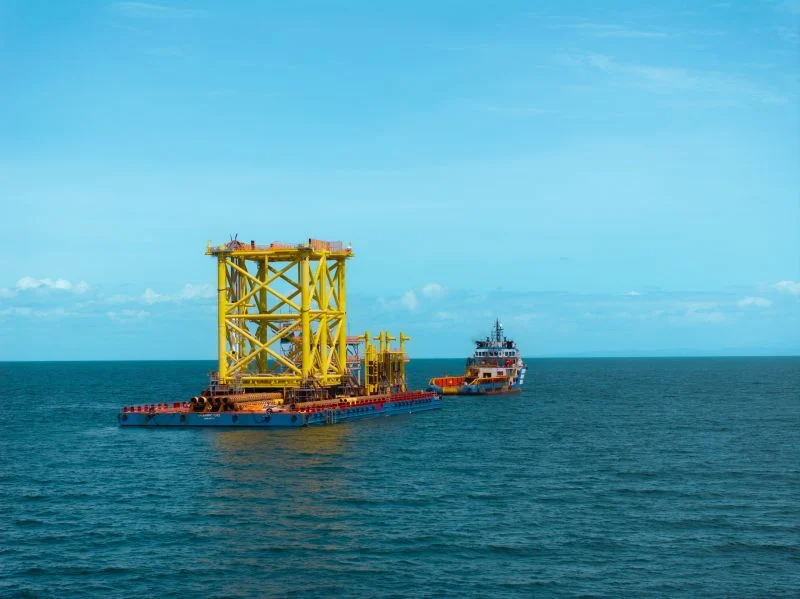
BP, a UK-headquartered energy giant, has tucked a new milestone under its belt with the arrival of the first jacket at the installation site in Indonesia out of four offshore pieces undergoing construction for a project featuring enhanced gas recovery (EGR) through carbon capture, utilization, and storage (CCUS) in the Southeast Asian country.
More than two months after BP and its contractors confirmed that the first jacket for the Tangguh Ubadari CCUS, Compression (UCC) project was ready to sail away for installation in Fakfak, Papua Barat province, the company confirmed the completion of its journey from Karimun Yard following over 357,000 work hours with no major incidents.
The firm emphasized: “More than an engineering milestone, its arrival reflects months of preparation, including early engagement with local communities which marks the start of the next phase of offshore installation.
“A significant step for a project that could potentially unlock approximately 3 tcf of gas, help support continued gas supply to Tangguh LNG and advance Indonesia’s only CCUS project at scale currently under development.”
The 1,000-ton jacket, first out of four in offshore construction, was loaded onto a transport barge in May 2026 at the Saipem Karimun yard, which has fabricated all of Tangguh LNG offshore installation in the past decades, to travel some 5,800 kilometers to its installation site in Fakfak.
The next item on BP’s to-do list is the laying of the 75-kilometer pipeline from the platform to the Tangguh site. The Tangguh UCC project has 45% TKDN (local content) commitment, with major equipment for offshore scopes such as the Ubadari jacket and topsides fabricated in the contractor’s yard in Karimun.
While all offshore line pipes are coated in East Java, modules for onshore scopes are being built in Bintan and Batam by Indonesian module fabricators. In addition, various equipment such as instruments, piping and electrical machinery are procured in country.
The Tangguh UCC project comprises of Ubadari gas field development, enhanced gas recovery through carbon capture, utilisation and storage, and onshore compression. The project includes offshore platforms, CCUS facilities and onshore compression to expand existing Tangguh LNG infrastructure.
According to BP, the Tangguh UCC project encapsulates the first CCUS project to be developed at scale in Indonesia, with potential for sequestering around 15 million tonnes of CO2 from Tangguh’s emissions in its initial phase.
The project develops approximately 3 trillion cubic feet of additional gas resources to support Indonesia’s long-term energy needs and help meet not just the growing energy needs in the country but also in Asia. Tangguh LNG contributes 35% of Indonesia’s natural gas production.
Following a final investment decision (FID) from November 2024, Saipem embarked on construction activities for the project in summer 2025. The Ubadari gas field is anticipated to come online in 2028.

Power Your Brand With Offshore Energy ⤵️
Take the spotlight and anchor your brand in the heart of the offshore world!
Join us for a bigger impact and amplify your presence at the core hub of the offshore energy community!
