


By Katrina Michalak, Howard Center for Investigative Journalism, Arizona State University
Erin Orr was at the inception of her journalism career in the 1990s, working the business and real estate beat.
As she was interviewing a source at an evening business event, the man repeatedly called her “honey,” commented on her dress, and drew her in for a lingering embrace — all in front of his wife.
“It never happened again, which was good,” said Orr, 59, who is now executive director of the news nonprofit Investigate Midwest. “I also got out of reporting within probably six months of that because I was kind of tired of it.”
In the early 2010s, at the start of another woman’s journalism career, similar problems occurred.
Jayme Fraser, 35, remembers a former colleague who was tasked with helping her acclimate as a newsroom intern. He would make explicit, lewd comments that made her “dread coming to work,” said the now 18-year veteran of journalism.
Fast forward to today, and women are still reporting the same kinds of workplace issues in journalism, and in larger numbers than men, according to a new survey of members of Investigative Reporters and Editors (IRE). Problems include unwelcome sexual advances from sources and colleagues, questions about objectivity and bias and difficulties maintaining work-life balance.
“We talk about shining the light on truth. That’s what journalism is all about, and holding power to account is by shining the light on them, right? The same thing is true for these kinds of things,” Diana Fuentes, the late IRE executive director, said in a February 2026 interview.
In all, 4,221 IRE members were contacted by email and asked to complete a voluntary and anonymous online questionnaire, which included the opportunity to comment on certain questions and to provide contact information for follow-up questions.
The survey garnered 450 responses, nearly 64 percent from respondents who identified as female and nearly 33 percent who identified as male. Overall, responses showed that substantially more women than men in journalism still face sexual harassment and gender discrimination.
Respondents included 47 women ages 18 to 34, who reported experiencing sexual harassment from a colleague or an editor, and 78 women in the same age bracket who said they experienced sexual harassment from a source. Only two men in the younger age group said they experienced sexual advances or harassment from a colleague or editor, and just seven reported sexual harassment from a source.
Because the survey did not automatically capture contact information to ensure privacy, follow-up questions were possible only for those who agreed to answer them.
“I would imagine that you got more respondents because it was anonymous,” Fuentes said. “I think there is still that idea that people are worried that they will be, again, stigmatized.”
Feeling embarrassed and ‘somehow responsible’
When asked, “Have you ever experienced unwelcome sexual advances or harassment from a source?” nearly 63 percent of women and 15 percent of men who responded chose “yes.”
Orr can still remember, nearly three decades on, the evening event when a source, whom she did not know very well, used inappropriate language, commented on her appearance and gave her a prolonged “bear hug” as she was trying to ask him questions for her article.
“I was shocked at first when he did it,” Orr said, adding that she froze as he held her. “And so I just worked my way out of the embrace.”
Orr said she felt embarrassed because this all happened within view of the man’s wife.
“I was very embarrassed, even though in hindsight, I had no reason to be embarrassed. But I felt embarrassed and somehow responsible for it. You know, the old trope on that,” Orr said.
Unwelcome source advances have moved, with the media, to digital platforms.
Sydnee Chapman, 28, recalled an instance a few years ago from a previous job, in which she was trying to build a source relationship with a crucial contact via Instagram. Through DMs, the source started “coming on” to her, she said.
“I was like, I can’t lose this source, that would suck,” said Chapman, who’s been a journalist for four years and now works for the nonprofit Utah Investigative Journalism Project. “I need to set this hard boundary that, ‘Hey, maybe I’m just reading (into) this, but just want to be very clear that I’m not interested. That would be totally unethical and inappropriate.’ And it went over well; it was fine.”
Several people interviewed for this story – reporters, editors and HR managers – said bosses can play an important role in addressing such unwanted behavior.
Brandon Quester is the founder, executive director and editor of the Arizona Center for Investigative Reporting. A few years ago, he said one of his reporters received a “highly inappropriate” comment on social media from a source. After Quester saw the comment, he immediately called the reporter and asked how he could help.
“We put our heads together, and instead of me just doing a thing and responding in a way that could have caused more harm than good, I talked with the reporter first, and we should do that,” Quester said. “People need agency in how they respond to these things.”
Quester contacted the source himself after deciding with the reporter that it would be the best approach. He said it’s important for newsroom leadership to be supportive in any way possible to make these situations easier for staff members.
“If you make an unwanted advance, or even an inappropriate comment, that stuff doesn’t fly,” Quester said. “And they’ll hear from me.”
It’s coming from inside the newsroom
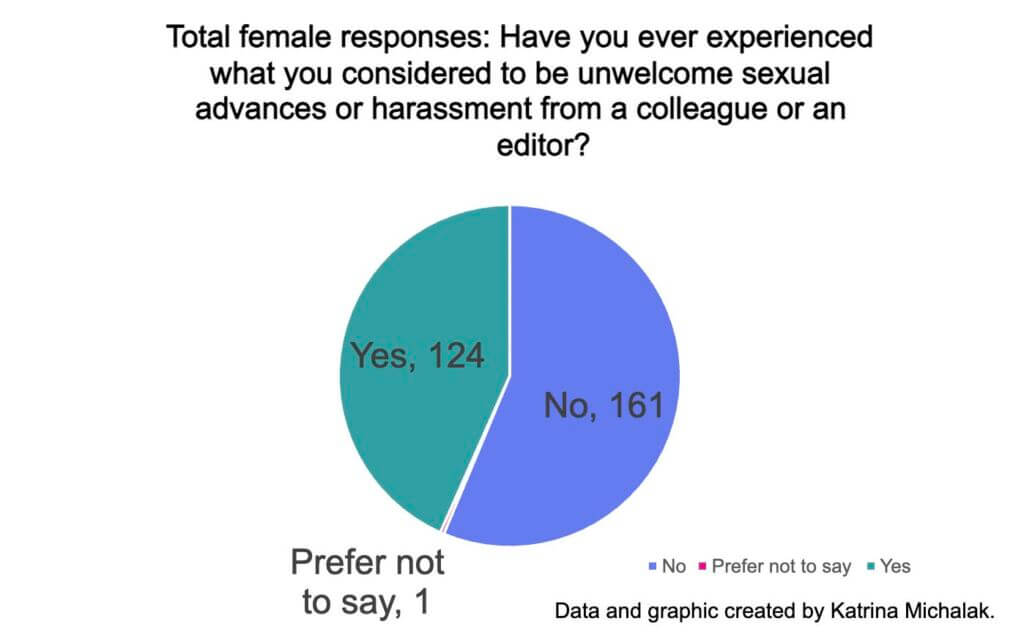
When asked, “Have you ever experienced what you considered to be unwelcome sexual advances or harassment from a colleague or editor?” 43 percent of the women surveyed and 6 percent of the men said “yes.”
As an intern, Fraser said her appointed newsroom guide made “sexually explicit comments” that left her feeling uncomfortable and would invite other female interns out for drinks after work. She did not report the situation, she said, because as an intern she didn’t feel secure enough within the newsroom to voice her concerns.
“In hindsight, I wish there had been someone that had explicitly asked about, ‘Has everyone been treating you appropriately in the newsroom?’” Fraser said. “Maybe I wouldn’t have said anything for all the same reasons, but it would have shown me at least one person cared.”
Journalism’s after-hours drinking culture with colleagues can present a special risk for unwelcome advances, Fraser said. She said she knows women who experienced unwelcome sexual advances but were told they were not “reportable” events because they occurred after hours and not in the office or at an official work event.
Fuentes said she wasn’t surprised by the overall survey results.
“Especially after the #MeToo movement, I think more people were moved to report, which I think is important, because I think there’s power in reporting,” Fuentes said. “When you talk about these things, these advancements, this harassment being made toward you, you take over the power, you take control.”
‘We don’t ask men if they can cover crime because they’ve been a victim of crime’
About 30 percent of the women who responded to the September 2025 survey said an editor or supervisor had challenged their work for reasons that seemed directly related to their gender. By comparison, only 4 percent of men reported similar experiences. Examples included questions about a woman’s ability to objectively cover sexual assault cases, fertility, abortion and LGBTQ+ rights.
An open-ended text box followed the survey question, asking, “Have you ever had an editor or boss challenge your work for reasons that seemed directly related to your gender?” This was done to provide respondents with the option to elaborate on their answers.
Of 102 respondents who left a note in the text box, 11 specifically mentioned instances of being questioned about their objectivity and possible bias.
Fraser said challenges to her objectivity usually occurred when she was covering issues around rape and “how police investigate rape, or sexual violence against children.”
“There was a fear, I think, from the editors that because I am a survivor of that violence, that I would inherently believe any survivor who came forward, and I would be lax in journalistic standards in vetting their story,” Fraser said. “And it’s just not true.”
Instead, Fraser believes her lived experience helps her to be more sensitive when speaking with sources who have had similar experiences. She has also taken trauma-informed training, she said.
“I like to argue that having lived experience makes us more qualified sometimes to cover certain topics,” Fraser said. “It’s an example where you can bring new insights to a topic and how you approach reporting it, but you still apply the same standards of fairness.”
Chapman said that while she hasn’t faced challenges to her objectivity, she’s had mixed responses to some of her story ideas for what seemed to be reasons of gender bias.
“I’ve pitched stories in a pitch meeting in front of our whole newsroom, and the editor is like, ‘No, I don’t think that’s a story,’ until a male colleague pipes up and is like, ‘Oh no, I think that’s interesting,’” Chapman said.
Previous research also notes other factors that influence such situations, including race and sexual orientation, but gender is a common denominator.
Fraser said there were times when she wanted to report on gender dynamics within a story at a previous job, and her editors questioned why she had to “make this about gender.”
“If we write a story as if an experience is universal, and we’re missing half of the reporting, which is that some people experience a policy or aspect of life differently,” Fraser said, “it’s just incomplete reporting.”
When discussing the topics of objectivity and bias, Fraser said that men typically aren’t asked whether their lived experiences disqualify them from reporting on a story. “We don’t ask men if they can cover crime because they’ve been a victim of crime,” she added.
However, a few men did report challenges related to their gender in the survey commentary. One said his story pitch was passed to a female colleague because editors felt the woman would do a better job.
Thomas Maier, 70, worked as an investigative reporter for Newsday for 40 years before retiring in May 2024. He said he once pitched an investigation on phony pregnancy clinics that were popping up next to Planned Parenthood centers on Long Island.
In an interview, Maier said he was “fundamentally dissuaded” by his editors from pursuing the story, and that he got the impression it was because he was a man in his 60s at the time.
“I think a good reporter could do that story of the pregnancy clinics that I’m talking about, be they male or female,” Maier said. “I just think you have different approaches to it, but I think you can get the story.”
Work-life balance and pay
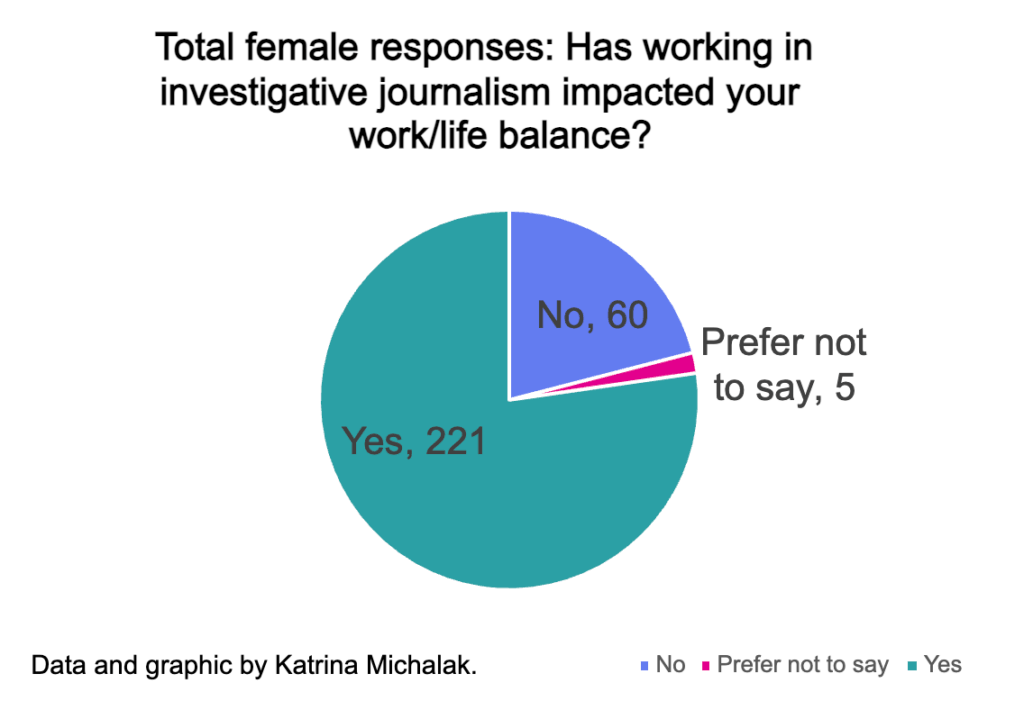
About 77 percent of both women and men said investigative journalism impacted their work-life balance. Additional survey comments indicated that the work-life balance impacted female investigative reporters in different ways.
Orr and Chapman both said they have better work-life balance in their current positions compared to when they were daily beat reporters because they have more control over their work schedules. Chapman and Fraser both work remotely and don’t follow a traditional 9-to-5 job.
The topics explored in investigative journalism, however, are harder to shake off when the day ends.
Chapman has recently reported on topics surrounding domestic abuse and sexual violence. She said thoughts about the work can linger and seep into her personal life.
Even though she knows there are helpful resources outside of her job, she finds it hard to use them because they make her think about work-related issues during non-working hours. “I don’t want to think about work,” Chapman said, “even if it is the impacts of my work on my personal life.”
In Orr’s survey commentary, she said female reporters were not taken as seriously as male reporters, especially within investigative journalism. When asked in a later interview why, Orr attributed it to the history of investigative journalism being male-dominated.
“I think it’s much more balanced than it was, say, even just five years ago,” Orr said. “But those gender disparities and tropes are very hard to get rid of.”
Fraser said in survey comments that her “biggest frustration” is having her willingness to go the extra mile and other actions being perceived as kindness rather than leadership. She said she’s previously been passed over for various promotions because she didn’t have the experience – even when she’s filled in for that job.
“Women have always been doing investigative and accountability work,” said Fraser, now an investigative and data reporter for USA Today. “We haven’t always had the same title or protections or prestige or pay to go with it.”
While that gap has closed, Fraser said, “We are still running up against the mythos that was established by men.”
Gender as a plus
Chapman, Fraser and Orr all said being a woman in investigative journalism is a strength, specifically when it comes to developing sources and extracting information. Also, being underestimated has been useful in getting sources to talk.
Orr said the female investigative reporters she has worked with over the past few years had “fantastic” source-building skills.
“They were often able to connect with sources on a level that men weren’t necessarily able to do,” Orr said. “I don’t know if it’s sort of the innate capacity for empathy. I think that might be a big piece of it.”
David Mercado, 27, is an education reporter for the Galveston County Daily News, but worked for the Uvalde Leader-News when he completed the survey.
At his previous job, when he worked on an investigative piece, he said the schools would be distrustful and more hesitant to speak with him, “even if it was a positive story.”
“If you want to talk to students directly about something that happened, if you reach out to parents directly … there were women who have an easier time doing that, essentially,” Mercado said in an interview.
Beyond individual observations, the survey provided insight into the key question of whether newsrooms had resolved the long-standing issues of sexual harassment and gender bias in the industry.
“If we treated women equally in terms of pay and respect and promotions, it would be much harder to disrespect them at levels that rise to sexual harassment and violence,” Fraser said.
