


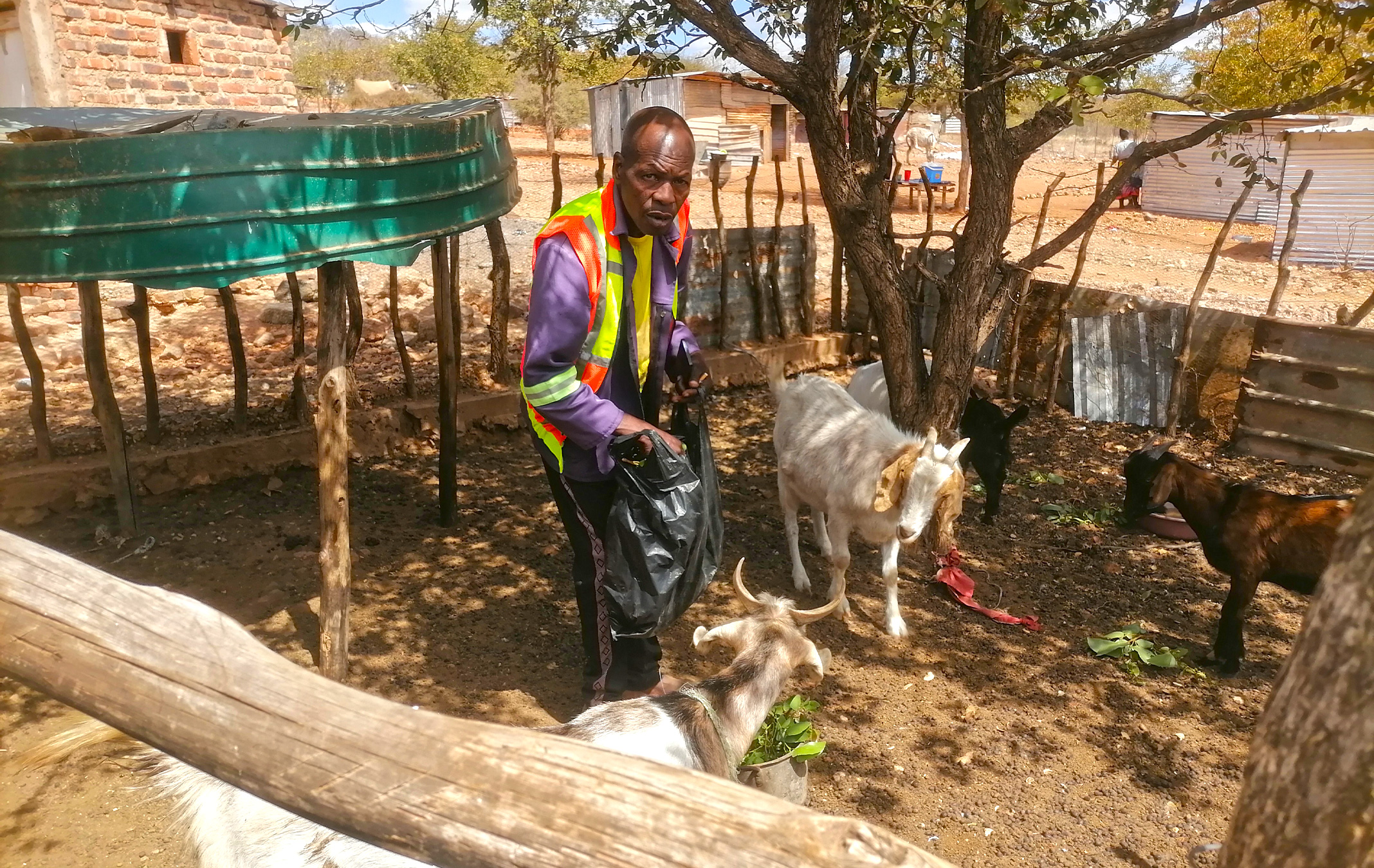
- In South Africa’s Malala Drift, near Musina in Limpopo province, farmers say rainfall has become increasingly unreliable, forcing some to abandon their crops.
- New research also documents increased rainfall variability in recent years, along with rising temperatures, drought, crop failures, livestock deaths and food insecurity.
- Some farmers say that when the river level falls, they hire an excavation company to dig into the riverbed.
MALALA DRIFT, South Africa — In Malala Drift, near the town of Musina in South Africa’s Limpopo province, drought and unreliable access to water are threatening the livelihoods of farmers. Some have abandoned crop production after struggling to secure enough water, while others continue farming under increasingly difficult conditions.
The farms lie along the Limpopo River, which separates South Africa from Zimbabwe. But even with a major river nearby, access to reliable water supply is not guaranteed. Farmers say rainfall has become increasingly unpredictable in the past decade, and when the river level falls, they sometimes pay an excavation company to dig into the riverbed to reach water, adding to the cost of keeping their farms operating.
The effects of the water scarcity are visible at one of the farms Mongabay visits. Poles that once supported tomato plants are scattered across the property, while irrigation pipes are obscured by overgrown grass. No crops are growing.
Kanny Ndou, who used to work here as a laborer and now takes care of the property, said the farm previously produced potatoes, butternut squash and tomatoes for sale in Musina. But after 10 years, Ndou said, the owner stopped farming in 2025 because of unreliable water supply.
“We used to grow a variety of vegetables for sale in Musina, but due to inconsistent water supply, the farm decided to stop farming last year,” he said. For years, farmers had faced unpredictable outcomes: a good harvest one season, a bad one the next, he said.

The farm stretches toward the Limpopo River, but the river does not always provide what the farmers need for their crops. According to Ndou, the problem is not simply whether there is rain in a particular season, but whether there is enough dependable water to sustain production from one season to the next.
A July 2026 study by researchers from the University of Venda, Limpopo, examined drought trends, their effects on livelihoods and coping strategies in the Musina area between 1991 and 2023. Using rainfall and temperature data together with information collected from 120 respondents, the researchers found that drought was a recurring problem throughout the study period.
The study identified about 15 drought episodes between 2010 and 2023, compared with about nine between 1991 and 2009, suggesting that drought episodes became slightly more frequent in the later period. The researchers identified severe drought conditions during several periods, including 1991-92 and 2015-16.
The researchers also found that temperatures increased over the study period. Minimum temperatures rose from about 21° Celsius (69.8° Fahrenheit) in the 1990s to about 23°C (73.4°F) in the 2010s, while maximum temperatures increased from about 30°C (86°F) to 32°C (89.6°F). Higher temperatures can increase evapotranspiration — the loss of water from soil and plants — potentially increasing water stress during drought periods.
The study, however, found that rainfall did not show a statistically significant long-term declining trend. Instead, the research found considerable rainfall variability from year to year. Combined with rising temperatures, this variability creates uncertainty for people whose livelihoods depend on reliable water supplies.
This uncertainty is also reported in a 2025 study of nearly 500 households across other areas of Limpopo: 89% of those surveyed had experienced severe drought within five years, leading to dramatic outcomes of crop failure, water scarcity and livestock death. Roughly 70% of people surveyed faced food insecurity.


The survey responses from the University of Venda study reflected similar effects of fluctuating rainfall and rising temperatures. Of the 120 respondents, more than half reported experiencing water shortages. Some of the respondents interviewed for the study reported reduced crop yields while some noted increased livestock mortality, food insecurity or reduced income.
For farmers in Malala Drift, these findings are reflected in the difficulties they face keeping up their operations — and their lives, since many depend entirely on farming to sustain their families. When water from the Limpopo River is scarce, some farmers said, they sometimes block and redirect the available flow for their use or hire excavators to dig. These measures come at a cost and do not provide a reliable long-term solution.
Ephias Mugari, a postdoctoral fellow at the University of Limpopo’s Centre for Global Change, said Musina is a semiarid, low-rainfall area that is particularly vulnerable to drought.
He said rising temperatures, unreliable rainfall and increasing demand for water were combining to put greater pressure on farmers and households.
“It’s the interaction of these three — less water arriving, more water lost to heat and more water being asked for — that compounds the pressure,” Mugari said.
Mugari said Musina needs to move from reacting to drought to preparing for it. He pointed to measures including stronger early-warning systems, improved water storage and water harvesting, cultivating drought-tolerant crops and livelihood diversification.

The University of Venda study similarly recommended improved water infrastructure, rainwater harvesting, climate-smart and drought-resilient agriculture, livelihood diversification and stronger drought early-warning and preparedness systems.
They also found that communities were already using different ways to cope with drought, including seeking alternative water sources such as boreholes and rainfall harvesting, conserving water, planting drought-tolerant crops and diversifying their livelihoods.
Back in Malala Drift, farmers continue to deal with the increasing uncertainty. And it is not just the crop farmers who are barely making do.
Another resident who may be facing the throes of drought is Kwinda Tshirundu. He said he settled in the area intending to build a goat-farming operation. But his goats have not multiplied as he expected they would, he said.
“From the time I started staying here, my goats should have multiplied to 30, but I only have five; I am not sure whether it is drought related,” said Tshirundu, while his goats were eating the leaves of a mopani tree (Colophospermum mopane), a drought-resistant species native to South Africa.
His experience illustrates the uncertainty facing farmers whose livelihoods depend on water and vegetation. While Tshirundu was unsure whether drought was responsible for the slow growth of his herd (research shows drought indeed can affect goat reproduction), the lack of reliable water and forage adds further challenges to running a livestock operation.
For farmers along the Limpopo River, having a major river nearby does not necessarily mean having reliable access to water. Some have continued farming, others have stopped, while those who remain face the costs and uncertainty of finding enough water to keep their livelihoods going.
Banner image: A Malala Drift area resident feeding his goats, which he said he believes should have multiplied by now. Research shows drought can affect goat reproduction. Image by Bernard Chiguvare for Mongabay.
‘Sharing is off the table’ as drought reshapes the culture of Ethiopia’s pastoralists
Like ‘climbing Kilimanjaro’ without help: Interview with a Limpopo conservationist
Citations:
Nekhavhambe, M., Nelwamondo, T., Mudau, N. V., Netshisaulu, K. H., Mohomi, T., & Munyai, R. B. (2026). Determining spatiotemporal drought trends, livelihood impacts and associated coping strategies in Musina local municipality, Limpopo province, South Africa. Sustainability, 18(15), 7629. doi:10.3390/su18157629
Matimolane, S., Strydom, S., Chikoore, H., & Mathivha, F. I. (2025). Household experiences and adaptation to drought impacts on rural livelihoods in Limpopo province, South Africa. Discover Sustainability, 7(1). doi:10.1007/s43621-025-02428-7
Bashiru, H. A., Lestari, D. A., Mustofa, F., & Setiaji, A. (2026). Challenges and opportunities of goat breeding practices in low- and middle-income countries. Frontiers in Animal Science, 7. doi:10.3389/fanim.2026.1769206
Cite this article
Bernard Chiguvare (2026). Farmers in South Africa’s Limpopo face unpredictable rainfall, uncertain futures. Mongabay Conservation news. DOI: https://doi.org/10.66709/news-330882

