


- A global study estimates that drifting fish aggregating devices, or dFADs, affect more than half of the world’s protected marine area.
- Researchers documented at least 6,324 dFAD strandings across 174 protected areas in 53 maritime jurisdictions over a period spanning 2007-2023.
- The analysis found no clear evidence that fishing fleets systematically concentrate dFAD fishing around large marine protected areas.
- Researchers and an independent fisheries expert are calling for stronger limits on dFAD deployments, better tracking and for companies to have greater responsibility for retrieving lost devices.
Marine protected areas (MPAs) may prohibit industrial fishing within their boundaries, but they cannot stop fishing gear released elsewhere from drifting inside.
A new global study estimates that drifting fish aggregating devices (dFADs) used by industrial tuna fleets affect more than half of the world’s protected marine areas. Some travel thousands of kilometers before sinking or washing ashore, where they can damage coral reefs, entangle wildlife and leave coastal communities with the burden of removing the debris.
Published in Science Advances in June 2026, the study combined fishing records, published research, an online survey of MPA staff and experts, and follow-up interviews to assess the global distribution, strandings and impacts of drifting FADs in MPAs.
“We were surprised to find that FADs appear to affect more than half of the world’s protected marine area, and that impacts often occurred thousands of kilometers from the original fishing grounds,” study co-author Boris Worm, a marine ecologist at Dalhousie University in Canada, told Mongabay by email.
Fishing gear does not respect boundaries
dFADs are floating rafts deployed by purse-seine fishing vessels — industrial boats that encircle schools of tuna with large nets — to attract skipjack (Katsuwonus pelamis), yellowfin (Thunnus albacares) and bigeye tuna (Thunnus obesus).
The devices carry satellite-linked buoys and echo sounders that allow companies to track them and estimate the fish below. But many are later deactivated, abandoned or lost and continue drifting beyond the fishing grounds where they were released.
A 2025 study led by Laurenne Schiller, a marine conservation scientist at Dalhousie University, estimated that tuna fishers deployed 1.41 million dFADs from 2007-2021 that drifted across more than one-third of the world’s oceans. Schiller, who also led the new study, found they traveled well beyond tuna fishing grounds, potentially reaching biodiversity hotspots and protected areas.
Previous studies had already shown that dFADs could enter individual protected areas.
Worm said their new research expanded the analysis from one modeled MPA to protected areas worldwide, using empirical evidence to examine how often dFADs entered them and what impacts managers observed.

Thousands of strandings in protected areas
The team documented at least 6,324 dFAD strandings across 174 protected areas, including 161 MPAs and 13 shark sanctuaries, in 53 maritime jurisdictions.
Hotspots occurred in the western and central Pacific, western Indian Ocean and the Caribbean Sea. French Polynesia recorded 1,539 strandings, followed by Seychelles with 1,404 and the Maldives with 746.
Around 30% of protected areas with recorded or inferred strandings were in “small island developing states,” where local authorities often bear recovery and disposal costs, according to the study.
Stranded dFADs can break, smother or entangle corals, while their submerged tails can entangle sharks, turtles and other animals. Their plastic and electronic components may persist even when rafts are made mainly from biodegradable materials.
The researchers cautioned that finding a stranded dFAD in habitat occupied by threatened species does not prove direct harm. The effects of devices that sink offshore also remain largely undocumented.

No clear evidence of deliberate fishing near MPAs
The researchers also examined whether tuna fleets increasingly concentrated dFAD fishing just outside large MPAs to exploit fish crossing their boundaries.
Study co-author Juan Carlos Villaseñor-Derbez, a marine scientist at the University of Miami in the U.S., said this question interested him most.
Using publicly available data, the researchers found that dFAD fishing near the examined MPAs had increased, but at roughly the same rate as fishing farther away.
“This tells us two things,” Villaseñor-Derbez told Mongabay by email. “First, confirmation that dFAD fishing has become more common, which was already known. And second, that fishers are likely not strategically fishing on dFADs near MPA boundaries, at least at the very broad spatial scales at which we were able to measure this.”
The findings do not rule out deliberate deployments near individual MPAs. One industry interviewee, according to the study, said crews sometimes release dFADs near MPA boundaries to attract tuna from protected waters, but available data were too coarse to show how widespread this is.
Tracking data remain out of reach
Villaseñor-Derbez said the lack of public dFAD tracking data remains a major obstacle to more detailed analyses. Real-time locations may need to remain confidential, he said, but companies and regulators could release historical records once their commercial sensitivity has passed.
“This would allow us to better understand the spatial and temporal dynamics of dFAD fishing in relation to MPA boundaries, while still preserving the privacy aspects of real-time data,” Villaseñor-Derbez said.
Historical records could show where devices were deployed, how long companies controlled them and whether they entered MPAs accidentally or after their buoys were deliberately deactivated.
Worm said researchers should also assess compliance with 2025 dFAD construction rules banning entangling materials such as netting, and whether the rules reduce harm to sharks, sea turtles and other threatened species.

Harder limits on deployment
Glen Holmes, a marine ecologist and international fisheries expert with the U.S.-based Pew Charitable Trusts who was not involved in the study, said its main strength and contribution were assembling a global picture from research previously focused on individual regions.
“This study is one of the few truly ‘global picture’ pieces of research on the impacts of drifting FADs,” Holmes told Mongabay by email. Focusing on MPAs, he said, highlights potential damage to habitats that governments and communities have chosen to protect.
Holmes also noted that the study’s analysis of possible solutions drew on 18 interviews, including only three purse-seine industry representatives and no negotiators from regional fisheries management organizations (RFMOs), which he said limited the perspectives of institutions that regulate tuna fisheries and dFAD use.
Existing reforms have emphasized non-entangling designs and biodegradable materials. Holmes described these as the politically easier parts of dFAD regulation.
“Improvements on FAD management have historically followed the path of least resistance, and so the ‘easy stuff’ is already done or underway,” he said. “But the biggest impacts are arguably coming from the politically harder elements to implement.”
Worm called for an annual cap on dFAD deployments and restrictions in waters directly upstream from MPAs, where currents may carry devices into protected areas.
Holmes similarly urged regulators to prevent dFADs from being abandoned or lost. Companies often deactivate tracking buoys after devices leave productive fishing grounds, reducing the chance of retrieval.
“Most deployed dFADs are ‘lost’ either accidentally or intentionally, and so regulating to minimise this ‘loss’ and therefore minimise the risk of overall interaction with MPAs is, I think, the most important element,” Holmes said.
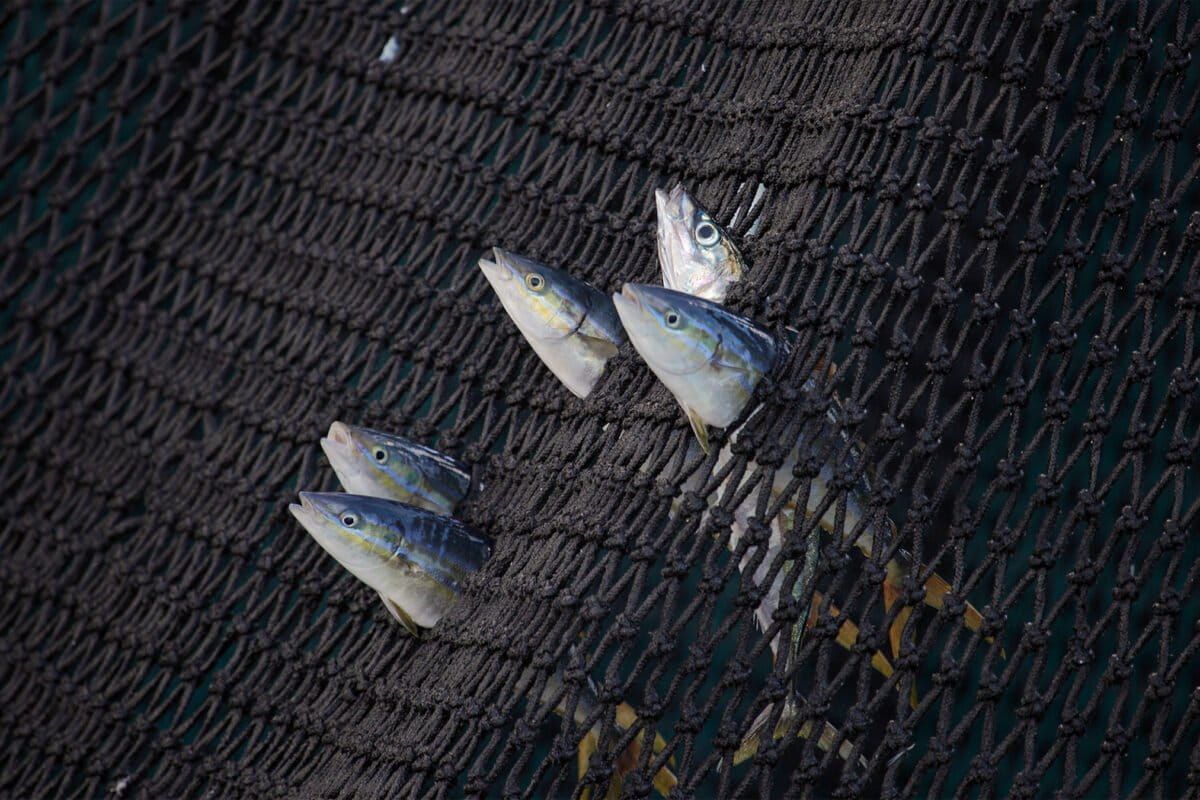
Banner image: Juvenile yellowfin tuna hang in the purse seine net of the French fishing vessel Trevignon after setting on a fish aggregating device (FAD) in the Mozambique Channel. Image by © Jiri Rezac / Greenpeace.
A marine protected area can ban fishing boats. It cannot stop drifting gear
Abandoned tuna-fishing devices pollute the Galápagos Marine Reserve
Citations:
Blanluet, A., Game, E. T., Pollock, K., Wolff, N. H., Everett, J. D., Neubert, S., … Richardson, A. J. (2025). Drifting fish aggregation devices as a tool to study oceanic marine protected areas. Fisheries Research, 289, 107474. doi:10.1016/j.fishres.2025.107474
Bode, M., Game, E. T., Wegmann, A. S., and Pollock, K. (2023). Fish aggregating devices could enhance the effectiveness of blue water marine protected areas. Conservation Letters, 16(6). doi:10.1111/conl.12984
Curnick, D. J., Feary, D. A., and Cavalcante, G. H. (2021). Risks to large marine protected areas posed by drifting fish aggregation devices. Conservation Biology, 35(4), 1222-1232. doi:10.1111/cobi.13684
Schiller, L., Villaseñor-Derbez, J. C., Lynham, J., and Worm, B. (2026). Global impacts of drifting fish aggregating devices on marine protected areas. Science Advances 12(25). doi:10.1126/sciadv.aee6998
Feedback: Use this form to send a message to the editor of this post. If you want to post a public comment, you can do that at the bottom of the page.
Cite this article
Keith Anthony Fabro (2026). Drifting tuna fishing gear enter half of marine protected areas: study. Mongabay Conservation news. DOI: https://doi.org/10.66709/news-325073

