


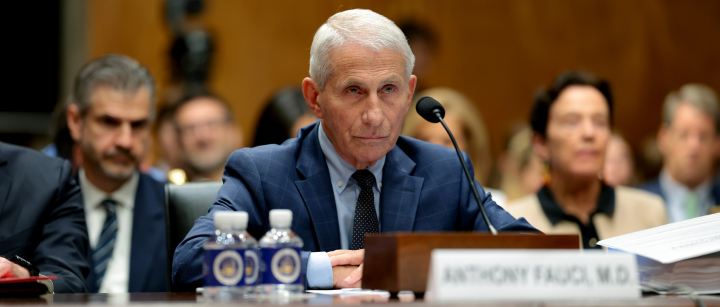
Sen. Rand Paul has pointed to a line in Dr. Anthony Fauci’s diary to claim that the former director of the National Institute of Allergy and Infectious Diseases privately “knew” in January 2020 that the coronavirus did not come from a wet market, saying this contradicted Fauci’s public statements regarding a natural origin of the virus. That misconstrues Fauci’s original statement.
The origin of the virus that causes COVID-19 hasn’t been definitively proven, so the question remains open. But the scientific evidence supports a natural spillover from an infected animal to humans rather than a leak from a lab.
In January 2020, Fauci indicated that he believed the virus most likely has a natural origin – an idea that he has consistently expressed for years.
Paul has clashed with Fauci over the origin of the coronavirus since 2021. The Republican senator from Kentucky — who has been conducting an investigation of the origins of COVID-19 as chairman of the Senate Committee on Homeland Security and Governmental Affairs — has accused Fauci of approving research in China that could have produced the coronavirus. There is no evidence that’s true.
Four days before a July 29 Senate hearing in which Fauci declined to answer any questions, Paul released more than 1,100 pages of day-by-day recaps that Fauci wrote during the first years of the pandemic. (Fauci has referred to the log as his “personal diary”; Health and Human Services Secretary Robert F. Kennedy Jr. has said that he provided the entries after pulling and assembling the information from “11 separate servers.”)
Fauci said in a brief opening statement at the hearing that given Paul’s “unhinged obsession” with him, and on the advice of his lawyers, he would be invoking his Fifth Amendment right against self-incrimination. Before leaving office, former President Joe Biden pardoned Fauci for any potential crimes related to his service in government. The pardon does not cover any statements he might have made during this week’s hearing. Fauci, who was the head of NIAID from 1984 to 2022, has maintained that he has committed no crime and is the target of baseless attacks.
In the hearing, and in multiple statements before and after, Paul has focused on a Jan. 26, 2020, diary entry in which Fauci stated that “the first infection was in early December and was not connected to the market. … Now we know the market was not the source, it was the amplifier.”
Paul has zeroed in on these statements to falsely suggest that Fauci was saying then that the coronavirus didn’t have a natural origin and to argue that he wasn’t being transparent with the public.
“One of the biggest items that we found in there was that in January of 2020, he already was acknowledging that the virus didn’t originate in the marketplace,” Paul said of the diary entries in a press gaggle on July 27. “For years he’s been telling you — if you interviewed him last week, he’s probably still telling you — the reason we think it came from nature is because they had these exotic animals and that’s where SARS came from previously. But he knew, he already knew.”
“He told dear diary,” Paul continued, “but to the public, he commissioned this paper called proximal origins. And in it, they go on and on saying it’s implausible that it came from the lab and we’re really convinced it came from these wild animals in the marketplace. But that level of dishonesty is really astounding.”
“On Jan. 26, 2020, before the country had heard the phrase ‘lab leak,’ Fauci wrote in his private notes that the wet market was not the source, it was the amplifier,” Paul similarly wrote in a July 28 Fox News editorial.
This is not the “gotcha” that Paul makes it out to be. Citing this one passage removes critical context for Fauci’s statements and falsely implies that if the pandemic didn’t originate in the one market, that it couldn’t have had a natural origin. It also treats Fauci’s diary statement as an immutable fact, when in reality, it was an interpretation of the information that was known at the time.
Immediately after the “amplifier” sentence, Fauci was clear in his diary that this did not change his opinion that the outbreak had a natural origin. “Having said that, somewhere the virus jumped from animals to humans,” he wrote.
The diary entry also reflects the science as it was known at the time. Two days before Fauci’s entry, a Lancet article had been published that had found about a third of the 41 first lab-confirmed COVID-19 cases that had been hospitalized – including the patient with the earliest symptom onset – did not have a known connection to the wet market in question, the Huanan seafood market.
This information surprised scientists and suggested to some that the market might not be the source of the virus. The day of Fauci’s diary entry, Science had published a news story about the paper. Headlined “Wuhan seafood market may not be source of novel virus spreading globally,” it emphasized these particular findings, but did not mention anything about a non-natural or lab origin.
Later, in 2021, scientists published articles showing that the first recognized COVID-19 case did have a connection to the wet market, although such a link is not required for a natural origin. Other evidence has also accumulated that supports a natural spillover from an infected animal to humans, which is precisely what scientists think has occurred in the past with an earlier coronavirus, and in particular points to that occurring at the Huanan seafood market.
An analysis of the earliest cases shows that even those without a known connection to the market still cluster around the market. Environmental samples also show evidence of the virus in the market, clustering in areas now known to have sold coronavirus-susceptible live mammals, and in some cases mixed with the DNA of such animals. Analyses of viral sequences also point to two separate spillovers, both linked to the market.
While this evidence can’t prove a natural origin at the market, hypotheses about any kind of potential lab leak remain speculative. The much-discussed features of the coronavirus that might initially appear to be unusual and manipulated in the lab in fact have been found in nature and are not ones scientists could have predicted. Vague and shifting claims about possible illnesses among lab members at the Wuhan Institute of Virology are too unclear to shed light on the issue. There is no evidence that researchers ever had a virus close enough to the coronavirus to lead to any kind of lab leak.
“There’s overwhelming scientific evidence that COVID emerged from an animal market in Wuhan, which was miles away from a virology lab,” Gigi Gronvall, a senior scholar at the Johns Hopkins Center for Health Security and professor at the Bloomberg School of Public Health, told us for a previous story.
The Intelligence Community remains split. Three agencies — the FBI, Department of Energy and the CIA — have assessed a lab origin is “most likely,” but aren’t in agreement about which lab is to blame. Five others favor a natural spillover or are undecided.
We asked Paul’s office about his statements on Fauci’s diary entry, but we haven’t received a response.
Paul’s Video Montage
One of Paul’s core claims related to the Jan. 26, 2020, entry is that Fauci was dishonest with the public about the coronavirus origin.
“For years, Anthony Fauci has been the public face of saying this in all likelihood came from nature. He kept saying, ‘it’s the marketplace, it’s the marketplace, it’s the marketplace.’ He’s been saying that on television up until recently,” Paul said during the hearing. “But what we find is that what he was saying in public is different than what he was saying in private.”
“In January, in private, he wrote that, looks like the wet market was a superspreader event. It didn’t originate there. We know that some of the earliest deaths and sickness came from somewhere else,” Paul continued. “But then for years and years, we got dishonesty.”
Paul then played a video of nine clips of Fauci discussing wet markets. The video referred on screen to “Fauci’s Wet Market Lie,” and a voiceover claimed the video showed that “Fauci’s journal entries contradict what he said publicly about the origins of COVID-19.”
That’s misleading. The video clips don’t show a clear contradiction with Fauci’s diary entries.
We identified each clip and found that the earliest one dates to April 3, 2020, after scientists had already published their “proximal origin” paper in Nature Medicine, which said that they did not find any lab leak scenario “plausible,” and which Fauci has indicated he was persuaded by.
Two clips show Fauci suggesting government officials address risks related to both labs and wet markets. In at least four of the videos, Fauci acknowledged the origin of the coronavirus was uncertain.
“I think you could say we don’t know how and where it originated,” he said in November 2021 on “Face the Nation.” “We don’t have definitive evidence one way or the other,” he said on NewsNation in April 2023.
In another, from February 2022, Fauci wasn’t even speaking about the coronavirus, but rather another coronavirus that caused an outbreak that began in 2002.
As we’ve established, Fauci’s remarks in January 2020 about the market being an amplifier don’t indicate that he thought the coronavirus leaked from a lab, nor do the remarks show that he had permanently discarded the idea that the outbreak began in the market. The diary shows Fauci consistently supporting a natural origin as most likely.
In a July 2021 diary entry, he wrote that a natural origin is “almost certain,” but noted that he had been careful to acknowledge a lab leak could still be possible.
“There is no question in my mind based on so many factors including history, molecular makeup with the virus, among others that this virus naturally emerged from an animal reservoir,” he wrote a month later.
What Fauci Said About Origins Early On
According to emails made public in June 2021, Fauci was aware on Jan. 31, 2020, that some scientists had taken a cursory look at the coronavirus genome and had seen some sequences that they thought might be suspicious of engineering. But within days, after more investigation and discussion, those same scientists had concluded that engineering was extremely unlikely after all. By mid-March, the scientists had published their findings in a paper titled, “The proximal origin of SARS-CoV-2,” explaining why they did not think any of the various lab leak scenarios were plausible. A preprint of the paper was online in mid-February.
It is unclear exactly when Fauci was updated on their progress, but records indicate that Fauci received some kind of feedback on Feb. 4 and was told of the paper’s acceptance on March 6. In any case, it was a relatively short period of time between Fauci receiving information about potentially suspicious sequences and getting the same scientists’ conclusion that a natural spillover was the most likely origin of the virus.
Paul has used Fauci’s diary entry about a Feb. 1, 2020, conference call with some of these scientists to again claim that Fauci was not transparent with the public. (We’ll explain the conference call in the next section.)
Setting aside that a health official might not want to share every suspicion immediately with the American public, we did not find evidence that Fauci’s public statements substantially differed from his diary notes between Jan. 26, 2020, and February or March 2020.
In an interview with Fox News’ Sean Hannity on Jan. 27, 2020, Fauci alluded to the Lancet paper’s findings and the first cases and suggested that the market might not be the original source.
In a February 6, 2020, interview with ABC News, Fauci said of engineering or deliberate release of the virus, “There’s always that concern.” He went on to say that “one of the things that people are doing right now is very carefully looking at sequences to see if there’s even any possibility much less likelihood that that’s going on.”
His remarks in a Feb. 17, 2020, interview with USA Today are remarkably similar to his sentiments in his Jan. 26 diary entry.
“Almost certainly, somewhere, somehow a bat infected an intermediate host who infected a human. What epidemiologists feel is that the market was an amplifier of something that was already going on,” Fauci said. “So it didn’t necessarily start in the market, but when people congregated in the market they got infected from each other as opposed to all of them getting infected from whatever animal there was in the market.”
He went on to acknowledge that he couldn’t rule out an accidental or deliberate release, but that he thought the odds were very low. “I can’t say absolutely that’s not the case,” he said. “It is extremely unlikely that that’s the case, but you can find out if it is or not. And there are people who are actually looking at that right now. So I think we’re going to get some sort of an answer about that.”
Misrepresentations of Conference Call
As we said, Paul has pointed to a call Fauci had with scientists on Feb. 1, 2020.
“Feb. 1, 2020. The call that produced Proximal Origin. Twelve scientists. Only 2 concluded it was natural. Per Fauci’s own notes, ‘the rest felt that deliberate insertion was possible.’ This was never a 50/50 room,” Paul said in a July 25 X post.
“12 scientists took part in the call that produced Proximal Origin. Only two concluded natural origin,” Paul wrote in his Fox editorial about the diary entries.
Some of this selectively quotes and misinterprets Fauci’s diary. “There was not total agreement about the likelihood of deliberate insertion,” Fauci’s Feb. 1 entry reads. He described two individuals who were so convinced of a natural origin that they didn’t think it was worth investigating further. The rest disagreed, and thought it should be studied. Thinking something is “possible” enough to study, however, does not necessarily mean those individuals viewed it as likely.
While Paul says it “was never a 50/50 room,” a later entry by Fauci describes the call in nearly exactly those terms.
“After a considerable amount of discussion about half of the people felt that this was possibly a constructed virus and the other half were convinced that this was a natural occurrence,” Fauci wrote in a June 2021 entry, noting that he had consulted with these experts since he was not an evolutionary biologist himself. “A few weeks later,” he said, scientists got together “to examine this more carefully and they came to the conclusion that they were convinced that this. was a natural occurrence and a jump from the animal reservoir. They published their data in a preprint server in February followed by a nature paper in March of 2020.”
One of those scientists, Kristian G. Andersen, a professor of immunology and microbiology at Scripps Research, has described that time period as “a clear example of the scientific process.”
In a June 1, 2021, social media post, Andersen said, “As I have said many times, we seriously considered a lab leak a possibility. However, significant new data, extensive analyses, and many discussions led to the conclusions in our paper.”
Kate Yandell contributed to the story.
Editor’s note: FactCheck.org does not accept advertising. We rely on grants and individual donations from people like you. Please consider a donation. Credit card donations may be made through our “Donate” page. If you prefer to give by check, send to: FactCheck.org, Annenberg Public Policy Center, P.O. Box 58100, Philadelphia, PA 19102.
