


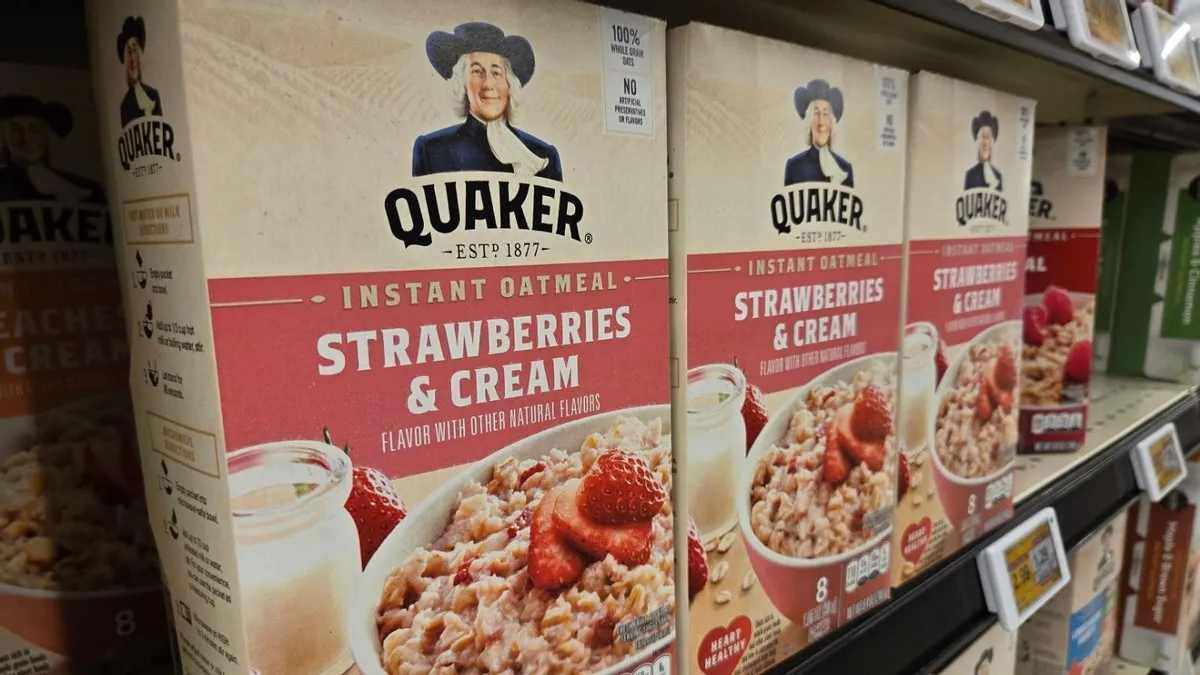
- A long-standing online rumor claims the “natural flavor” ingredient listed on boxes of Quaker Oats’ instant strawberries and cream oatmeal secretly contains castoreum, an oily substance derived from an area near a beaver’s anal glands.
- A spokesperson for PepsiCo, the company that owns Quaker, denied the rumor, saying, “The claim is inaccurate. The flavoring used in Quaker Instant Oatmeal Strawberries & Cream does not contain castoreum.”
- Snopes was not able to independently verify this claim and therefore did not apply a fact-check rating.
- A 1977 Federal Register document shows castoreum receiving a “Generally Recognized as Safe (GRAS)” classification in the Code of Federal Regulations. A spokesperson for the U.S. Department of Health and Human Services, speaking generally about food products, said that classification was specifically “for use as a natural flavoring agent,” adding the substance may appear on ingredients labels “simply as ‘natural flavoring.'”
For years, people have shared videos about
In one example, a YouTube video (archived) from May 2026 combined clips from other users’ videos, including from author and creator Jabez el Israel (@jabez_invests), who has recorded multiple clips promoting the rumor. The YouTube video also showed part of a 2013 clip from author Vani Hari, known online under the name Food Babe.
The rumor has also appeared on Facebook (archived), Instagram (archived), Reddit (archived), TikTok (archived) and X (archived).
In short, Snopes was not able to independently verify this rumor. For that reason, we did not apply a fact-check rating to this story.
We emailed PepsiCo,
A spokesperson responded, “The claim is inaccurate. The flavoring used in Quaker Instant Oatmeal Strawberries & Cream does not contain castoreum.”
In an email, a U.S. Health and Human Service spokesperson told us castoreum received a “Generally Recognized as Safe (GRAS)” classification in the Code of Federal Regulations, specifically “for use as a natural flavoring agent,” as well as that the substance “may appear on the ingredient label simply as “natural flavoring.” That classification appears on page 14,645 in a 1977 Federal Register document.
The HHS spokesperson added that the Food and Drug Administration, a division operating under HHS, “does not maintain a list of specific commercial products that contain any particular flavoring substance, including castoreum.”
The official Quaker page for the strawberries and cream instant oatmeal product provides the following information about the “natural flavor” ingredient: “Natural flavors are obtained from essences or extracts of sources found in nature such as spice, fruit, vegetable, yeast, herb, plant material, meat, seafood, poultry, eggs, dairy products.” The front of the product box reads, “Strawberries & Cream,” then “flavor with other natural flavors.”
What is castoreum?
Beavers’ rear ends contain anal glands and castor glands, the latter also known as castor sacs. Researchers and people working in other fields derive castoreum specifically from the castor sacs.
Britannica defines castoreum as follows:
Castoreum, an oily, viscid glandular secretion contained in two pairs of membranous sacs between the anus and external genitals of both sexes of beaver. It is yellow or yellow-brown in colour, of a butterlike consistency, and has a highly disagreeable odour due to the presence of an essential oil.
Beavers deposit castoreum on rocks and shorelines to mark territorial boundaries, but its utility as a fixative agent in perfume formulation was among the causes of the near extinction of the North American species (Castor canadensis) by 1900. After beavers were trapped and killed, the sacs were removed and dried, either in smoke or in the sun. Drying darkened and hardened the castoreum and reduced its odour. Castoreum is soluble in alcohol and is prepared for use as a tincture.
The Center for Science in the Public Interest, a nonprofit organization based in Washington, D.C., reported beavers mix their castor-sac secretions with urine for marking territory. The organization’s website defines its purpose as advocating for consumers and holding government agencies and corporations to account, including focusing on “evidence-based and community-informed policies on nutrition, food safety and health.”
Castoreum usage in present-day foods
In 2013, Snopes fact-checked the claim that companies commonly use castoreum as a food additive with a rating of mostly false. The article highlighted data from “Fenaroli’s Handbook of Flavor Ingredients,” a reference source compiling purportedly accurate data about flavor ingredients companies feature in food products.
Some data for castoreum, castoreum extract and castoreum liquid remained unchanged between the book’s fourth edition, published in 2001, and its sixth edition from 2016.
According the 2001 edition, total annual U.S. consumption consisted of 43.33 pounds of castoreum, 96.67 pounds of castoreum extract and 151.67 pounds of castoreum liquid. On a per-individual basis, those numbers break down into extremely small amounts. The book’s 2016 edition displayed the same numbers.
The book stated regulatory status usage data on castoreum extract and castoreum liquid in food products using the parts per million metric, which helps to numerically express trace amount information for extremely small concentrations of substances. The numbers published in 2001 remained the same in the book’s 2016 edition.
Castoreum extract usage data was stated as follows, in parts per million: “baked goods 68.47; frozen dairy 26.26; meat product 2; soft candy 44.10; gelatin, pudding 47.34; nonalcoholic beverages 29.77; alcoholic beverages 93.69; gravies 0.60; hard candy 24.17; chewing gum 42.09.”
Castoreum liquid information was stated as follows, also in parts per million: “baked goods 4.87; frozen dairy 1.46; soft candy 2.92; gelatin, pudding 1.25; nonalcoholic beverages 1.27; hard candy 9.09; chewing gum 0.01.”
The book also included castoreum extract and liquid usage information from 1994, sourced from the Flavor and Extract Manufacturers’ Association.
An International Journal of Toxicology report from 2007, citing a limited toxicological database, concluded castoreum extract consumption levels were safe for use and nontoxic with “no reports of human adverse reactions.”
We will update this article if we find or receive further credible data.
Sources
Britannica Editors. “Castoreum.” Britannica, https://www.britannica.com/science/castoreum.
Burdock, G. A. “Safety Assessment of Castoreum Extract as a Food Ingredient.” International Journal of Toxicology, vol. 26, no. 1, 2007, pp. 51–55. PubMed, https://doi.org/10.1080/10915810601120145.
Burdock, George A. Fenaroli’s Handbook of Flavor Ingredients. Fourth Edition, CRC Press, 2001.
———. Fenaroli’s Handbook of Flavor Ingredients. Sixth Edition, CRC Press, 2016.
“Castoreum.” Center for Science in the Public Interest, May 2026, https://www.cspi.org/chemical-cuisine/castoreum.
“CASTOREUM, EXTRACT (CASTOR SPP.).” Substances Added to Food (Formerly EAFUS), https://www.hfpappexternal.fda.gov/scripts/fdcc/index.cfm?set=FoodSubstances&id=CASTOREUMEXTRACT.
Mikkelson, David. “Does Your Food Contain Beaver Anal Secretions?” Snopes, 5 Feb. 2013, https://www.snopes.com//fact-check/castoreum/.
PPM Calculator | Parts Per Million Conversion & Formula. https://ppmcalculator.net/.
Svendsen, Gerald E. Castor and Anal Glands of the Beaver (Castor Canadensis). vol. 59, no. 3, Aug. 1978, pp. 618–20, https://www.jstor.org/stable/1380239.
Walro, J. M., and Gerald. E. Svendsen. “Castor Sacs and Anal Glands of the North American Beaver (Castor Canadensis): Their Histology, Development, and Relationship to Scent Communication.” Journal of Chemical Ecology, vol. 8, no. 5, May 1982, pp. 809–19. PubMed, https://doi.org/10.1007/BF00994781.
