


Reading Time: 3 minutes
Although the Milwaukee Police Department halted its use of facial recognition technology in February, there are still cases being prosecuted in Milwaukee County in which the technology was used at some point in the investigation.
This means concerns about the technology – and the potential errors it can introduce – still remain, community members told NNS.
Facial recognition technology uses artificial intelligence to identify someone by comparing a photo of an unknown face to a database of images of known faces.
“The reliability of these systems is certainly in question, and particularly the disproportionate risk of inaccuracy when identifying non-white faces,” said Amanda Merkwae, policy and advocacy director for the American Civil Liberties Union of Wisconsin.
Questions also remain about whether defendants and their lawyers have always been told when facial recognition technology played a role in an investigation.
MPD and facial recognition
In April 2025, the Milwaukee Police Department acknowledged it had, for two to three years, used other agencies’ licenses to obtain facial recognition search results without having a written department policy governing the practice.
At the same time, MPD was considering expanding its access to facial recognition technology through an agreement with the company Biometrica.
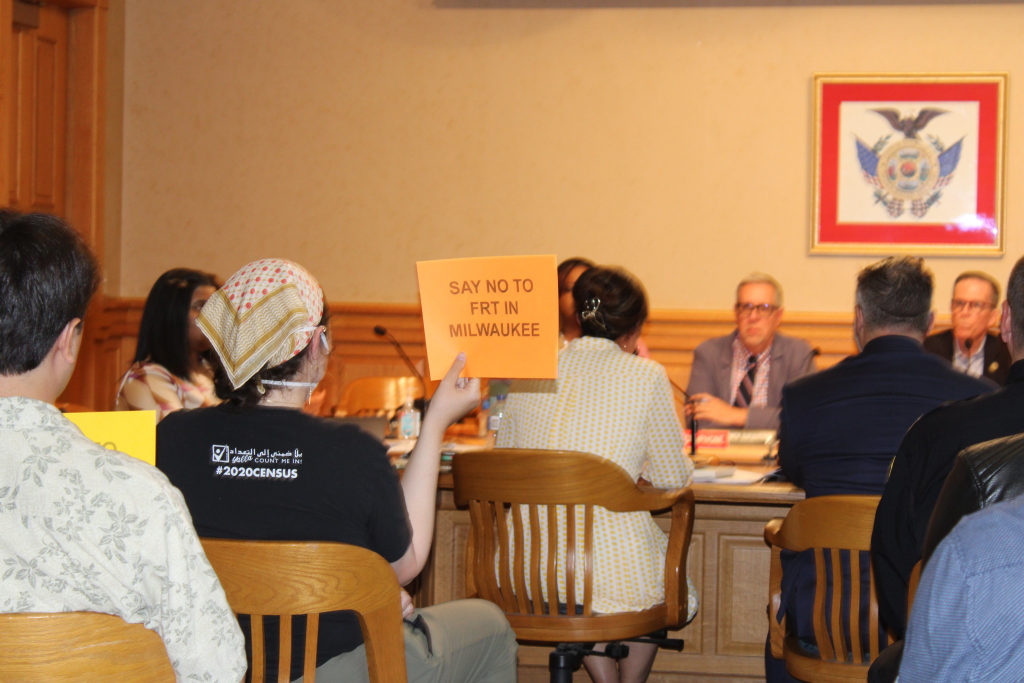
The proposal provoked substantial opposition from residents and civil rights groups who raised concerns about misidentification, racial bias, surveillance and public trust.
Milwaukee Police Chief Jeffrey Norman announced in February that MPD would prohibit its members from using facial recognition technology and would not consider acquiring the technology until after the department develops a policy with the Fire and Police Commission.
However, the moratorium did not eliminate the technology from criminal cases in which it had already been used.
MPD did not respond to questions about its policies and practices relating to disclosing the use of facial recognition to the DA’s office.
What happens at the DA’s office?
Milwaukee County District Attorney Kent Lovern said his office treats facial recognition technology as an investigative lead.
“It is not, in and of itself, probable cause,” Lovern said. “It’s not, in and of itself, the sole basis for gaining a search warrant.”
Lovern said information his office receives about the use of facial recognition in an investigation gets turned over to the defense as part of the case file.
Deputy District Attorney Matthew Torbenson described a 2021 home invasion and sexual assault case prosecuted by the DA’s office in which another law enforcement agency used facial recognition technology to develop about five potential suspects from surveillance footage.
Investigators pursued these leads and focused on one person based on additional evidence, including an identification by his former spouse.
The five individuals who it came back with as a potential match were all turned over to the defense, Torbenson said.
Torbenson said the potential errors would be more concerning if just facial recognition were being used to directly identify a suspect.
“That is not at all how we’re using it,” he said.
Technology creates challenges
Connor Romenesko, a forensic science practice coordinator with the Wisconsin State Public Defenders Office, said defense attorneys can obtain the image submitted for a facial recognition search and some information about the software used but may not have the information needed to evaluate the system as a whole.
“The biggest concern I have with these services is that they’re provided by private companies who don’t necessarily provide information about how these systems are trained,” Romenesko said.
This can make challenging a facial recognition result “extremely difficult,” he said.
Federal research has found that facial recognition systems can have higher false-positive rates for some racial and ethnic groups, including Black, Asian and American Indian people.
‘Still a big unknown’
Another question is whether prosecutors and defendants have always been told when MPD used facial recognition technology.
The ACLU of Wisconsin reviewed police reports from more than a dozen cases MPD had identified as examples of facial recognition use.
“In many of those cases, there was just no mention of (facial recognition technology) use at all,” Merkwae said.
She said it still isn’t known how many total cases in recent years – or ever – MPD used facial recognition technology in any step of an investigation.
“And of that total – was that information turned over to the defendant in discovery if that person was charged?” Merkwae asked. “I think that’s still a big unknown.”
Romenesko said facial recognition information is sometimes included in initial discovery but sometimes must be requested from law enforcement or prosecutors.
Public defenders are trained to spot vague language such as “investigative lead” that can indicate facial recognition technology was used, Romenesko said.
“Our lawyers are all trained, so that if they see that language, they’re going to go up to kind of alert to the fact that maybe this hasn’t been disclosed up front, which we also see in some cases,” he said.
Jeffrey Altenburg, Milwaukee County’s chief deputy district attorney, said there are instances in which leads or suspects developed early in an investigation are not initially shared with prosecutors.
“However, once those leads are corroborated using standard investigative techniques, those details are included in the reports that are provided to our office and turned over to the defendant if they are criminally charged,” Altenburg said.
Despite police department ban, facial recognition technology lingers in Milwaukee’s criminal justice system is a post from Wisconsin Watch, a non-profit investigative news site covering Wisconsin since 2009. Please consider making a contribution to support our journalism.
