


In the obscure yet consequential world of the cost of television ads for political candidates and parties, Democrats scored a legal victory on Tuesday ahead of the midterm elections.
A three-judge panel of the U.S. Court of Appeals for the Fourth Circuit ruled that low-cost ad rates that candidates qualify for do not have to be made available to political parties.
The ruling is a win for Democrats, whose candidates tend to raise more money than its committees. The opposite is true for Republicans, whose party committees are more flush with cash than many of its individual candidates.
The ruling comes less than two months after the Supreme Court, in an unrelated case, unshackled political parties from any limit on how much they could spend in coordination with candidates.
Critics and supporters of the decision believed the ruling gave an advantage to Republicans this year because of their committees’ financial edge. Republicans had planned to use that ruling to buy up tens of millions of dollars of television ads in coordination with their candidates, taking advantage of the lower rates the candidates were eligible for.
The latest ruling blocks that. The two parties can both still buy unlimited television ads, but no longer at the favorable rates. Across multiple races, the difference in price could add up to tens of millions of dollars.
The ruling also comes just as the final fall sprint is set to begin for the midterm elections, when the airwaves will be flooded with campaign ads as the two major parties battle for control of Congress.
Republicans plan to appeal to the decision to the Supreme Court.
“This was an incorrect ruling that ignores decades of precedent,” said Joanna Rodriguez, communications director for the party committee of Senate Republicans. “This is the first word, not the last.”
Mike Marinella, spokesman for the House Republican campaign arm, called the ruling “a partisan attack on the First Amendment.”
In a joint statement, the executive directors of the House and Senate Democratic campaign arms, Devan Barber and Julie Merz, said the decision was “a major blow” for Republicans.
“Put plainly, today’s ruling makes clear that lowest unit rate is an exclusive right given to candidates and incumbent campaigns and that is the law of the land,” they said. “Democratic candidates’ strong grass-roots fund-raising amplifying the voice of everyday Americans remains a fundamental advantage in the midterms.”
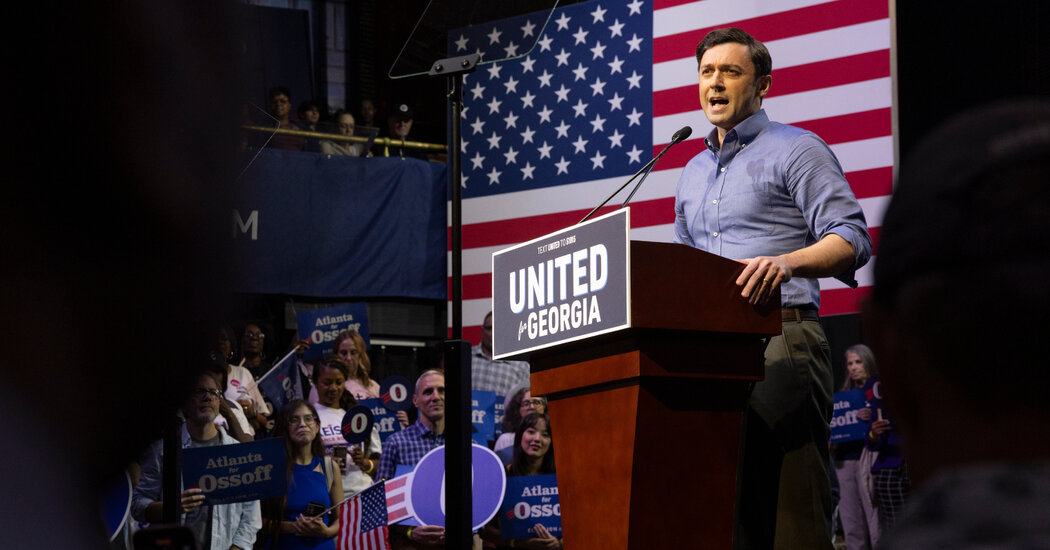
Four Democratic candidates in key battlegrounds filed the lawsuit to prevent parties from receiving the more favorable rates, including Senator Jon Ossoff of Georgia, former Senator Sherrod Brown of Ohio, former Gov. Roy Cooper of North Carolina and Representative Kristen McDonald Rivet of Michigan.
The National Republican Senatorial Committee and National Republican Congressional Committee argued the other side.
The Fourth Circuit panel ruled in favor of the Democrats in a 2-1 decision. Both judges in favor were appointed by Democratic presidents.
Judge Robert B. King, an appointee of President Bill Clinton, wrote in the majority opinion that “campaign finance statutes are clear that neither political parties nor joint fund-raising committees with noncandidate members can be entitled” to the cheaper ad rates.
The stakes are particularly high for Mr. Ossoff, who last reported $42.6 million cash on hand compared to only $2 million for his Republican opponent, Representative Mike Collins.
Republicans had hoped to use the Supreme Court ruling to close that gap by using party cash to buy ads at the same rate. Instead, the parties must pay the same rate as super PACs, which can easily run four or five times as high.
Judge J. Harvie Wilkinson III, an appointee of President Ronald Reagan, dissented in the case, disagreeing both with the court’s jurisdiction and its decision.
