


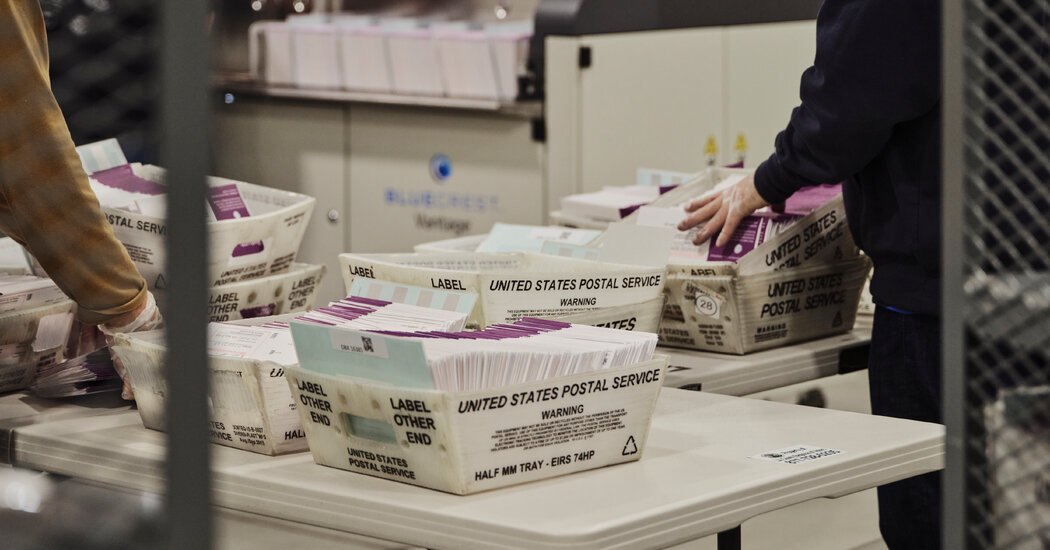
President Trump has been trying to restrict mail voting. The Supreme Court has now weighed in for the first time on an executive order on mail-in voting Mr. Trump issued in March.
But the ruling — and the slew of challenges to Mr. Trump’s order — are confusing. No one is sure exactly what happens from here, or and how it may affect the midterms.
The executive order directs the U.S. Postal Service to restrict mail-in ballots. It also authorizes the Department of Homeland Security to create state-by-state citizen lists to help determine voter eligibility.
For now, it appears the Department of Homeland Security can proceed with compiling lists. But another court order blocks the Postal Service from moving ahead with plans to restrict who can receive a ballot by mail.
Here is where things stand, and why it matters.
Trump is trying to leverage the federal government to control mail voting.
Mr. Trump has long falsely claimed that mail-in balloting leads to fraud, and he blames a pandemic-era increase in the practice in 2020 with his loss in that year’s presidential election.
The president signed an executive order on March 31 directing the Postal Service to deliver ballots only in states that hand over voter data to the federal government.
The order also called on the Department of Homeland Security to compile state-by-state citizenship lists that could be used to help determine voter eligibility. The United States has never created a central citizenship registry. In a court hearing, government lawyers acknowledged that federal citizen lists were bound to be imperfect.
The order immediately faced several legal challenges, including from a number of Democratic state attorneys general, voting rights organizations and Democratic groups.
The Supreme Court acted on Monday — but only preliminarily.
Dividing along ideological lines, the Supreme Court on Monday found that a legal challenge by Democratic state attorneys general was premature, because the government had not yet finalized its plans.
The court did not weigh in on the legal merits of the executive order. And the justices cautioned that they had not determined whether the president’s directive would “necessarily be lawful” once those plans were complete.
The Trump administration had asked the Supreme Court to weigh in after a federal judge in Massachusetts temporarily blocked key parts of the executive order.
Government lawyers told the Supreme Court that the lower court had acted prematurely because the agencies had yet to issue final rules on how to carry out the president’s order.
The challengers — Democratic state attorneys general — had argued that the president’s order would confuse voters and likely disenfranchise people who rely on voting by mail in the midterm elections.
Got a news tip about the courts? If you have information to share about the Supreme Court or other federal courts, please contact us.
The court took nearly a month to rule. Important developments took place while the case was pending. For instance, on Friday, the Postal Service finalized its plan for how it would put the executive order into effect, should the courts allow it. The justices did not address the document.
There is a lot more legal action to come.
The legal fight over Mr. Trump’s executive order remains a fluid, high-stakes battle with multiple lawsuits pending in lower courts.
The Supreme Court will likely soon be asked to weigh in again, and the legal issues will likely ultimately be resolved by the justices. It is not clear what cases will be the ones to get the justices’ attention next.
The challenge by state attorneys general that the Supreme Court decided on Monday could come back. The states that sued will likely argue that the Postal Service’s action on Friday made their case ripe.
Another case that is being closely watched is a challenge by voting rights organizations. In League of Women Voters of Massachusetts v. Trump, a federal judge also temporarily blocked the part of the executive order that involves the Postal Service. That block appears to remain in place, meaning that the Postal Service cannot, for now, move forward with its plan. The Justice Department has asked the judge to lift it.
On Tuesday, Judge Indira Talwani announced that the Trump administration had violated her order by finalizing the Postal Service plan. Although she determined the government had ignored her “explicit directive,” she did not impose any penalty.
A third challenge to the executive order, brought by Democratic groups, also remains in play. In that case, a unanimous panel of federal judges on the U.S. Court of Appeals for the District of Columbia Circuit in July had sided with the Trump administration, relying on much the same reasoning as the Supreme Court.
Additional lawsuits could still be filed.
The Trump plan on mail-in voting will be hard to execute. There may not be time to put it in place before the election.
Even if Mr. Trump’s executive order survives all legal challenges, it still may not be possible for the administration to execute its plans before voters go to the polls for the midterms.
When the Postal Service released its plan on Friday, the agency indicated it would like to move ahead by November. But the agency acknowledged that this timeline could be unrealistic. Protracted litigation, the agency said, “would jeopardize implementation of this rule in time for the 2026 general election.”
A spokesperson for the agency declined to comment after the Supreme Court’s order on Monday.
The plan would require ballot envelopes to undergo a Postal Service design review and face new regulations, including that they carry bar codes. But many states and counties have already printed their ballot envelopes. It is not clear if there would be time for states to start over. It would certainly be costly.
The plan would also call for states to compile a list of voters eligible to vote by mail and submit it to the Postal Service 30 days before the election, “to the extent practicable.” If states failed to hand over this voter data, the Postal Service would not deliver mail ballots in that state. But the election is around 70 days away, and mail-in ballots will soon be sent in many states.
The Department of Homeland Security has been preparing to build citizenship lists even as litigation proceeds.
Even after the courts halted key parts of the order dealing with the Postal Service, the administration has continued with its preparations, particularly at the Department of Homeland Security, according to court documents.
In an opinion, one appeals court panel wrote that the department had acknowledged it was “establishing infrastructure” for its citizenship lists.
And the Supreme Court’s order on Monday lifted a lower-court order that had blocked the portion of the executive order that deals with the Department of Homeland Security, clearing the way for the agency to proceed.
Trump administration officials have said that states would not be required to do anything with the D.H.S.-created citizenship lists, and government lawyers have said the lists would likely be unreliable. “No list is ever going to be perfect,” a Justice Department lawyer told a federal judge in Washington in May, adding that it would be inadvisable for states to rely completely on the lists to update their voter roles.
States and voting rights groups have raised concerns about the accuracy of the proposed lists, concerned that using them could mean that the government would attempt to disenfranchise citizens whose names were omitted from the lists by mistake. They have also warned that the federal government could attempt to prosecute state officials for sending ballots to people whose names are not on the homeland security lists.
Nick Corasaniti contributed reporting.
