


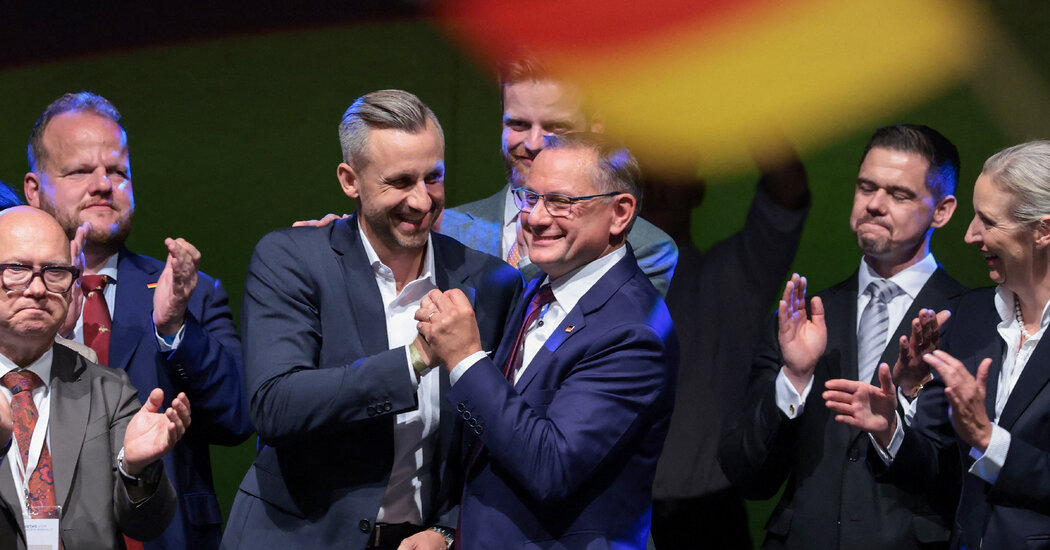
When I was growing up in Germany, the conventional wisdom was that the far right would never again gain a meaningful foothold in our politics. Our Nazi past, the argument went, had immunized voters against the appeal of such parties. And our post-Holocaust constitution had powerful tools to help prevent it. The rise of the anti-immigrant, far-right AfD over the past decade has made clear the first argument was wrong. The second? We’ll see.
The AfD won big in a state election on Sunday. It not only won more than twice as many votes as the nearest contender. It won with the biggest voter turnout since reunification. In most circumstances, that would count as a clear mandate to govern. The AfD, though, still might not be able to.
For years, Germany’s entire political establishment has made common cause to stop the far right from exercising power. Now, a question that has long been raised by AfD voters is being debated in mainstream circles, too: Are these efforts to sideline the AfD in the name of democracy actually undermining democracy?
The firewall’s biggest test yet
The idea that the far right has to be kept out of power at all costs runs deep in Germany.
In 1933, Hitler’s Nazi party was able to take office only after a center-right party agreed to go into coalition with it. Less than two months later, democracy had been dismantled. That historical catastrophe has underpinned the concept of a firewall, a voluntary but so far enduring commitment by all parties to shun the AfD (though one is currently wavering).
It has also been used as a justification for a range of other measures that mainstream parties have taken to deny the AfD other rights and powers.
The state election in Saxony-Anhalt has challenged this approach like never before. The firewall and other measures were designed to keep the AfD away from levers of power that opponents say it would use not only to pursue policies like deporting terrorism suspects who are German citizens and share sensitive intelligence with Russia, but also to undermine the country’s checks and balances. Call it autocracy-proofing.
But a win at this scale indicates that, at the very least, this strategy isn’t working, and might even be making the AfD stronger. When a party receives 44 percent of the vote, keeping it out of power looks, to some eyes, less like preserving democracy than thwarting it.
Their only common ground? Keep out the AfD
AfD supporters would say democracy wasn’t working properly to start with. The AfD — the Alternative for Germany — was created in 2013, at a time when German voters didn’t have much of an alternative. Former Chancellor Angela Merkel, on the center-right, made a habit of going into coalition with her party’s traditional opponents on the center-left, which meant, in effect, that whatever party you voted for, you’d get the same government.
The AfD thrived in that vacuum.
And as its vote share has reached new highs — polls show it’s the most popular party in the country — and the vote share of mainstream parties has shrunk to historic lows, the coalitions to prevent the AfD from taking power have become increasingly tenuous.
Saxony-Anhalt is a case in point. The only way to keep the AfD out of power is to have all other five wildly disparate parties join forces, from the conservative center-right all the way to the post-Communist far left (they’re the wavering ones). Their only common ground: Keep out the AfD.
That’s not the only way mainstream parties have sought to avoid giving the party power.
When the AfD first entered parliament in 2017, the rules were hastily changed to give the post of honorary head of the legislature to the longest-serving lawmaker rather than the eldest, who was an AfD lawmaker. Taxpayer funds traditionally allocated to a party for an affiliated foundation were frozen when the AfD created one. The chairs of parliamentary committees were traditionally appointed based on vote share, with the approval of other parties treated as a formality; not anymore.
When it became clear this spring that the AfD might win a majority in Saxony-Anhalt, one of its East German strongholds, the state’s governing coalition passed a law designed to stop any one party from vetoing judicial appointments or blocking the appointment of a governor it does not like.
And as my colleagues in Berlin report, interior ministers in other German states have circulated ideas for restricting the power of a potential future AfD government not least by limiting its access to intelligence.
None of this has worked to reduce the AfD’s appeal. On the contrary. Chancellor Friedrich Merz won office promising to halve the AfD’s support. Last weekend the AfD doubled its vote share in Saxony-Anhalt. The party whose support halved was Merz’s.
A militant democracy
Germany’s postwar constitution was written with the goal of producing a “militant” democracy, with a robust tool kit for battling extremism. It’s why the domestic intelligence agency can put parties under surveillance or even ban them if they present a threat to democracy.
But if you sideline a party, its voters feel sidelined, too. I spoke to Matthias Quent, an expert on the far right in Germany. Exit polls in Saxony Anhalt asked voters if they agreed that the AfD is a danger to democracy. About half said they did. But the other half said they didn’t.
The fact that some parties, like the governing conservatives, are simultaneously floating a ban of the AfD and copying parts of its agenda further undermines their credibility, Quent said.
Looking back to the moment when the AfD first entered parliament, German politics has gone through three phases of digesting its rise. In the first, establishment politicians dismissed it as a protest vote. In the second, they acted aggressively to keep it from exercising any kind of formal power.
It will likely be weeks before we learn who will govern Saxony-Anhalt. But this week might be the beginning of the third phase — in which mainstream parties accept that the way to defeat the AfD is to offer voters a platform they actually want to vote for.
For more: The far-right victory in eastern Germany has given fresh momentum to hard-right parties hoping to win elections elsewhere in Europe.
Indonesia’s toxic microplastics
When fires erupt across sprawling landfills in Indonesia, they don’t just burn trash. They send toxic microplastics into the air.
And once those plastic particles are drifting in smoke, they’re carried far and wide by rain, rivers and ocean currents — eventually entering human bodies through food, drinking water and the air. Our article shows the full scope of the microplastics epidemic.
OTHER NEWS
When the mathematician Joan Birman was 92, she thought her important work was behind her. Then, an email arrived out of the blue from a 15-year-old girl who wanted to know more about math.
What began as occasional mentorship evolved into an intellectual partnership that resulted in a major discovery. Read more about how they solved a seemingly impossible problem.
Portugal’s pastry artisans
Isabel Rama begins each morning by kneading, resting and stretching out a high-gluten dough across the floor into a giant billowing blanket. With each pull, the dough gets thinner. Then, she carves the dough into translucent sheets before adding a sweet egg custard to each one. The result: an ethereal pastry called pastel de Tentúgal.
Generations of women like Rama, from a single village in Portugal, have kept the tradition alive. Read more and watch the process.
This iced coconut limeade, modeled after Brazilian lemonade, features a blend of bitter, sharp and sweet flavors. Serve with fresh basil, mint leaves and a crack of black pepper.
