


NY-17: Last in a series on the environmental stakes behind one of the nation’s most fiercely contested congressional races.
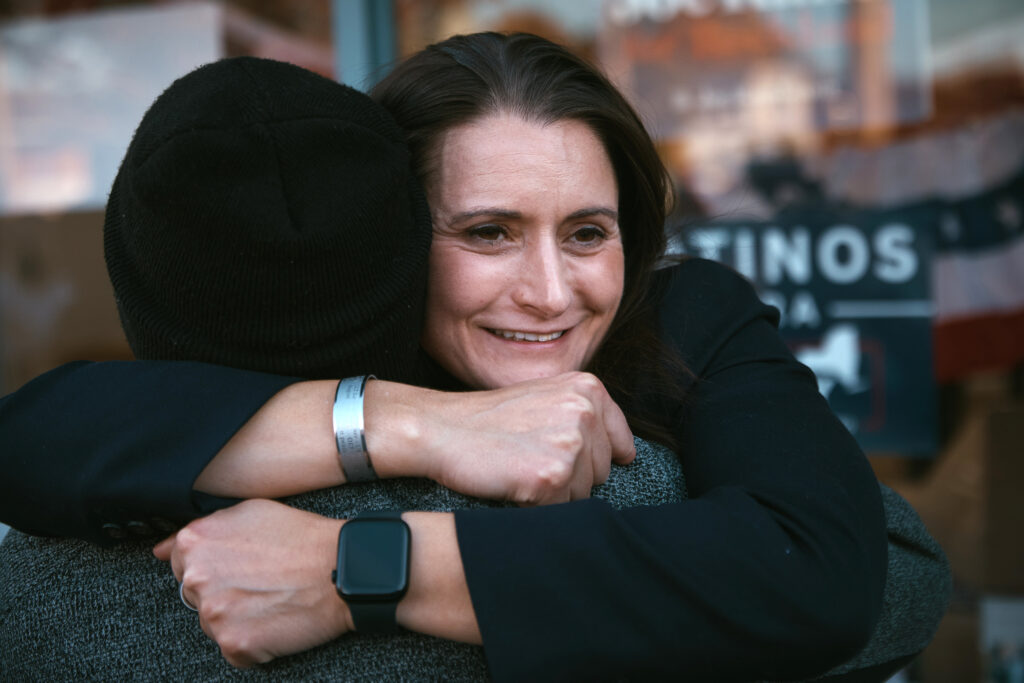
Before midnight, and before any official body had called the race, Republican incumbent Mike Lawler conceded to Democratic challenger Cait Conley in New York’s 17th Congressional District. Conley flipped the closely watched toss-up seat, denying Lawler a third term in a district Kamala Harris won in 2024, as a nationwide blue wave promises Democrats a commanding House majority.
It was a district in which energy costs, data center development and nuclear power were central to campaign messaging. Though climate policy was seldom invoked by name, Conley pledged to fight climate change “as a national security priority.”
“When all of the votes are counted tomorrow in Westchester, it’s gonna be pretty clear that we will be short,” Lawler said during a speech to supporters Tuesday evening.
Westchester County experienced widespread problems with ballot-scanning machines on Election Day, delaying results, with concerns that the issues might discourage low-propensity voters. Still, Conley carried the county by a 34-point margin and flipped the seat by roughly 5 percentage points, according to preliminary results Wednesday. The outcome represents an approximately 11-point swing toward Democrats compared with the 2024 congressional race.
Many in the district viewed Conley’s victory as a repudiation of President Donald Trump and Lawler’s alignment with him, despite the congressman’s efforts to portray himself as a moderate. Lawler was formerly head of the New York state GOP, while Conley is a decorated Army combat veteran who served in Iraq and Afghanistan before working on the National Security Council during the Biden administration.
Trump has repeatedly endorsed Lawler, who joined him at what Trump called the 2026 Republican Midterm Convention in September in Dallas. On Tuesday, Trump urged Jewish voters in the district to re-elect Lawler, an appeal that underscored the perceived political influence of the district’s Orthodox Jewish voting bloc.
“VOTE MIKE LAWLER FOR CONGRESS — HE WILL NEVER LET YOU DOWN!” he wrote on X.
Yet Erik Lindberg, a Westchester County resident who voted for Conley, said that while Lawler “ran a really impressive constituent services shop,” he “had no significant ideological principles, other than being a member of the Republican caucus.”
“He lost because he worked in lockstep with Trump,” said Susan Shapiro, an environmental attorney and resident of the district.
William Knox, a veteran and self-described “anti-MAGA Republican” who had been undecided shortly before the election, said he voted for Democrats across the board, not necessarily because he agreed with their policies, but to give those opposing MAGA all the support he could.
A Referendum on Lawler
Throughout the campaign, Lawler sought to make rising energy costs a central issue, blaming Albany Democrats for higher utility bills. But his own record included millions of dollars in contributions from utility-related political action committees, as well as previous work as a registered lobbyist for a natural-gas advocacy group whose backers included utilities and fossil-fuel interests.
While Republicans like Lawler repeatedly sought to shift blame for rising costs onto Democrats, a majority of Americans now blame Trump’s policies for persistently high prices.
“The fact that there has been a Republican trifecta while fuel prices have hugely increased has made it clear to everyone, including the most MAGA Republicans, that this isn’t Democrats’ doing,” said Madalina Vlasceanu, a researcher at Stanford University’s Doerr School of Sustainability.
Lawler continually advocated for reopening Indian Point, the district’s shuttered nuclear power plant, and for expanding domestic oil and gas production. In addition to centering the energy debate, he capitalized on public unease surrounding artificial intelligence and data centers, regularly highlighting more than $328,000 in payments from two AI surveillance companies disclosed in Conley’s financial filings.
The result suggests Conley succeeded in distancing herself from accusations leveled throughout the campaign that she was the “AI candidate for the AI industry.”
What’s Next?
The district, in the Lower Hudson Valley, includes all of Rockland and Putnam counties, most of northern Westchester County and portions of southern Dutchess County. For many environmental advocates there, the prevailing sentiment after Conley’s victory was hope.
On her campaign website, and less consistently in campaign appearances and debates, she said she would expand federal investment in clean energy, protect open spaces, hold corporate polluters accountable and pressure the administration to rejoin the Paris climate agreement. She also opposed efforts to reopen Indian Point and pledged to tackle PFAS, better known as “forever chemicals.”
“With Democratic control of Congress, it becomes possible again to begin to reverse the assault on the environment,” said Peggy Kurtz, an environmental activist from Rockland County.
This story is funded by readers like you.
Our nonprofit newsroom provides award-winning climate coverage free of charge and advertising. We rely on donations from readers like you to keep going. Please donate now to support our work.
Lindberg, who has campaigned against reopening Indian Point and called for its safe decommissioning, agreed.
“I’m hopeful we can make some progress. Lawler was a real roadblock to any progressive climate action,” he said.
Advocates said further education on climate change, for both elected officials and members of the public, was a priority. They described Conley as responsive and said they hoped she would follow through on positions she had adopted during the campaign.
Among the priorities of the local Sierra Club chapter, and residents involved in local environmental disputes, were opposing new nuclear and natural gas plants, addressing pollution from an aging waste incinerator, reducing dependence on plastics and restoring funding for solar programs that had benefited local communities.
“It’s about the will. We haven’t had the political will,” Shapiro said.
“We need to restore the policies of a green and clean energy future. It’s time for the money to move from the fossil fuel/nuclear column to the solar, wind, tidal and geothermal column,” she added.
Sylke Jackson, a Democrat who won a seat on the Clarkstown Town Council, which yesterday flipped from entirely Republican to entirely Democratic, said the change in local leadership creates an opportunity to advance environmental priorities. She has already established a group chat with fellow council members and is preparing to push for measures that could be implemented immediately in Clarkstown, Rockland County’s economic center.
“It’s about really being proactive, instead of bemoaning environmental issues,” she said.
Shapiro, however, remained concerned about Conley’s and Gov. Kathy Hochul’s positions on nuclear power, particularly what she considers their mistaken characterization of nuclear energy as emissions-free. She pointed to carbon emissions produced across the nuclear fuel cycle, and significant thermal pollution produced by nuclear plants.
The most pressing concern for environmentalists in the district, she said, ought to be the ongoing federal court appeal, brought by New York Attorney General Letitia James, that would reverse a federal decision to allow the proposed discharge of radioactive wastewater from Indian Point. After attending a recent hearing on the dispute, Shapiro said she felt the state had not made a strong case and that officials needed to find a way to prevent the large-scale release of radioactive waste into the Hudson River.
“Now, there are opportunities for hearings and reasonable conversation not available under the Republican hammer,” she said.
Lindberg said it would be important to see whether the incoming class of Democratic representatives, especially Conley, made climate policy a priority.
“I don’t want to hear anyone saying we need to wait for the presidency, for 2028,” he said.
About This Story
Perhaps you noticed: This story, like all the news we publish, is free to read. That’s because Inside Climate News is a 501c3 nonprofit organization. We do not charge a subscription fee, lock our news behind a paywall, or clutter our website with ads. We make our news on climate and the environment freely available to you and anyone who wants it.
That’s not all. We also share our news for free with scores of other media organizations around the country. Many of them can’t afford to do environmental journalism of their own. We’ve built bureaus from coast to coast to report local stories, collaborate with local newsrooms and co-publish articles so that this vital work is shared as widely as possible.
Two of us launched ICN in 2007. Six years later we earned a Pulitzer Prize for National Reporting, and now we run the oldest and largest dedicated climate newsroom in the nation. We tell the story in all its complexity. We hold polluters accountable. We expose environmental injustice. We debunk misinformation. We scrutinize solutions and inspire action.
Donations from readers like you fund every aspect of what we do. If you don’t already, will you support our ongoing work, our reporting on the biggest crisis facing our planet, and help us reach even more readers in more places?
Please take a moment to make a tax-deductible donation. Every one of them makes a difference.
Thank you,
Fellow
Leana Carbonez is a fellow at Inside Climate News. Born in London, she studied History at the University of Cambridge, and recently graduated from Columbia’s Graduate School of Journalism. She is interested in exploring Americans’ manifold understandings of ‘nature’ and the ways these perceptions are shaped by, and serve, political ideologies. She hopes to continue pursuing investigative projects while working across a variety of journalistic mediums.
