


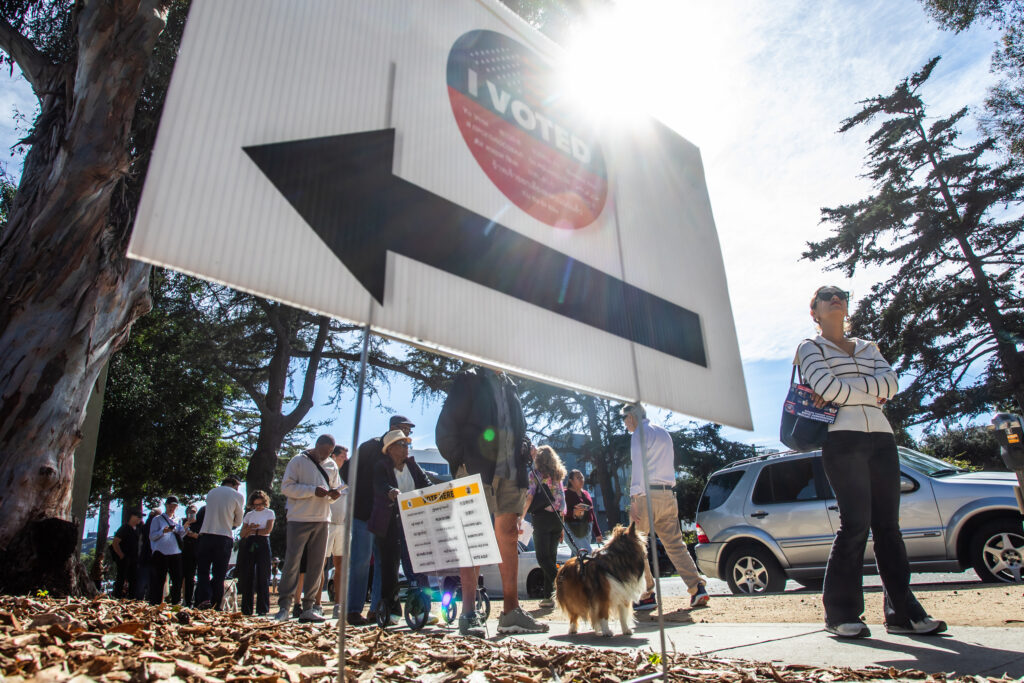
As a blue wave washed over Election Day, ballot measures across the country showed voters strongly support environmental protection, with notable early outcomes in California and Colorado.
Democrats swept Congress on Tuesday, winning control of both houses with notable victories in Ohio, South Carolina, Texas, Michigan and Maine.
Results, which are still being tallied Wednesday, represented national disapproval of Donald Trump’s second presidency on issues like the high cost of fuel and food, an unpopular war with Iran and the proliferation of data centers, according to analysts.
The outcome of ballot measures—some of which had industry backing—on a gamut of environmental and energy issues made voter sentiment clear: they want to safeguard the environment.
With more than half of the ballots counted in California, voters appear to be rejecting a measure to fast-track construction of “essential projects” like housing, clean energy and broadband internet access by streamlining California’s bedrock environmental law.
Proposition 45 would overhaul the California Environmental Quality Act, or CEQA, by limiting the timeline for environmental review of major projects to 365 days and requiring that legal challenges of projects based on threats to air and water quality, tribal cultural resources and other harms be resolved within 270 days.
Proponents of the measure, sponsored by California’s Chamber of Commerce, say these deadlines are needed to speed the building of much-needed housing and infrastructure in the state. But opponents, including some affordable housing advocates, say the new rules would hobble the state’s landmark environmental law by limiting the scope of review as well as the ability of communities and tribes that are not federally recognized to mitigate the harms of polluting developments on their neighborhoods or ancestral lands.
As of Wednesday afternoon, with 58 percent of the votes counted, just over 54 percent opposed the measure and about 46 percent supported it. The measure can pass with a simple majority but would need two-thirds of the Legislature to amend it.
“We’re encouraged by what we’re seeing,” said Woody Little, spokesperson for the No on Prop 45 campaign, which represents more than 550 labor, health and environmental organizations.
“We’re seeing folks show up at the polls who represent the really broad coalition that came together against this measure [and] around protecting our core environmental law here in California,” Little said.
Though it’s too early to declare the final result, Little said, “it’s very clear that millions of Californians voted to defend our core environmental protections.”
Amelia Matier, a spokesperson for Yes on Prop 45, was not immediately available to comment Wednesday. Matier previously told CalMatters that by allowing for faster, more predictable reviews, the measure would let California build housing and infrastructure at a lower cost.
Prop 45’s likely defeat is encouraging news, said Noelle Chambers, executive director of the Amah Mutsun Land Trust, an initiative to restore Indigenous knowledge and practices on the Amah Mutsun tribe’s ancestral lands, which cover parts of counties from Monterey Bay to regions southeast of Silicon Valley.
“Meaningful tribal consultation is essential to protecting ancestral lands and cultural resources, particularly for non-federally recognized tribes whose voices are too often marginalized,” Chambers said. Such consultation, she said, is fundamental to advancing the return of Indigenous stewardship to Amah Mutsun homelands.
Polling from the nonpartisan Public Policy Institute of California showed that support for Prop 45 had dropped considerably, from 73 percent to 46 percent, between July and October, as voters learned more about the measure.
This story is funded by readers like you.
Our nonprofit newsroom provides award-winning climate coverage free of charge and advertising. We rely on donations from readers like you to keep going. Please donate now to support our work.
If passed, the measure could cost state and local governments more than $100 million a year, partly to cover environmental damages that emerged from projects built with limited review or public input, according to the nonpartisan Legislative Analyst’s Office.
Californians are rejecting a “false choice” between addressing the affordability crisis and protecting California’s air, water, health and climate at the same time, Little said. “They’re seeing through the tens of millions of dollars of misleading advertising from some of the largest, most powerful corporations in the state,” he said. “That should really send a message to the Legislature about which side their voters are on.”
In Colorado, with 81 percent of votes tallied as of Wednesday afternoon, voters rejected Amendment 82—which would have established a constitutional right for consumers in the state to buy natural gas and for distributors and utilities to sell the fuel. The initiative was intended to prevent local and state restrictions or bans on the sale of natural gas, such as through prohibitions on gas infrastructure in new construction, and to overturn existing regulations that curtail use of the fuel.
Environmentalists worried the change would endanger Colorado’s climate goals and—as the first of its kind—set a dangerous precedent.
“It would have made Colorado the first state in the country to put one industry’s profits into the constitution,” said Kelly Nordini, CEO of environmental advocacy group Conservation Colorado.
“That would have been the opposite direction of where Colorado voters have been going for decades, which is for health and safety protections, for clean energy, and certainly not putting a preference for one industry into the constitution,” Nordini said.
Conservation Colorado organizers criticized anonymous donors for trying to convince voters the measure was sensible.
Conservative advocacy group Advance Colorado, which proposed Amendment 82, could not immediately be reached for comment Wednesday.
Although measures that failed—despite millions in donations from supporters including from anonymous sources—have significant environmental impacts, so did many of those that passed.
As of Wednesday afternoon, 38 ballot measures to restrict data centers nationwide had been passed by voters, according to tracking by Data Centers on the Ballot.
Michigan voters—as part of a citizen-led ballot initiative—passed a proposal to prohibit utility and electric companies and specific government contractors from making campaign contributions.
Early results also showed Tucson, Arizona, voters rejecting a 25-year franchise agreement with Tucson Electric Power. The agreement would have brought $64 million to the city for sustainability and infrastructure projects. However, according to critics, it also would have locked the city into a long-term agreement with a for-profit utility that provides services that could be run by the city.
The agreement’s rejection came after the utility sought a major increase in the rate it charges its customers and backed the state’s most controversial data center development, Project Blue.
In Florida, Amendment 3—geared toward cutting property taxes—passed. With state water management districts’ budgets based partly on local property tax revenues, districts are projected to take a big financial hit as a result of the measure’s passage, including more than $89 million in 2027 alone.
As part of a citizen-led petition, voters in Corpus Christi, Texas, approved a measure to impose significant fees for water use on the region’s refineries and chemical plants during future droughts.
Ultimately, people value the health of their families, their health as workers and the open spaces that support wildlife, said Little, of California’s No on Prop 45 campaign.
The results in other states suggest California voters are not alone in those concerns.
About This Story
Perhaps you noticed: This story, like all the news we publish, is free to read. That’s because Inside Climate News is a 501c3 nonprofit organization. We do not charge a subscription fee, lock our news behind a paywall, or clutter our website with ads. We make our news on climate and the environment freely available to you and anyone who wants it.
That’s not all. We also share our news for free with scores of other media organizations around the country. Many of them can’t afford to do environmental journalism of their own. We’ve built bureaus from coast to coast to report local stories, collaborate with local newsrooms and co-publish articles so that this vital work is shared as widely as possible.
Two of us launched ICN in 2007. Six years later we earned a Pulitzer Prize for National Reporting, and now we run the oldest and largest dedicated climate newsroom in the nation. We tell the story in all its complexity. We hold polluters accountable. We expose environmental injustice. We debunk misinformation. We scrutinize solutions and inspire action.
Donations from readers like you fund every aspect of what we do. If you don’t already, will you support our ongoing work, our reporting on the biggest crisis facing our planet, and help us reach even more readers in more places?
Please take a moment to make a tax-deductible donation. Every one of them makes a difference.
Thank you,

Reporter, California
Liza Gross is a reporter for Inside Climate News based in Northern California. She is the author of The Science Writers’ Investigative Reporting Handbook and a contributor to The Science Writers’ Handbook, both funded by National Association of Science Writers’ Peggy Girshman Idea Grants. She has long covered science, conservation, agriculture, public and environmental health and justice with a focus on the misuse of science for private gain. Prior to joining ICN, she worked as a part-time magazine editor for the open-access journal PLOS Biology, a reporter for the Food & Environment Reporting Network and produced freelance stories for numerous national outlets, including The New York Times, The Washington Post, Discover and Mother Jones. Her work has won awards from the Association of Health Care Journalists, American Society of Journalists and Authors, Society of Professional Journalists NorCal and Association of Food Journalists.
