


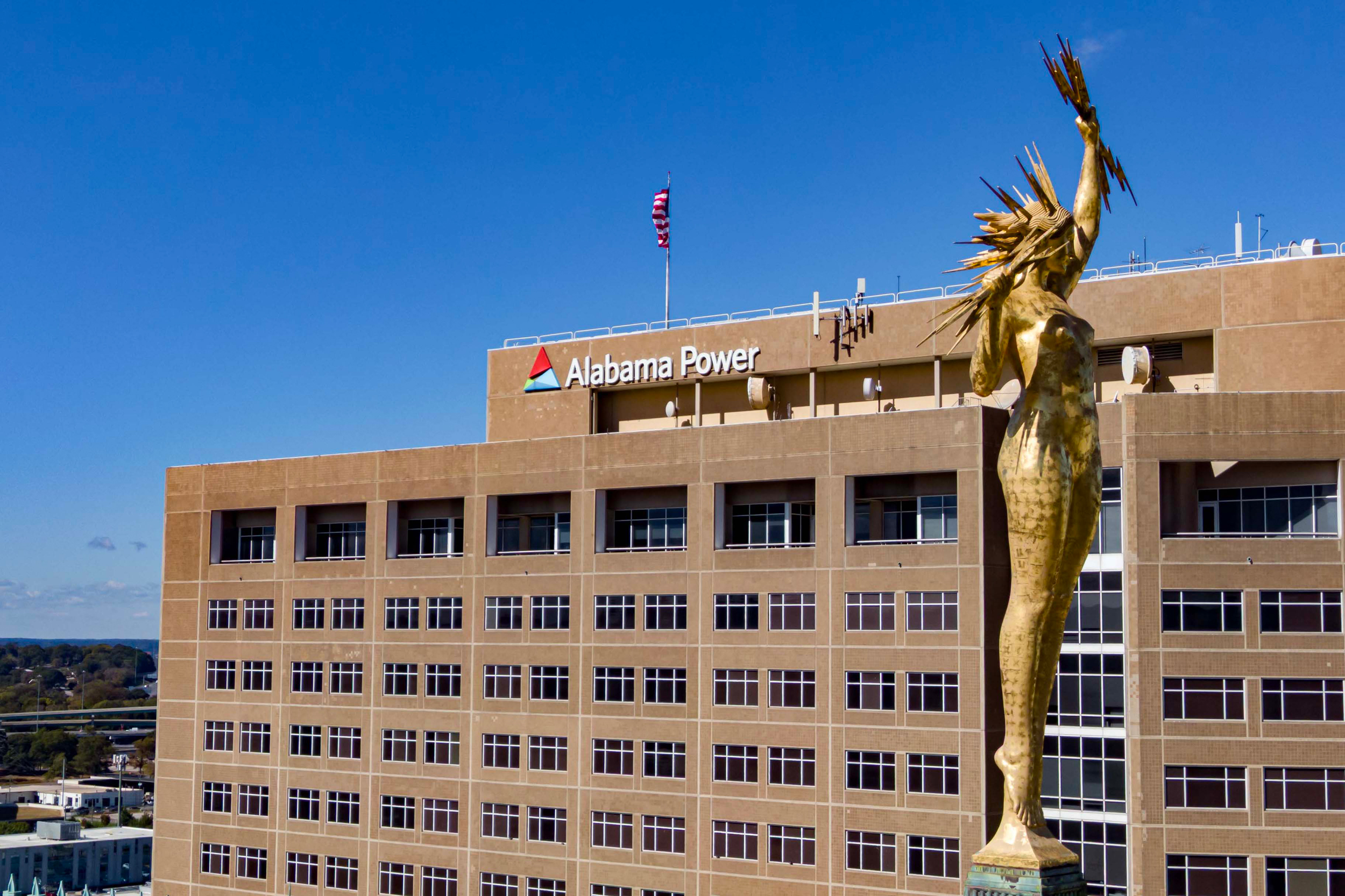
On a busy election day, the Alabama Public Service Commission requested that Alabama Power voluntarily stop billing customers, effective immediately, for television commercials and other ads it buys to promote various aspects of its business.
Alabama Power is the largest electricity provider in Alabama, with territory covering about two-thirds of the state. Though it is a monopoly, the company spends millions each year on advertising, touting its reliability, customer service and other aspects of its business.
In recent months, the company has launched a series of television commercials touting a rate freeze it announced late last year amid heavy criticism over rising electricity prices.
A state law passed earlier this year will prohibit Alabama Power from including the costs of those commercials in customers’ electric bills, meaning the powerful utility will have to find all of the dollars in corporate profits. But the new law won’t take effect until 2029.
Currently, Alabama Power is allowed to bill customers for half of its non-public safety advertising costs.
During Tuesday’s meeting, PSC President Cynthia Lee Almond moved to “request” that Alabama Power voluntarily begin excluding those costs immediately.
“I don’t see any reason why we shouldn’t go ahead and take steps now to begin that process, rather than waiting until Jan. 1, 2029,” Almond said during the meeting.
Almond then made her motion, which was not on the meeting agenda, but came after the regular report from the commission’s electricity division.
“I move that the commission request that Alabama Power consent to exclude all advertising expenses from retail rate setting until after Dec. 31, 2028, when the new law takes effect,” Almond said. “Assuming Alabama Power consents, this interim measure would be reflected in its [Rate Stabilization and Equalization] filings for 2027 and 2028.”
Commissioners Jeremy Oden and Chris Beeker IV voted yes after a brief discussion.
According to the company filings with the Federal Energy Regulatory Commission, Alabama Power spent more than $6 million in general advertising last year, roughly $4 per customer. It’s unclear from the federal filing how much of that total was passed on to customers or how much might be impacted by the new prohibition.
Alabama Power did not immediately respond to a request for comment.
Daniel Tait, executive director of Energy Alabama, said the move was a boon to Alabama Power customers, who faced some of the highest electric bills in the country in recent years.
“We are grateful for the leadership of President Almond and the full commission for acting to end customers paying for Alabama Power’s advertising,” Tait said. “Once in place, Alabama will have one of the strongest customer protections in the nation on this front.”
This will be among the last actions of the commission under its current construction before a major overhaul takes effect.
In January, the commission will expand from three members to seven. Outgoing Gov. Kay Ivey has appointed four new commissioners, who will take office in January, including the PSC’s two first-ever Black members.
Oden and Beeker will also leave the commission in January after being defeated in Republican primaries. Cullman County Sheriff Matt Gentry will take Oden’s Place 1 seat, and former state auditor and PSC Commissioner Jim Zeigler will replace Beeker in Place 2.
Zeigler, a perennial candidate in Alabama across several decades, will return to the commission 48 years after leaving the PSC. He served one term from 1975-1979, during an era of skyrocketing energy costs and protracted political battles over electric rates between Alabama Power and then-Gov. George Wallace.
Almond will be the sole remaining member of the current commission.
The new seven-member commission will be overseen by the state’s first secretary of energy, who will be selected by Gov.-elect Tommy Tuberville. The new secretary will set the commission agenda, and overruling the secretary will require a vote of five of seven commissioners.
Tuberville has not yet announced his pick for secretary of energy. The only statutory requirement is that the secretary “must have experience in utility regulation or energy policy or a related field.”
About This Story
Perhaps you noticed: This story, like all the news we publish, is free to read. That’s because Inside Climate News is a 501c3 nonprofit organization. We do not charge a subscription fee, lock our news behind a paywall, or clutter our website with ads. We make our news on climate and the environment freely available to you and anyone who wants it.
That’s not all. We also share our news for free with scores of other media organizations around the country. Many of them can’t afford to do environmental journalism of their own. We’ve built bureaus from coast to coast to report local stories, collaborate with local newsrooms and co-publish articles so that this vital work is shared as widely as possible.
Two of us launched ICN in 2007. Six years later we earned a Pulitzer Prize for National Reporting, and now we run the oldest and largest dedicated climate newsroom in the nation. We tell the story in all its complexity. We hold polluters accountable. We expose environmental injustice. We debunk misinformation. We scrutinize solutions and inspire action.
Donations from readers like you fund every aspect of what we do. If you don’t already, will you support our ongoing work, our reporting on the biggest crisis facing our planet, and help us reach even more readers in more places?
Please take a moment to make a tax-deductible donation. Every one of them makes a difference.
Thank you,
