


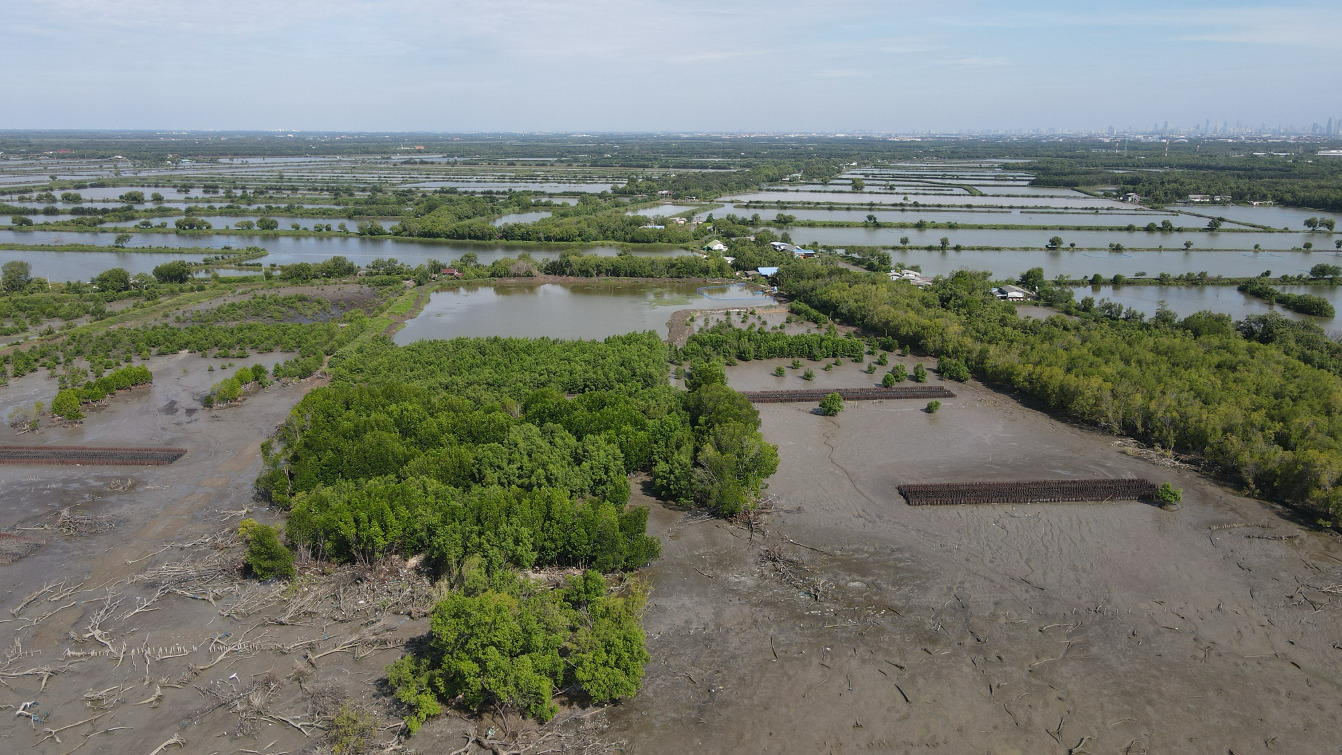
Coastal communities near Bangkok in Thailand are testing artificial mangrove roots to combat severe shoreline erosion, reports Mongabay’s Carolyn Cowan.
The shorelines of Phra Samut Chedi district, located in the Chao Phraya River Delta where Bangkok’s main waterway empties into the Gulf of Thailand, is especially vulnerable to erosion. Each year, strong surges claim 20 to 60 meters (66 to 200 feet) of land, and wave energy regularly collapses dikes and inundates aquaculture farms. Several methods of protecting the coast — from mangrove restoration to bamboo fences — have proved ineffective.
Researchers recently evaluated a new method: they installed artificial mangrove root systems that mimic the shape of natural mangrove roots, to see whether these would also mimic their function and prevent loss of land to the sea.
A 15-month trial at 11 sites in Phra Samut Chedi and other parts of Samut Prakan province showed some success, according to a recent study. It found the engineered mangrove roots captured 16 to 88 centimeters (6 to 35 inches) of sediment behind them across 10 locations.
Unlike hard-engineered structures or short-lived bamboo fences that quickly break down into marine debris, the composite wood-plastic and rubber structures of the artificial mangrove roots allow water to flow through, the researchers said. This creates localized turbulence that encourages suspended mud to settle onto the seabed, they added.
“Aquaculture farmers sent us a video of the waves hitting their dikes,” Butsawan Bidorn, senior author of the study and an assistant professor of coastal engineering at Chulalongkorn University, Bangkok, told Mongabay. “By the next day, the dike had collapsed and they’d lost everything. They need urgent action — the erosion can cause damage overnight.”
Butsawan said that while the structures imitate root function rather than exact anatomy, their fast modular installation provides a crucial intermediate pathway for vulnerable communities.
Field evaluations several months after installation showed that raised sediment levels behind the structures had allowed shrimp farmers at one site to rebuild mud dikes. At another site, it had enabled landowners to resume replanting mangrove seedlings.
Sompratana Ritphring, an associate professor of water engineering at Kasetsart University in Bangkok, who wasn’t involved in the study, said that while the engineered mangrove roots are an interesting intervention, such a system can’t serve as a universal or permanent fix.
“At best, it should be a temporary or enabling engineering component that helps create conditions in which a real mangrove ecosystem can establish itself,” Sompratana said. “The ultimate objective should be a functioning natural system, not a coastline permanently dependent on artificial structures.”
Sompratana added the structures should also be monitored long term so the materials used in them don’t end up as marine litter.
Read the full story by Carolyn Cowan here.
Banner image: Aerial view of artificial mangrove root units installed at a study site seaward of an intensively farmed aquaculture zone, with Bangkok’s skyline in the distance. Image courtesy of Warit Charoenlerkthawin.
